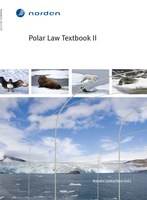
A Polar Law Textbook has been published by the Nordic Council of Ministers which endorsed the Polar Law Textbook project under the Arctic Cooperation Program. Chapters in the textbook generally follow materials from the Polar law program which is offered at the University of Akureyri. The editor of the Polar Law Textbook is Natalia Loukacheva, Director of the Polar Law Program at the University of Akureyri.
The idea for the Polar Law Textbook was developed from the recognition of the need to disseminate information about Polar Law as an emerging field of legal studies – an area of study long overdue greater recognition. Developments in the Polar Regions – the Arctic and Antarctica – are now the subject of growing interest and importance. They concern a divergent range of global and regional development issues and beg further inquiry into the role of law in dealing with many of these issues. The Polar Law Textbook is the first educational material of its kind. It attempts to illustrate the importance of legal values in addressing various challenges across the Nordic region, among remote Arctic communities and globally.
The topics of the Polar Law Textbook are various developments in international and domestic law concerning the Polar Regions (e.g., issues of environmental law, law of the sea, resources, human rights law and Indigenous peoples’ rights, etc.). By looking at linkages between different areas of law and the other social sciences, the textbook also explores the relevant aspects of the economic, social and political developments affecting both Polar areas (e.g., questions of Polar governance, economics, and the political situation in some of the Arctic areas).
Download the Polar Law Textbook
About the Polar Law Program at the University of Akureyri
Authors of the Polar Law Textbook are:
- Gudmundur Alfredsson, S.J.D., Professor, Faculty of Humanities and Social Sciences, Polar Law Program, University of Akureyri, Iceland and Faculty of Law, University of Strasbourg, France.
- Nigel Bankes, Professor of Law at the University of Calgary, Calgary, Alberta.
- Galina Diatchkova, Ph.D. student in anthropology.
- Mininnguaq Kleist, M.A., University of Aarhus (Denmark), the Head of Office in the Department of Foreign Affairs under the Government of Greenland since 2009 and a Member of the Board of the University of Greenland since 2008.
- Timo Koivurova, LL.D., Research Professor/Director, Northern Institute for Environmental and Minority Law/Arctic Centre, University of Lapland, Rovaniemi, Finland.
- Natalia Loukacheva (Editor), Ph.D., S.J.D., Director, Polar Law Program, University of Akureyri, Iceland and Research Associate, Munk Centre for International Studies, University of Toronto, Toronto, Ontario, Canada.
- Joan Nymand Larsen, Ph.D., senior scientist, Stefansson Arctic Institute, and Faculty of Humanities and Social Sciences, Polar Law Program, University of Akureyri, Iceland.
- Tavis Potts, Ph.D., Principal Investigator – Oceans Governance and Theme Leader – Prosperity from Marine Ecosystems, Centre for Coastal and Oceans Governance Scottish Association for Marine Science (SAMS).
- Dalee Sambo Dorough (an Inuk), Ph.D., University of British Columbia, Faculty of Law (2002); MALD The Fletcher School of Law & Diplomacy (1991); Assistant Professor, Political Science, University of Alaska, Anchorage.
- David L. VanderZwaag, Ph.D., Professor, Schulich School of Law, Dalhousie University, Halifax, Nova Scotia, Canada.
 Many important linkages between Polar Law issues and questions are addressed in other realms of the humanities and social sciences. Many of the Arctic or Antarctic developments are a result of, or the subject of ongoing political or international relations discourses. For example, various current and emerging security issues in both areas; the adaptation or mitigation capacity-building of communities in facing their attempt to face the consequences of climate change or bi- or multi-lateral diplomacy and political controversies in the negation of outstanding legal disagreements in the Arctic; the impact of the cold war on the outcome of the Antarctic Treaty provisions (e.g., the principle of demilitarization), to name but a few. In other words, as a discipline, “Polar Law” is developing in a multi-disciplinary direction suggesting that it is of the utmost significance for the discipline to utilize information gained from, and maintain linkages with, the various cognate humanities and social sciences (e.g., Human Geography, Anthropology, Economics, Political Science, and International Relations).
Polar Law is developing as an educational discipline. This textbook is partially based on courses taught in the context of the Master’s programme in Polar Law (University of Akureyri, Iceland) and it is hoped that eventually long-distance courses in Polar Law will be offered internationally. At the same time, recently, several universities have begun to offer special courses or visiting lectures on Polar Law issues within their law school curriculums and in other departments. Moreover, the level of public attention given to the Polar issues has in recent years increased dramatically on the basis of the numerous media statements made. Several Polar-related reports and studies have been commissioned domestically and internationally all addressing legal issues. The continuing legacy of the International Polar Year (2007–09) and materials from numerous conferences that included legal questions also suggest that in the near future “Polar Law” will become as important as it is topical at many educational, political and legal venues.
In addition to its educational value Polar Law is not just a developing academic discipline it is also a practical tool in resolving current and emerging legal issues at both the international and domestic levels.
 The content of the textbook is developed in line with the expertise garnered from different areas of law. Thus, chapters by Koivurova, Van-derZwaag and Potts provide us with an analysis of various aspects of international environmental law and the law of sea in relation to the Arctic and the Antarctic (including matters of environmental protection, shipping and marine living resources). The chapter by Bankes provides us with a useful overview of energy resources law highlighting the relevant developments in the Arctic. The chapters by Alfredsson, Kleist, Loukacheva, and Sambo Dorough form the bedrock of the theoretical analysis undertaken here while also highlighting a number of practical examples in the areas of international and domestic human rights law and the constitutional law in the Arctic. They also touch upon the questions of self-governance, sustainable governance and indigenous peoples’ rights. The textbook also contains valuable information on regional and local economies in the Arctic (see the chapter by Larsen), political matters and international relations (see chapters by Kleist, Diatchkova and Loukacheva). Despite its comprehensive content, the textbook nevertheless leaves room for further research in the area of Polar Law and its connection to other cognate disciplines. The textbook is the first educational material of its kind in the field and can be seen as a milestone in the promotion of legal values in both the Nordic community and indeed globally.
The authors of the Polar Law Textbook hope that this pioneering work will encourage anybody interested in Polar Law to pursue further studies, research or cooperation on the many initiatives which take place within the Nordic, Arctic and global community in relation not just to the Arctic but also to the Antarctic.
Cited from Introduction to Polar Law by Natalia Loukacheva, pages 16-17, 21