Tag: protocol

  • UN Climate Change Conference – COP15 Copenhagen

    UN Climate Change Conference – COP15 Copenhagen

    Background

    Cop 15

    One of the major international environmental and political challenges of our time is the climate change. It has been known for some time now, but for economic reasons it has been very difficult to find shared stand on what to do and how to do it. The 1997 Kyoto Protocol, which entered into force in 2005, is the first legally binding climate change solution that the international community has been able to agree upon.

    The major feature of the Kyoto Protocol are the targets for 37 industrialized countries and the European Community for reducing greenhouse gas emissions. In addition to the limits, the Kyoto Protocol introduces three mechanisms how the targets are to be met. Primarily, the countries were to reduce the emissions through national measures, meaning that they were to take action to actually diminish their greenhouse gas pollution. But since the economies of most countries are highly dependent on industries that are high polluters, three other mechanisms were introduced to ease the reduction scheme.

    The industrialized countries were given opportunity to trade emission units they themselves did not use, earn emission credits by implementing an emission-reduction project in developing countries or earn emission reduction units from a joint investment on emission-reduction or emission removal project in another industrialized country.

    Major Post-Kyoto Challenges

    All has come to nothing the fact being that almost all the industrialized countries that have ratified the Kyoto protocol are far from their targets for 2012. Another, and perhaps even more severe, drawback is that the biggest polluters in the world, the USA, China and India, either did not ratify the Protocol or were not categorized as industrialized countries under the Protocol thus not being under any emission reduction scheme.
    Cop 13

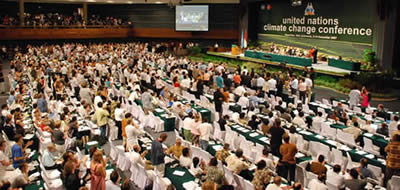
    The Bali Road Map, adopted in the 13th Conference of Parties (COP) in 2007 in Bali, Indonesia includes the Bali Action Plan, which charted the course for a new negotiation process designed to create a climate change solution package for post-Kyoto era. The Bali Action Plan identified the COP 15, the upcoming Copenhagen UN Climate change Conference as the major event, where a new legally binding post-Kyoto agreement is to be enacted.

    One of the major challenges for the Copenhagen Conference has been the engagement of the world’s biggest leaders. Despite the very good ratification situation, the Kyoto Protocol fails to address some of the major problems of today, namely the emergence of new industrialized powers. China has already announced that it aims at cutting its carbon emissions by up to 45 percent as measured against its economic output – a target aimed at keeping its surging growth while still reining in pollution, while India has not clearly expressed its will to cut emissions, but only to accept “deviation from business as usual”. The US, which never ratified the Kyoto Protocol has as well already announced that it is going to reduce its greenhouse gas emissions by 17%.

    Now at the eve of the Conference many significant countries have announced their willingness to sign a binding treaty on emission reduction. The Commonwealth, a 53-member state union, has stated that a deal should be adopted no later than next year and 10 billion US dollars should be made available to help developing countries to reach their emission goals.

    The COP15 negotiations start on Monday, December 7 and will be carried out throughout the two week period closing session being on Friday, December 18. In addition to the actual COP15, 5th Session of the Conference of the Parties serving as the meeting of the Parties to the Kyoto Protocol (CMP 5) will also be held in Copenhagen at the same dates. Further, 31st Session of the Subsidiary Body for Scientific and Technological Advice (SBSTA 31), 31st Session of the Subsidiary Body for Implementation (SBI 31), 10th session of the Ad Hoc Working Group on Further Commitments for Annex I Parties under the Kyoto Protocol (AWG-KP 10) and 8th session of the Ad Hoc Working Group on Long-term Cooperative Action (AWG-LCA 8) will takes place in Copenhagen between the December 7 and December 18.

    For more information and for latest news, please visit the COP15 homepage

    [http://www.youtube.com/watch?v=r3x4OnMPeCs]

  • UNFCCC – 55 days to the 15th Conference of the Parties in Copenhagen, 7-18 December

    UNFCCC – 55 days to the 15th Conference of the Parties in Copenhagen, 7-18 December

    UNFCCC

    UNFCCC

    United Nations Framework Convention on Climate Change (UNFCCC) was originally initiated in the 1992 Rio Earth Summit. It is an international treaty on environmental law aiming at reducing the greenhouse gas concentrations in the atmosphere.

    The UNFCCC does not lay down any binding limits of reduction, but divides the signatories to the convention in to three categories each category agreeing to reduce their emissions of greenhouse gas a certain amount.

    First category of industrialized countries, so called Annex I countries, agree to reduce their emissions of greenhouse gasses to targets that are mainly set below their 1990 levels. These countries are Australia, Austria, Belarus, Belgium, Bulgaria, Canada, Croatia, Czech Republic, Denmark, Estonia, Finland, France, Germany, Greece, Hungary, Iceland, Ireland, Italy, Japan, Latvia, Liechtenstein, Lithuania, Luxembourg, Monaco, Netherlands, New Zealand, Norway, Poland, Portugal, Romania, Russia, Slovakia, Slovenia, Spain, Sweden, Switzerland, Turkey, Ukraine, UK and USA.

    Annex II countries, developed countries that are to pay for the costs of developing countries for their efforts to reduce greenhouse gasses, are Australia, Austria, Canada, Denmark, Finland, France, Germany, Greece, Iceland, Ireland, Italy, Japan, Luxembourg, Netherlands, New Zealand, Norway, Portugal, Spain, Sweden, Switzerland, UK, USA and the European Union.

    Finally, in the Annex III are developing countries and countries with economy in a transition.

    Today, the UNFCCC enjoys near-universal membership having 192 signatory members. The members meet annually in Conferences of the Parties (COP), in which they assess progress and negotiate binding rules on greenhouse gas emissions. One of the most significant COPs has been the COP-3 in 1997 in Kyoto, Japan, where the so called Kyoto Protocol, the legally binding protocol on emission reduction, was adopted.

    Kyoto Protocol

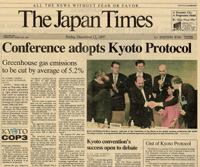
    The Japan Times - Kyoto protocol accepted

    The major feature of the Kyoto Protocol are the targets for 37 industrialized countries and the European Community for reducing greenhouse gas emissions .The target is an average of five per cent against 1990 levels between 2008-2012. In addition to the limits, the Kyoto Protocol introduces three mechanisms how the targets are to be met. Primarily, the countries must reduce their emissions through national measures, meaning that they have to take action to actually diminish their greenhouse gas pollution. But since the economies of most countries are highly dependent on industries that are high polluters, three other mechanisms were introduced to ease the reduction scheme.

    The first mechanism introduced in the Kyoto Protocol is the Emissions Trading. Emissions trading, as set out in Article 17 of the Kyoto Protocol, allows countries that have emission units to spare – emissions permitted them but not “used” – to sell this excess capacity to countries that are over their targets. This scheme is in use for example in the European Union and is one of the largest trading schemes in operation.

    Second mechanism provided by the Kyoto Protocol is the Clean Development Mechanism (CDM), defined in Article 12 of the Protocol. The CDM is a purchase system where saleable certified emission reduction (CER) credits can be earned by implementing an emission-reduction project in developing countries. This is a unique global environmental investment system and there exists now 1849 registered CDM project activities.

    Third mechanism is so called „joint implementation” ,defined in Article 6 of the Kyoto Protocol. The „joint implementation“ allows an Annex II country to earn emission reduction units (ERUs) from an emission-reduction or emission removal project in another Annex II country through a flexible and cost-efficient foreign investment and technology transfer system.

    The Kyoto Protocol entered into force on 16 February 2005 and has today been ratified by 184 countries.

    COP 15 – Copenhagen, 7-18 December

    cop 15

    The 15th Conference of the Parties to the UNFCCC (COP 15) and the 5th Meeting of the Parties (MOP 5) to the Kyoto Protocol will be held in 55 days, 7-18 December 2009, in Copenhagen, Denmark. The COP15 / MOP5 is of special significance because of the goals set forth in the Bali Road Map. In the Bali Road Map it was stated that in Copenhagen, a post-Kyoto Protocol action is to be negotiated. The fact is that the consequences of the climate change are getting increasingly apparent and in the Arctic alone it has been estimated that the sea ice will melt in ever accelerating rate the North pole being ice free over the summer time already as soon as in 2040.

    Ad Hoc Working Group on Kyoto Protocol (AWG-KP) has been preparing the COP 15 / MOP 5 and most participants seem to agree that a positive outcome for the global community can be reach in the COP Meeting. However, it is to be seen how the global recess has influenced the ability of the major industrialized countries to act upon their commitments and how far they are willing to go to further the legally binding commitments for the post-Kyoto era.

    For more information, please visit the UNFCCC homepage or the COP 15 homepage