Tag: satellite

  • A new record low before the ice increase

    A new record low before the ice increase

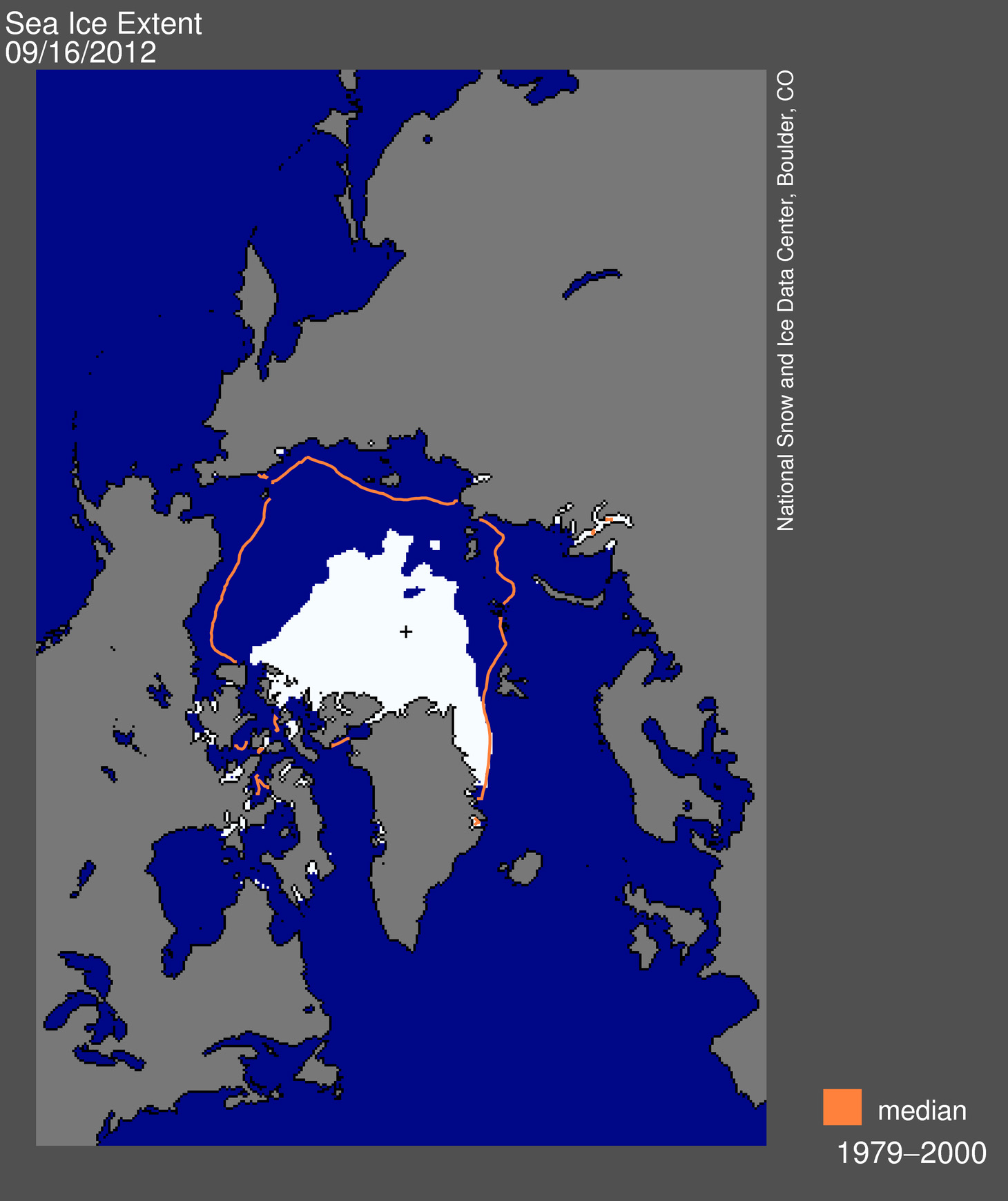
    Arctic sea ice extent for September 16, 2012

    The summer sea ice is increasing again as winter looms but recorded its lowest ever extent since satellite measurements began in 1979. The ice on September 16th was significantly lower than the previous record year of 2007.

    On September 16, 2012 sea ice extent dropped to 3.41 million square kilometers, 760,000 square kilometers below the previous record minimum extent in the satellite record, which occurred on September 18, 2007.

    That means there less ice in the Arctic which would cover all of Norway, Denmark and Finland combined.

    The National Snow and Ice Data Center reports that in response to the setting sun and falling temperatures, ice extent will now climb through autumn and winter. However, a shift in wind patterns or a period of late season melt could still push the ice extent lower. The minimum extent was reached three days later than the 1979 to 2000 average minimum date of September 13.

    This year’s minimum is 18% below 2007 and 49% below the 1979 to 2000 average.

    Overall there was a loss of 11.83 million square kilometers (4.57 million square miles) of ice since the maximum extent occurred on March 20, 2012, which is the largest summer ice extent loss in the satellite record, more than one million square kilometers greater than in any previous year.

    Source:

    NSIDC

  • CrySat to enhance marine safety

    CrySat to enhance marine safety

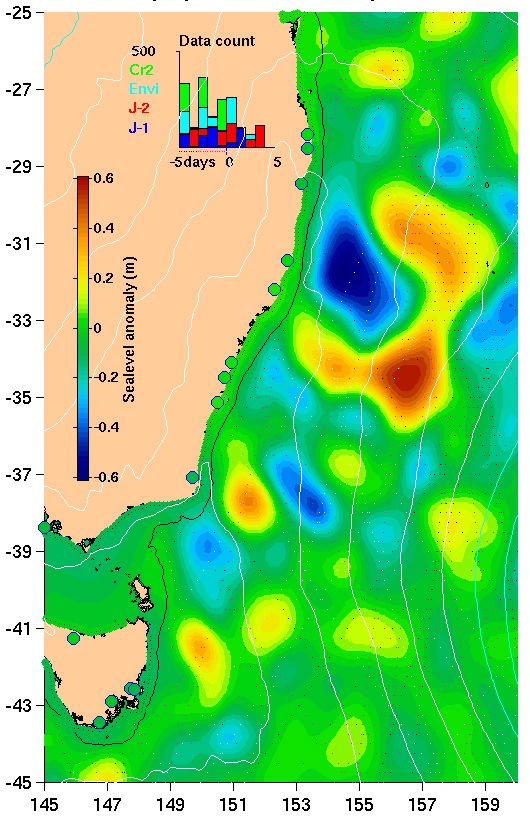
    Demonstration of the measurement of sea level.

    The European Space Agency will use its powerful satellite for monitoring weather conditions to enhance marine safety. This will benefit the Arctic as the CryoSat is designed for measuring thickness of ice.

    ESA’s CryoSat mission has been gathering detailed information on the thickness of Earth’s ice since its launch in 2010. Through international collaboration, this state-of-the-art mission will broaden to monitor the weather.

    With the satellite scientists now have data to research and conclude about the understanding of the relationship between ice, climate and sea level.

    The CryoSat moves from pole to pole and will now measure the measure the sea level and the height of waves.

    From February this new technology will start for this important work which will benefit throughout the world.

    The image on the right shows mweasurments of sea level, when tested near Australia. The green is 0 but the yellow to red is high and light blue to dark blue belov sea level.

    Sources

    European Space Agency

  • Iceland stands by its name

    Iceland stands by its name

    Iceland, covered with snow and ice.

    Iceland showed last week why it is indeed ice-land. This amazing photograph taken by a NASA satellite is from the Earth Science department of the University of Iceland.

    The picture was taken the 9th of December at 12.58.

    The freezing temperatures last week went down to -27 in Northeast Iceland, in Mývatn. The record low temperature is for Iceland is -38, the year 1918 often dubbed the “Frosty Winter”.

    The image, which you can expand by clicking, shows that sea ice is stretching from the North to Iceland.

    Only a few days later the temperature was above 0 again.

    This truly is Iceland.

    University of Iceland
    NASA

  • Rock and roll satellite

    Rock and roll satellite

    ice saltellite

    ESA’s ice satellite is collecting data in the two poles, and the project is going well. The satellite is to give precise measurements of the vast ice sheets that blanket Greenland and Antarctica.

    Since its launch 18 months ago, CryoSat-2 has been collecting data to improve our understanding of the relationship between ice and climate, according to ESA website.

    For the first time a map of the Arctic sea-ice thickness was released, by ESA. The ice-satellite is to thank for that map and it is still colleting data.

    To ensure the precision of the measurements, an operation is under way to roll the satellite from side to side as it flies over the flat oceans. This maneuver is to calibrate CryoSat’s radar altimeter for measuring ice thickness, especially over the margins of ice sheets.

    The altimeter has two antennas mounted on a bench about a meter apart. When it is working in the ‘SARIn’ mode, both antennas are used in parallel: one emits a signal and both receive the signals that bounce back.  

    Normally, this bench is parallel to Earth’s surface. But at the edges of the ice sheets, the ice surface is not always flat and the slopes affect the return signals.

    Harsh conditions in space – with huge temperature differences between Sun and shade – can lead to the deterioration of CryoSat’s instruments, which can also lead to measurement errors.

    ice satellite

    In order to quantify these errors, ESA ground controllers are working to recalibrate the altimeter.

    They are rolling the satellite to simulate the ice slopes and holding it in this position for several minutes. This must be done while CryoSat is over large, flat surfaces. For satellite altimeters, oceans are Earth’s largest flat surfaces.

    It will also check whether errors are related to CryoSat’s varying thermal conditions – like when exposed to the Sun or in the shade.

    “With the results from the different sets of rolls over different ocean surfaces and at different ambient conditions, we are aiming to characterize the instrument to a precision better than we thought we could make at the time of the launch,” said Tommaso Parrinello, CryoSat mission manager.

    During several maneuvers on Monday and Tuesday, the satellite is rolling 0.4º to both sides while over the Indian and Pacific oceans, before returning to its original position.

    “The preparations for the roll activities have been quite challenging,” explained Nic Mardle, spacecraft operations manager.

    “Although we had experience of these activities from the commissioning phase, we had to iterate a few more times with the planning and mission control teams so that we could support exactly what was required.”

    Satellites have already shown that the extent of sea ice in the Arctic is diminishing. In fact, this year’s minimum has set a new record low.