Tag: Scandinavia

  • Cold winter conditions in the Arctic

    Cold winter conditions in the Arctic

    Climate conditions have been negative

    States for 2012 was climate conditions in Scandinavia, Siberia, Alaska and Canada have been colder than average this winter.

    The National Snow and Ice Data Center reports that the Arctic sea ice extent for December 2012 was well below average, driven by anomalously low ice conditions in the Kara, Barents, and Labrador seas.

    NSIDC states that the winter has been dominated by the negative phase of the Arctic Oscillation, bringing the cold climate around the Arctic.

    The Arctic Oscillation is an Arctic climate index with positive and negative phases, which represents the state of atmospheric circulation over the Arctic. The positive phase brings lower-than-normal pressure over the polar region, steering ocean storms northward, bringing wetter weather to Scotland and Scandinavia, and drier conditions to areas such as Spain and the Middle East.

    Reports today also show that the average temperature for USA for 2012 was above average, showing different climate than in the Arctic, outside of Alaska.

    Sources
    NSIDC

    NOAA 1

    NOAA 2

  • Greatest warming in Scandinavia

    Greatest warming in Scandinavia

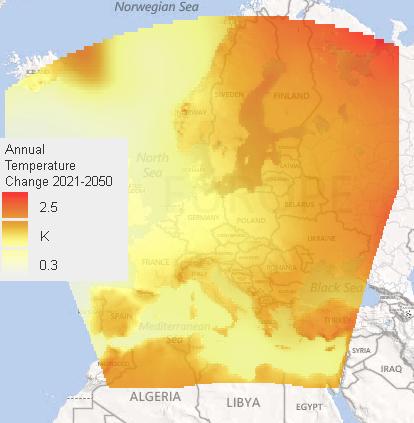
    Annual Temperature Change 2021 - 2050

    Predictions of the European Environmental Agency of global warming have been released. Records have already confirmed a warmer Europe and the future predictions say that Europe will be on average 1.5° C warmer in the period 2021-2050 than the period 1960-1990.

    According to the EEA, higher temperatures lead to an increase in number of heat waves and droughts, which have great impact on water supply, agriculture production and human health.

    The highest warming is projected over the eastern Scandinavia, and southern and south-eastern Europe. All areas of the continent will warm by a minimum of approximately 0.4° C and a maximum of 2.5° C, the projections indicate.

    Looking further ahead to the period 2071-2100, the models predict that Europe will be on average 3 °C warmer than 1960-1990. In north eastern Scandinavia the temperature change could be up to 6° C higher than the reference period, while the Mediterranean basin and parts of Eastern Europe will also see much bigger changes than elsewhere. All areas are expected to see average annual temperatures at least 1.5° C warmer than the reference period.

    Interestingly, there are great differences between summer and winter – the maps show the winters will see the greatest change in Scandinavia and Eastern Europe, while the biggest temperature increases in the summer will be around the Mediterranean.

    The website also states that while a few degrees increase may not seem significant, it is important to note that these are average annual temperatures, potentially masking large extremes. For example, during the period 2021 – 2050 summer in some parts of the Mediterranean is expected to be upto 2.5° C warmer than 1961-1990.

    Source

    EEA