Tag: SCAR

  • Future Directions in Antarctic Science

    Future Directions in Antarctic Science

    Penguins

    IASC´s southern hemisphere partner, the Scientific Committee on Antarctic Research (SCAR), is embarking on a unique and exciting project to identify the most important and compelling questions in Antarctic and Southern Ocean science over the next two decades.

    A collective, community-based vision of the 100 highest priority scientific questions will be developed to assist in strategic planning; influence future directions in Antarctic research; highlight opportunities for collaborations and synergies; identify future critical infrastructure, logistical, and technological needs; and inform international decisions about investments in the Antarctic scientific enterprise.

    For this project to be successful organizers need the opinions and insights on what are or will be THE scientific questions that once answered, will measurably improve our understanding of Antarctica and the Southern Ocean and its connections to the Earth and climate systems and beyond.

    Outputs will include a high-profile, summary paper published in a leading journal and various other documents and products that will be widely disseminated to the community. Public responses will be the “raw material’ to identify the most compelling and timely questions for Antarctic and Southern Ocean science in the future.

    This project will only be successful if the communities and individuals choose to participate!

    Please encourage your colleagues to submit questions as well. The first round solicitation will close on 15 June 2013.

    For more detailed information and to submit your questions, please visit SCAR Website.

    Source
    Scientific Committee on Antarctic Research

  • Palm trees in latest SCAR newsletter

    Palm trees in latest SCAR newsletter

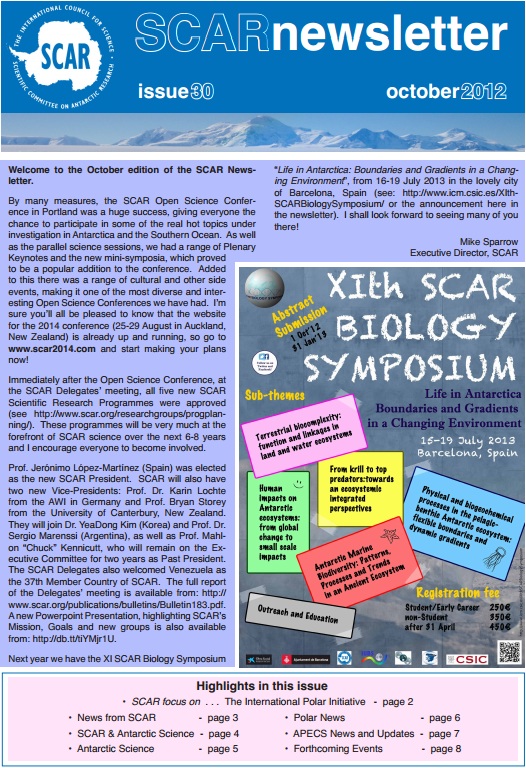
    SCAR newsletter for October

    The latest issue of the SCAR newsletter is now available. SCAR is the Scientific Committee on Antarctic Research, an inter-disciplinary committee of the International Council for Science (ICSU).

    The latest issue looks back at the XXXII SCAR Meetings and Open Science Conference in July and forward to the XI SCAR Biology Symposium next July.

    The newsletter is news and announcement feature from SCAR, which includes articles, news stories, polar and APECS events and this issue even has a story about palm trees in Antarctica!

    Click here to read the newsletter.

  • Announcement of opportunity – SCAR Antarctic Science Fellowships 2011 – 2012 and COMNAP Antarctic Research Fellowship

    Announcement of opportunity – SCAR Antarctic Science Fellowships 2011 – 2012 and COMNAP Antarctic Research Fellowship

    SCAR

    Two leading Antarctic organisations announce today opportunities for early career researchers. The Scientific Committee on Antarctic Research (SCAR) and the Council of Managers of National Antarctic Programmes (COMNAP) are working together to attract talented researchers, engineers and other professionals to strengthen international capacity and cooperation.

    The Fellowships are worth up to $US 15,000 each and up to five (4 SCAR and 1 COMNAP Fellowships) are on offer for 2011.

    For the SCAR fellowships, the awardee should:

    1. Be PhD students or within 5 years of having completed a PhD on the day of the deadline for applications
    2. be from any country
    3. want to visit a SCAR member country’s research facilities or Antarctic base
    4. work in ANY field of SCAR’s Antarctic scientific interest, including Antarctic Climate change, Life Sciences, Geo Sciences, Physical Sciences.

    Further details of both the SCAR and COMNAP fellowships

    The deadline for applications is 15 May 2011.

  • Antarctic Climate Change and Environment

    Antarctic Climate Change and Environment

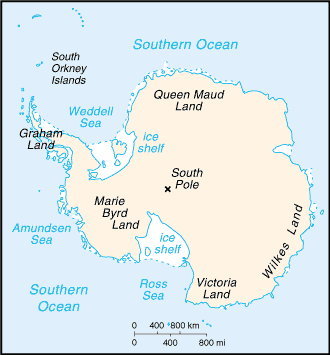
    Antarctica mapThe first comprehensive review of the state of Antarctica’s climate and its relationship to the global climate system was published in the beginning of December 2009 by the Scientific Committee of Antarctic Research (SCAR).

    The newly published report examines the highly complex relationship of Antarctic environment with the global ecosystem that is increasingly affected by human activity. Already some signs of the changed Antarctic environment had been detected, i.e. the Antarctic ozone hole, but the fact is that the climate change has and will most likely have an unprecedented affect on the Antarctic and thus to us all. For example, contains Antarctica 90% of the world’s ice and 70% of the world’s fresh water, which is enough to raise sea level by 63 m.

    The report draws, however, quite interesting picture of the changing environment in the Antarctic. While the overall surface temperature and ice coverage around the continent have remained the same over the past 30 years, some specific parts of Antarctica are experiencing significant change.

    First, the report points out that for the last 30 years the ozone hole has shielded the bulk of the Antarctic from the effects of the global warming. The report maintains that despite the quite extensive changes in the surface temperature and snowfall around the Antarctic the temperature as well as Antarctic overall snowfall have remained at the same level. It is further notable, that while sea ice extent across the Arctic Ocean has decreased markedly over recent decades, around the Antarctic it has increased by 10% since 1980, particularly in the Ross Sea region. This increase is a result of the stronger winds around the continent, changes in atmospheric circulation and the isolating effect of the ozone hole. This is especially interesting, since the Antarctic Circumpolar Current around the continent has warmed more rapidly than the global ocean as a whole resulting in a major change in the Southern Ocean ecosystem. In recent decades the Ocean has become less effective in absorbing CO2 and ecological key species (such as planktonic snails) are expected to be negatively affected by progressive ocean acidification.

    Antarctic dawnOn the other hand, along with higher temperatures, the Antarctic Peninsula on the west coast of the continent, has experienced a marked switch from snowfall to rain during the summer, which has led to rapid expansion of plant communities and the colonization of newly available land by plants and animals. In addition, there has been significant thinning of the West Antarctic Ice Sheet, especially around the Amundsen Sea Embayment, as well as a few smaller coastal areas in East Antarctica, which has resulted in diminishing Krill stocks and changed distribution of Adélie penguins.

    The report predicts that if greenhouse gas concentration in the atmosphere doubles over the next century, the Antarctic will warm around 3°. This increase could contribute to a projected total sea level rise of up to 1.4 metres by 2100.

    For further information, please go to the Scientific Committee of Antarctic Research or access the SCAR publications