Tag: science

  • Future Directions in Antarctic Science

    Future Directions in Antarctic Science

    Penguins

    IASC´s southern hemisphere partner, the Scientific Committee on Antarctic Research (SCAR), is embarking on a unique and exciting project to identify the most important and compelling questions in Antarctic and Southern Ocean science over the next two decades.

    A collective, community-based vision of the 100 highest priority scientific questions will be developed to assist in strategic planning; influence future directions in Antarctic research; highlight opportunities for collaborations and synergies; identify future critical infrastructure, logistical, and technological needs; and inform international decisions about investments in the Antarctic scientific enterprise.

    For this project to be successful organizers need the opinions and insights on what are or will be THE scientific questions that once answered, will measurably improve our understanding of Antarctica and the Southern Ocean and its connections to the Earth and climate systems and beyond.

    Outputs will include a high-profile, summary paper published in a leading journal and various other documents and products that will be widely disseminated to the community. Public responses will be the “raw material’ to identify the most compelling and timely questions for Antarctic and Southern Ocean science in the future.

    This project will only be successful if the communities and individuals choose to participate!

    Please encourage your colleagues to submit questions as well. The first round solicitation will close on 15 June 2013.

    For more detailed information and to submit your questions, please visit SCAR Website.

    Source
    Scientific Committee on Antarctic Research

  • Nominations for Antarctica prize open

    Nominations for Antarctica prize open

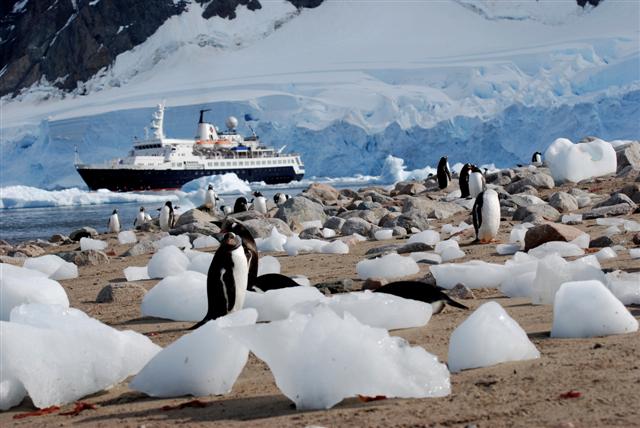
    Penguins in Antarctica

    Nominations for a prestigious prize for Science and Policy in Antarctica are now open.

    The “Martha T. Muse Prize for Science and Policy in Antarctica” is a US$ 100,000 unrestricted award presented to an individual in the fields of Antarctic science or policy who has demonstrated potential for sustained and significant contributions that will enhance the understanding and/or preservation of Antarctica.

    The Prize is inspired by Martha T. Muse’s passion for Antarctica and is intended to be a legacy of the International Polar Year 2007-2008.

    The prize-winner can be from any country and work in any field of Antarctic science or policy. The goal is to provide recognition of the important work being done by the individual and to call attention to the significance of understanding Antarctica in a time of change.

    A website with further details, including the process of nomination, closing date and selection of the Prize recipients is available at www.museprize.org.

    The Prize is awarded by the Tinker Foundation and administered by the Scientific Committee on Antarctic Research (SCAR).

    Source

    Muse Prize

  • Science Section begins today!

    Science Section begins today!

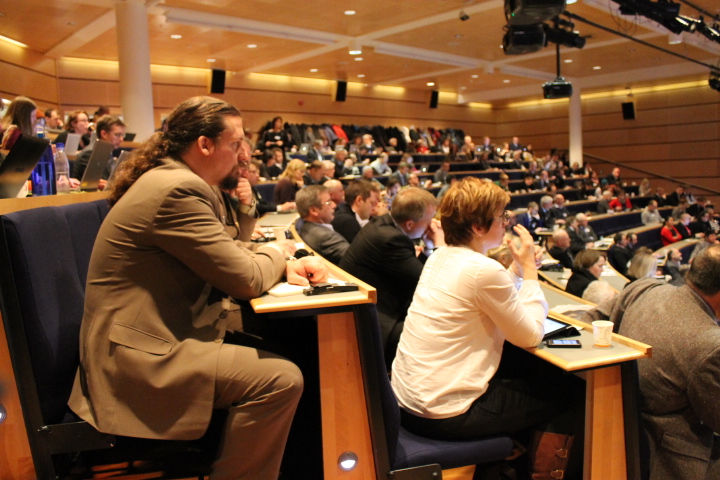
    The audience during science session at Arctic Frontiers 2013

    After 2 days of policy related discussions, the Arctic Frontiers conference that is being held in Tromso, Norway, opens the science section.

    This part will address the issues of security, energy and interstate relations in the Arctic. An overall aim is to identify conditions for continued stability in light of new developments in the region.

    A warming Arctic with less ice may involve opportunities in terms of economic activity and increased interstate cooperation, but it may also present Arctic stakeholders with new challenges in terms of how best to meet their interests and at the same time interact with other stakeholders through mutually beneficiary relations.

    Arctic Frontiers is organised as an independent network and a leading meeting place for pan-arctic issues. The network was established in 2006 and later extended. The science section that start today will end on Friday, 25th of January.

    HMM

  • Exhibition and science lab in Lenin

    Exhibition and science lab in Lenin

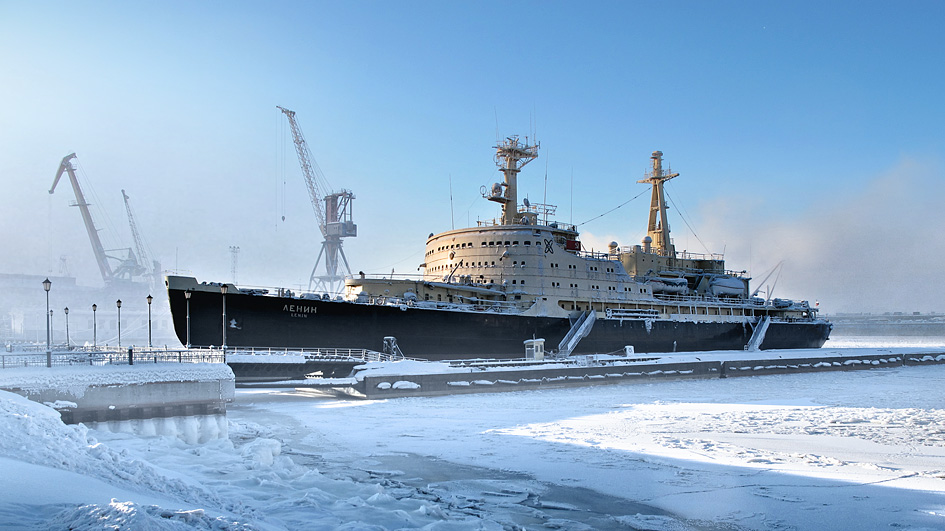
    The Lenin icebreaker.

    A Russian icebreaker will be modified into a floating museum. The icebreaker Lenin will serve the purpose of being a science and historical exhibition.

    The Arctic Centre of the University of Lapland, Polaria in Tromsö and Atomflot in Murmansk have been granted 1.2 million euros by Kolarctic ENPI CBC program for the project.

    The Arctic Centre will be the lead partner and act as the main exhibition producer in the project Arctic Expo Centre – Nuclear-Powered Icebreaker Lenin – ICE.

    The aim of the project is to develop new exhibitions and innovative communication tools as a means to improve the information on local and cross-borders concerns. This will help to facilitate a mutual understanding among neighboring people about common issues and the Arctic. As the exhibition is planned on board Icebreaker Lenin, the goal is also to tell about the technology and history of icebreaking.

    “Through exchange of expertise and share of experiences each member will increase the opportunities to develop its own exhibition and activities such as education package for teachers and pupils on certain issues, special tours for tourists”, says chief executive producer Nicolas Gunslay, Arctic Centre.

    “The goal is to raise awareness on topics related to the Arctic marine environment, climate change, and globalization,” he added.

    The icebreaker Lenin was launched in 1957 and is the world’s first nuclear powered surface ship and the first nuclear powered civilian vessel. It had a crew of 240 persons while in operation.

    He left service in Russia in 1989.

  • New source for science news

    Science Nordic website

    Science Nordic is a newly opened independent website for science news in english from the Nordic countries. The web site is a welcomed forum for Arctic research available in English.

    ScienceNordic is the result of a joint effort from two well-established science news services in the region, Forskning.no in Norway and Videnskab.dk in Denmark, who work in close collaboration with partners in Sweden, Finland, Iceland, Greenland, the Faroe Islands and Åland.

    The site covers everything from human sciences to natural science, health and technology.

    On the site now are articles on things like the connection between glaciers and the brain and another and many others.

    The site wants to rech out to the research community across the globe: researchers, students, the business sector, innovation clusters, international institutions and media – along with anybody else whose heart and mind is moved by science.

    Click here to visit Science Nordic.

  • New networking mechanism established in Russian northern research

    New networking mechanism established in Russian northern research

    Arctic Portal news

    New networking mechanism, promoting cooperation between science, youth associations, non-profit organizations, business and authorities, has been established for the benefit of development of northern regions in Russia.

    The cooperation called “Center for Problems of the North, Arctic and Cross-border Cooperation”, “North-Centre”, was established by Karelian Research Center of the Russian Academy of Science and International Public Youth Movement “Association AWARD”. The project is intended to unite the efforts of science in the area.

    Igor Shevchuk will be heading the project. Mr. Shevchuk is the foreign relations officer of the Karelian Research Center of RAS. Other members include, Alexander Titov, President of the Karelian Research Center of RAS, Corresponding Member of RAS, Chairman, Elena Antoshko, Head of the International Public Youth Movement “Association AWARD and Alexander Yuriev, Executive Director of the Association “Council of Municipalities, Republic of Karelia”

    The Karelian Research center is establishing a web page for the project and it will be located at http://northcentre.krc.karelia.ru/