Tag: Sea Ice

  • Sixth lowest sea ice extent

    Sixth lowest sea ice extent

    Melting Sea Ice in the arctic

    After an unusually cold summer in the northernmost latitudes, Arctic sea ice appears to have reached its annual minimum summer extent for 2013 on Sept. 13, the NASA-supported National Snow and Ice Data Center (NSIDC) at the University of Colorado in Boulder has reported. Analysis of satellite data by NSIDC and NASA showed that the sea ice extent shrunk to 1.97 million square miles (5.10 million square kilometers).

    Click here for the Arctic Portal Mapping system on Sea Ice Extent

    This year’s sea ice extent is substantially higher than last year’s record low minimum. On Sept.16, 2012, Arctic sea ice reached its smallest extent ever recorded by satellites at 1.32 million square miles (3.41 million square kilometers). That is about half the size of the average minimum extent from 1981 to 2010.

    This summer’s minimum is still the sixth lowest extent of the satellite record and is 432,000 square miles (1.12 million square kilometers) lower than the 1981-2010 average, roughly the size of Texas and California combined.

    The 2013 summertime minimum extent is in line with the long-term downward trend of about 12 percent per decade since the late 1970s, a decline that has accelerated after 2007. This year’s rebound from 2012 does not disagree with this downward trend and is not a surprise to scientists.

    “I was expecting that this year would be higher than last year,” said Walt Meier, a glaciologist at NASA’s Goddard Space Flight Center in Greenbelt, Md. “There is always a tendency to have an uptick after an extreme low; in our satellite data, the Arctic sea ice has never set record low minimums in consecutive years.”

    The ice cap covering the Arctic Ocean shrinks and expands with the passing of the seasons, melting in the summer and refreezing during the long, frigid Arctic winter. This year, cooler weather in the spring and summer led to a late start of the melt season and overall less melt.

    This year, Arctic temperatures were 1.8 to 4.5 degrees Fahrenheit (1 to 2.5 degrees Celsius) lower than average, according to NASA’s Modern Era Retrospective analysis for Research and Applications, a merging of observations and a modeled forecast. The colder temperatures were in part due to a series of summer cyclones. In August 2012, a big storm caused havoc on the Arctic Ocean’s icy cover, but this summer’s cyclones have had the opposite effect: under cloudier conditions, surface winds spread the ice over a larger area.

    “The trend with decreasing sea ice is having a high-pressure area in the center of the Arctic, which compresses the ice pack into a smaller area and also results in clear skies, which enhances melting due to the sun,” said Richard Cullather, an atmospheric scientist at Goddard and at the Earth System Science Interdisciplinary Center of the University of Maryland, College Park, Md. “This year, there was low pressure, so the cloudiness and the winds associated with the cyclones expanded the ice.”

    The remaining Arctic sea ice cover is much thinner on average than it was years ago. Satellite imagery, submarine sonar measurements, and data collected from NASA’s Operation IceBridge, an airborne survey of polar ice, indicate that the Arctic sea ice thickness is as much as 50 percent thinner than it was in previous decades, going from an average thickness of 12.5 feet (3.8 meters) in 1980 to 6.2 feet (1.9 meters) in recent years. The thinning is due to the loss of older, thicker ice, which is being replaced by thinner seasonal ice.

    Most of the Arctic Ocean used to be covered by multiyear ice, or ice that has survived at least two summers and is typically 10 to 13 feet (3 to 4 meters) thick. This older ice has declined at an even faster rate than younger ice and is now largely relegated to a strip along the northern coast of Greenland. The rest of the Arctic Ocean is dominated by first year ice, or ice that formed over the previous winter and is only 3 to 7 feet (1 to 2 meters) thick.

    “Thinner ice melts completely at a faster rate than thicker ice does, so if the average thickness of Arctic sea ice goes down, it’s more likely that the extent of the summer ice will go down as well,” said Joey Comiso, senior scientist at Goddard and coordinating lead author of the Cryosphere Observations chapter of the upcoming report of the Intergovernmental Panel on Climate Change. “At the rate we’re observing this decline, it’s very likely that the Arctic’s summer sea ice will completely disappear within this century.”

    Comiso added that the slight rebound in the 2013 sea ice minimum extent is consistent with a rebound in the multiyear ice cover observed last winter.

    “The character of the ice is fundamentally different: It’s thinner, more broken up, and thus more susceptible to melt completely,” Meier said. “This year, the cool temperatures saved more of the ice. However, the fact that as much of the ice melted as it did is an indication of how much the ice cover had changed. If we had this weather with the sea ice of 20 years ago, we would have had an above-normal extent this year.”

    The sea ice minimum extent analysis produced at NASA Goddard – one of many satellite-based scientific analyses of sea ice cover – is compiled from passive microwave data from NASA’s Nimbus 7 satellite, which operated from late October 1978 to August 1987, and the U.S. Department of Defense’s Defense Meteorological Satellite Program, which has been used to extend the Nimbus 7 sea ice record onwards from August 1987. The record began in October 1978.

    Source:NASA
  • Arctic sea ice disappearing faster than ever

    Arctic sea ice disappearing faster than ever

    arctic landscape

    The Arctic lost record amounts of sea ice last year and is changing at an unprecedented pace due to climate change, a landmark climate study says.

    Last year was among the 10 warmest years on record – ranking eighth or ninth depending on the data set, according to a report led by the National Oceanic and Atmospheric Administration (Noaa). The year 2012 also saw record greenhouse gas emissions, with concentrations of carbon dioxide and other warming gasses reaching a global average of 392.7 parts per million for the year.

    “The findings are striking,” Kathryn Sullivan, Noaa’s acting administrator, said on a conference call. “Our planet as a whole is becoming a warmer place.”

    The scientists were reluctant to point directly to the cause of the striking changes in the climate. But the annual reports are typically used by the federal government to prepare for the future, and in June president Barack Obama used his climate address to direct government agencies to begin planning for decades of warming atmosphere and rising seas.

    The biggest changes in the climate in 2012 were in the Arctic and in Greenland, said the report, which is an annual exercise by a team of American and British scientists. The Arctic warmed at about twice the rate of lower latitudes, the report found. By June 2012, snow cover had fallen to its lowest levels since the record began. By September 2012, sea-ice cover had retreated to its lowest levels since the beginning of satellite records, falling to 1.32 million square miles.

    That was, the report noted, a whopping 18% lower than the previous low, set in 2007, and a staggering 54% lower than the mark for 1980.

    The changes were widespread on land as well, with record warm permafrost temperatures in Alaska and in the Canadian Arctic, the report’s authors noted. On 11 July last year, Greenland experienced surface melting on 97% of the ice sheet. The record-breaking events indicate an era of “new normal” for the climate, the researchers said.

    “The record or near-records being reported from year to year in the Arctic are no longer anomalies or exceptions,” said Jackie Richter-Menge, a civil engineer with the US army corps of engineers. “Really they have become the rule for us, or the norm that we see in the Arctic and that we expect to see for the forseeable future.”

    That ice melt was also a major cause of sea-level rise, the report found. Global sea levels rose to record highs last year, after being depressed during the first half of 2011 because of the effects of La Niña. The average global sea level last year was 1.4in above the 1993-2010 average.

    “Over the past seven years of so, it appears that the ice melt is contributing more than twice as much to the global sea level rise compared with warming waters,” said Jessica Blunden, a climatologist at Noaa’s national climactic data centre.

    Source

    Guardian

  • Starved polar bear perished in Svalbard

    Starved polar bear perished in Svalbard

    Polar bear dead of starvation

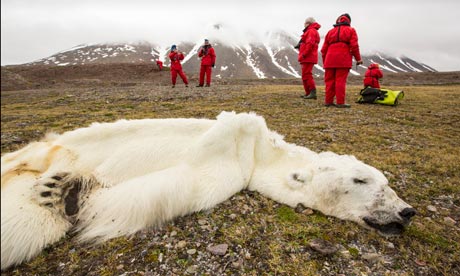
    A starved polar bear found found dead in Svalbard as “little more than skin and bones” perished due to a lack of sea ice on which to hunt seals, according to a renowned polar bear expert.

    Climate change has reduced sea ice in the Arctic to record lows in the last year and Dr Ian Stirling, who has studied the bears for almost 40 years and examined the animal, said the lack of ice forced the bear into ranging far and wide in an ultimately unsuccessful search for food.

    “From his lying position in death the bear appears to simply have starved and died where he dropped,” Stirling said. “He had no external suggestion of any remaining fat, having been reduced to little more than skin and bone.”

    The bear had been examined by scientists from the Norwegian Polar Institute in April in the southern part of Svalbard, an Arctic island archipelago, and appeared healthy. The same bear had been captured in the same area in previous years, suggesting that the discovery of its body, 250km away in northern Svalbard in July, represented an unusual movement away from its normal range. The bear probably followed the fjords inland as it trekked north, meaning it may have walked double or treble that distance.

    Polar bears feed almost exclusively on seals and need sea ice to capture their prey. But 2012 saw the lowest level of sea ice in the Arctic on record. Prond Robertson, at the Norwegian Meteorological Institute, said: “The sea ice break up around Svalbard in 2013 was both fast and very early.” He said recent years had been poor for ice around the islands: “Warm water entered the western fjords in 2005-06 and since then has not shifted.”

    Stirling, now at Polar Bears International and previously at the University of Alberta and the Canadian Wildlife Service, said: “Most of the fjords and inter-island channels in Svalbard did not freeze normally last winter and so many potential areas known to that bear for hunting seals in spring do not appear to have been as productive as in a normal winter. As a result the bear likely went looking for food in another area but appears to have been unsuccessful.”

    Research published in May showed that loss of sea ice was harming the health, breeding success and population size of the polar bears of Hudson Bay, Canada, as they spent longer on land waiting for the sea to refreeze. Other work has shown polar bear weights are declining. In February a panel of polar bear experts published a paper stating that rapid ice loss meant options such the feeding of starving bears by humans needed to be considered to protect the 20,000-25,000 animals thought to remain.

    The International Union for the Conservation of Nature, the world’s largest professional conservation network, states that of the 19 populations of polar bear around the Arctic, data is available for 12. Of those, eight are declining, three are stable and one is increasing.

    The IUCN predicts that increasing ice loss will mean between one-third and a half of polar bears will be lost in the next three generations, about 45 years. But the US and Russian governments said in March that faster-than-expected ice losses could mean two-thirds are lost.

    Attributing a single incident to climate change can be controversial, but Douglas Richardson, head of living collections at the Highland Wildlife Park near Kingussie, said: “It’s not just one bear though. There are an increasing number of bears in this condition: they are just not putting down enough fat to survive their summer fast. This particular polar bear is the latest bit of evidence of the impact of climate change.”

    Ice loss due to climate change is “absolutely, categorically and without question” the cause of falling polar bear populations, said Richardson, who cares for the UK’s only publicly kept polar bears. He said 16 years was not particularly old for a wild male polar bear, which usually live into their early 20s. “There may have been some underlying disease, but I would be surprised if this was anything other than starvation,” he said. “Once polar bears reach adulthood they are normally nigh on indestructible, they are hard as nails.”

    Jeff Flocken, at the International Fund for Animal Welfare, said: “While it is difficult to ascribe a single death or act to climate change it couldn’t be clearer that drastic and long-term changes in their Arctic habitat threaten the survival of the polar bear. The threat of habitat loss from climate change, exacerbated by unsustainable killing for commercial trade in Canada, could lead to the demise of one of the world’s most iconic animals, and this would be a true tragedy.

    Source

    Guardian

  • April Arctic sea ice below average

    April Arctic sea ice below average

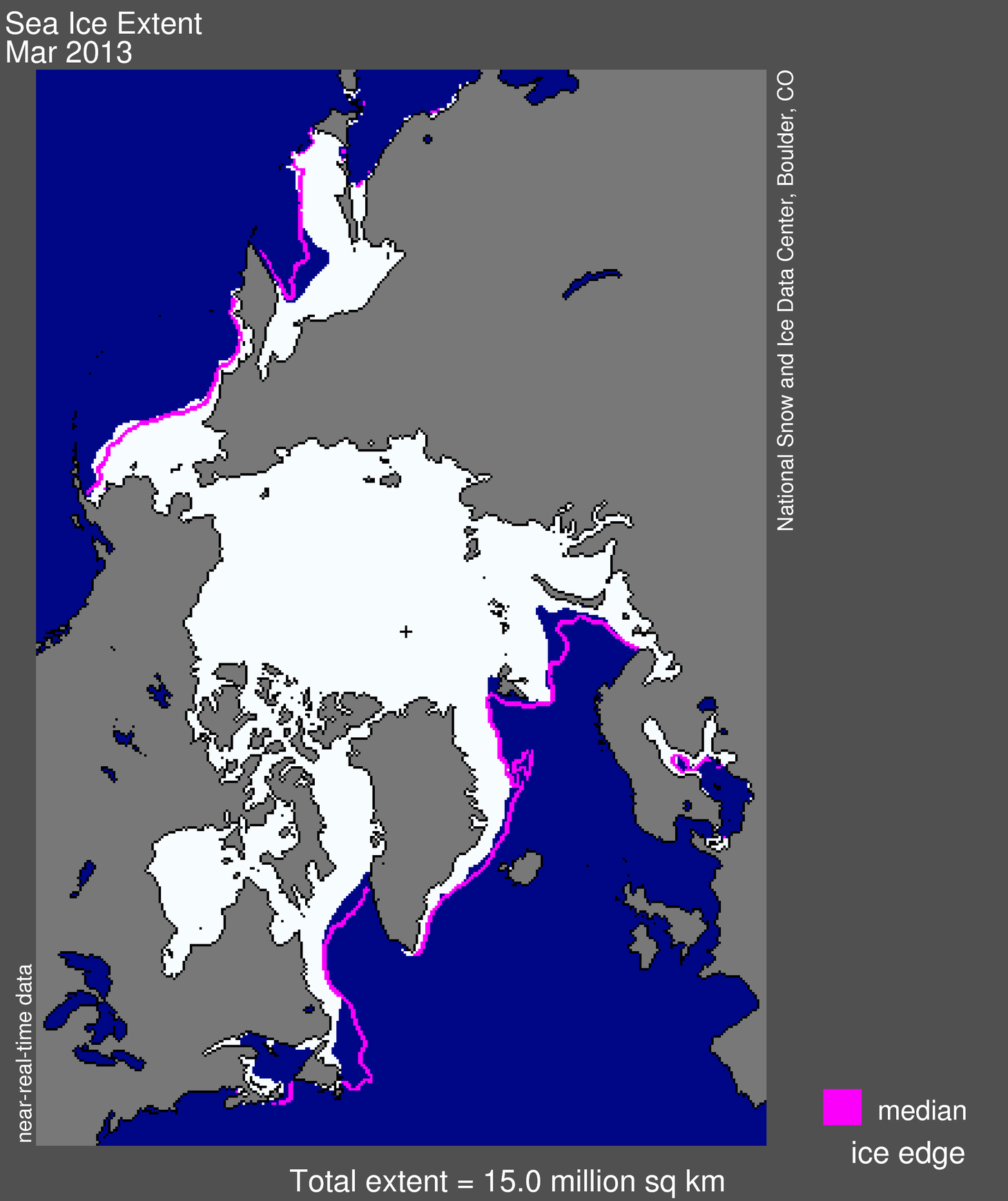
    Arctic sea ice extent for March 2013

    Arctic sea ice extent in March 2013 averaged 15.04 million square kilometers (5.81 million square miles). This is 710,000 kilometers (274,000 square miles) below the 1979 to 2000 average extent, and 610,000 square kilometers (236,000 square miles) above the record low for the month, which happened in 2006.

    Continuing a trend in recent winters, ice extent was near or below average levels throughout most of the Arctic, with the exception of higher extent in the Bering Sea.

    The Arcic sea ice is one of the key symbols of the cold and barren Arctic Region. It affects lives of both, Arctic and non – Arctic residents.

    The Arctic sea ice significantly contributes to the world weather patterns and it helps to keep the globes temperatures down.

    The measurements that have been conducted for the past six years show that the Arctic sea ice has been decreasing. Scientists predict that this pattern will lead to the ice – free Arctic before 2050.

    Click here to find daily reports on Arctic sea ice. To read more about the Arctic sea ice, climate change and more, please access the Arctic Portal Climate Change & Sea Ice Portlet.

    Source

    National Snow and Ice Data Center

  • Trapped whales now free

    Trapped whales now free

    Orca in arctic waters

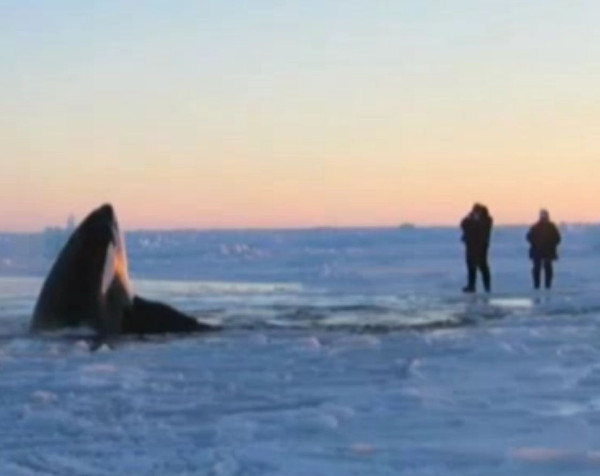
    The whales who were trapped in sea ice in Hudson Bay, Canada, are now free. The ice shifted away and the whales are free and safe after being trapped for two days.In our original story yesterday we reported that the town asked for an icebreaker to assist the whales. There was only a small patch of open water for the whales to breathe, and the gap was shrinking.

    Video of the whales can be seen here.

    A hunter spotted the whales and now the government is looking at its options. Peter Inukpuk, mayor of the small Inuit village, called on the Department of Fisheries and Oceans (DFO) to send out an icebreaker to help the whales.

    Source

    CBC News

  • Arctic brings cold weather to China

    Arctic brings cold weather to China

    A man works in a frozen river in Taiyuan, Shanxi province

    The year 2012 was unusually cold in China, which may be a result of the record loss of Arctic sea ice. “Observation and data analysis showed that Arctic sea ice loss may cause cold and snowy winters in parts of Asia,” Chen Yu, senior engineer of the National Climate Center in China states.

    The Arctic sea ice saw it record low extent on September 16th 2012.

    The China Daily reports and Chen explains that when sea ice melts in the Arctic, the water temperature increases. When that happens, the air becomes moister and is more likely to form cold fronts.

    According to the China Meteorological Administration, in December most of China suffered colder weather than usual. On Dec 24, frequent cold fronts led to temperatures in 21 monitoring stations hitting record lows.

    And the cold weather continued and the weather has been cold since late December.

    Kang Zhiming, weather forecaster of the National Meteorological Center, said weather models showed the temperature will not rise until late January.

    “The weather authorities will keep a close eye on any changes in the weather, especially before Spring Festival, in order to give timely information to transport and related departments, particularly in the event of extreme weather,” Kang said.

    China has a research station in Ny Alesund, on Svalbard, and among other projects is monitoring weather and sea ice from the station.

    Source

    China Daily

  • Few words on the Arctic cryosphere

    Few words on the Arctic cryosphere

    Arctic sea ice at its lowest during September 2012

    When scientists explain the notion of cryosphere, they mean the areas where water is in its solid form, frozen into ice or snow.

    It would occur to some that those frozen regions would be located on top and the bottom of our planet in so called Polar Regions. Of course, frozen areas are located not only in the Arctic or Antarctic but also in so many different places on Earth such as Canada, China, Russia and even Africa with the snow on Mount Kilimanjaro.

    Nevertheless, this feature will treat only about the frozen parts of the Arctic and to be more precise, about the Arctic sea ice which during the summer of 2012 did reach its record low.

    Arctic sea ice cover melted to its lowest extent in the satellite record on 16th of September 2012, breaking the previous record low observed around the same time in 2007. Sea ice extent fell to 4.10 million square kilometers. This was 70,000 square kilometers below the September 18, 2007 daily extent of 4.17 million square kilometers.

    Sea Ice significantly contributes to the worlds whether patterns and help to keep the globes temperature down.

    Measurements of sea Ice during 2010 have reinforced the general belief that the sea ice is declining year from year.

    In this coverage the AP will present an overview of these changes as well as some of the possible implementations, opportunities and effects this may have, based of information from leading scientific institutions involved in snow and ice measurements.

    Sea ice being white has a much higher reflection than other earths surfaces, making it function as a giant mirror reflecting the suns radiation into space. This is reflectiveness is referred to as “albeido” It has been estimated that Sea Ice reflects as much as 50-95% of the suns radiation while an open ocean surface only reflects about 10-15%.

    The Arctic landscape and ice free ocean.This reflection contributes significantly to keeping atmospheric temperatures cooler. Additionally this keeps the ocean in the northern hemisphere cooler, helping to maintain the planet’s ocean conveyor system. With the rapid decline in Sea Ice, documented in recent years there is the risk of a circle of warming as higher atmospheric temperatures contribute to loss of sea ice and further loss of sea ice contributes to more atmospheric warming, this effect is known as the “ice-albedo feedback”.

    The prevailing view among climate scientists had been that an ice-free Arctic ocean would occur in the 2070 – 2100 time frame. The February 2007 report from the U.N.-sponsored Intergovernmental Panel on Climate Change (IPCC), warned that without drastic changes in greenhouse gas emissions, Arctic sea ice will “almost entirely” disappear by the end of the century. The recent observations and the Holland et al. model study suggest that it is conceivable that a complete loss of summer Arctic sea ice will occur far earlier.

    In a 2007 interview published in The Guardian, Dr. Mark Serreze, an Arctic ice expert with the National Snow and Ice Data Center, said: “If you asked me a couple of years ago when the Arctic could lose all of its ice, then I would have said 2100, or 2070 maybe. But now I think that 2030 is a reasonable estimate. It seems that the Arctic is going to be a very different place within our lifetimes, and certainly within our children’s lifetimes.”

    Arctic Sea Ice ExtentWhile natural fluctuations in wind, ocean circulation, and temperatures are partly to blame for this loss of sea ice, human-caused global warming is also to blame. In the words of Dr. Serreze: “The rules are starting to change and what’s changing the rules is the input of greenhouse gases. This year puts the exclamation mark on a series of record lows that tell us something is happening.”
    Some argue that the process of achieving both consensus and rigor in the IPCC report yields a “conservative” estimate of climate change. It is true that predictions which involve phase changes are among the most difficult for climate models.

    This is made even more challenging for sea ice, which sits in water and is subject to amplified melting by stirring in the water, and is also sensitive to the local salinity of the water. If there are to be surprises in the predictions of climate change, then they are likely to involve phase changes. In a warming climate, this would involve the transition of water from ice to liquid.

    The decline of the Sea ice is likely to have a wide number of impacts to both the world in general and of course specifically the Arctic. These impacts are likely to be both negative and positive.

    The summer sea ice is increasing again as winter looms but recorded its lowest ever extent since satellite measurements began in 1979. The ice on September 16th was significantly lower than the previous record year of 2007.

    On September 16, 2012 sea ice extent dropped to 3.41 million square kilometers, 760,000 square kilometers below the previous record minimum extent in the satellite record, which occurred on September 18, 2007.That means there less ice in the Arctic which would cover all of Norway, Denmark and Finland combined.

    map of the arcticThe National Snow and Ice Data Center reports that in response to the setting sun and falling temperatures, ice extent will now climb through autumn and winter. However, a shift in wind patterns or a period of late season melt could still push the ice extent lower. The minimum extent was reached three days later than the 1979 to 2000 average minimum date of September 13. This year’s minimum is 18% below 2007 and 49% below the 1979 to 2000 average.

    Overall there was a loss of 11.83 million square kilometers (4.57 million square miles) of ice since the maximum extent occurred on March 20, 2012, which is the largest summer ice extent loss in the satellite record, more than one million square kilometers greater than in any previous year.

    The Arctic is changing so rapidly right now and that is connected to our global climate system, so it’s really a precursor to what is coming for the rest of the planet and it really should be an eye-opener for people from all over the world.

    Source: The Climate Change and Sea Ice Portlet

  • Relation between weather and sea ice

    Relation between weather and sea ice

    Iceberg in the arctic

    The probability of snowy cold winters in Central Europe rises when the Arctic is covered by less sea ice in summer. Scientists of the Research Unit Potsdam of the Alfred Wegener Institute for Polar and Marine Research in the Helmholtz Association have made this discovery.

    The scientist have decrypted a mechanism in which a shrinking summertime sea ice cover changes the air pressure zones in the Arctic atmosphere and impacts our European winter weather. If there is a larce scale melt in the summer, like in recent years, two important effects are intensified.

    Firstly, the retreat of the light ice surface reveals the darker ocean, causing it to warm up more in summer from the solar radiation.

    Secondly, the diminished ice cover can no longer prevent the heat stored in the ocean being released into the atmosphere (lid effect). As a result of the decreased sea ice cover the air is warmed more greatly than it used to be particularly in autumn and winter because during this period the ocean is warmer than the atmosphere.

    “These higher temperatures can be proven by current measurements from the Arctic regions,” reports Ralf Jaiser, lead author of the publication from the Research Unit Potsdam of the Alfred Wegener Institute. The warming of the air near to the ground leads to rising movements and the atmosphere becomes less stable.

    “We have analysed the complex non-linear processes behind this destabilisation and have shown how these altered conditions in the Arctic influence the typical circulation and air pressure patterns,” explains Jaiser.

    Sources

    Alfred Wegener Institute

  • Three polar bears in Kulusuk

    Three polar bears in Kulusuk

    Polar Bears dead

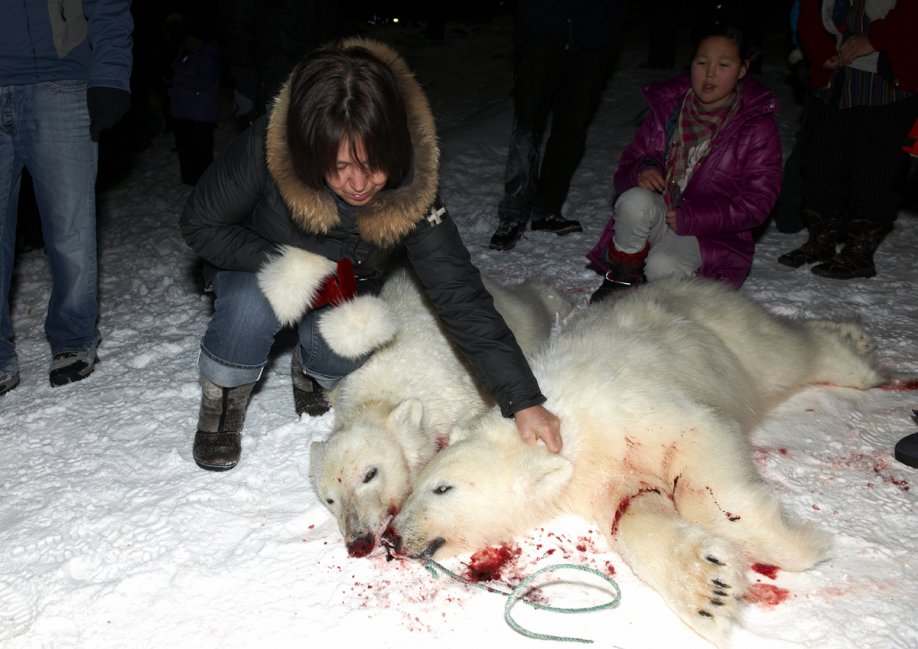
    Three polar bears were shot in Kulusuk, Greenland, yesterday. They drifted with sea ice to the town and were in search for food.

    A young girl approached the bears but the 13 year old thought they were dogs. Luckily she was not harmed, as the bears were shot shortly after. The mother and here two cubs were close to the airport in Kulusuk when they were first seen.

    The people tried to scare them away and thought they had succeeded. But the bears kept coming back and when the girl saw them yesterday afternoon they were shot.

    Although it was not the ideal end to the story, it was a necessity in this instance. The local elderly peoples home were given the meat but the fur was given to the government of Greenland.

    Source: Sermitsiaq

  • Barents-region ice free

    Barents-region ice free

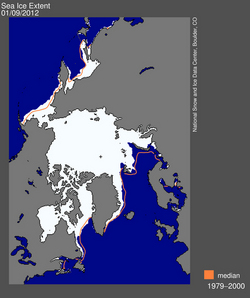
    The satellite image shows the difference from the median ice edge and the ice today

    Very little sea ice is in the Barents region for this time of year. This indicates that this trend will continue and sailing will become easier by every year.

    Satellite images show that the waters north of Spitsbergen and north of Novaya Zemlya is not covered with ice, which is unusual for this time of year.

    A NSIDC map from 9th of January clearly shows how little ice is in the area. The Kara gate and the Pechora Sea in the eastern Barents Sea are both usually ice-covered this time of the year, but not now.

    The entire west coast of Novaya Zemlya is also ice-free.

    Sources

    Barents Observer