Tag: Snow Dragon

  • Xuelong returns after historic voyage

    Xuelong returns after historic voyage

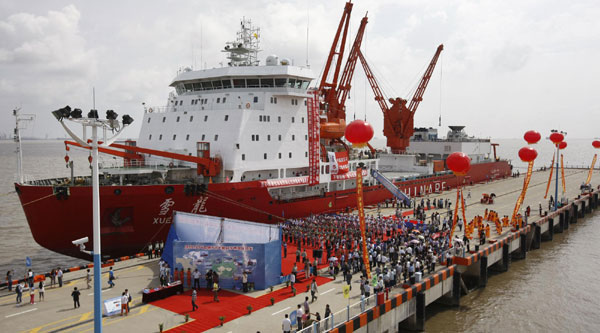
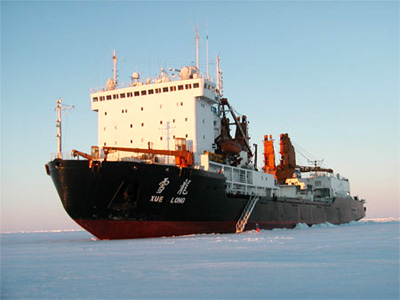
    Xuelong in the port of Shangai

    The historic voyage of the Xuelong, the Chinese icebreaker, was concluded yesterday when it returned to Shanghai. Xuelong, or the Snow Dragon, is the first Chinese vessel to complete a high-latitude voyage across the Arctic Ocean.

    The Xuelong travelled 18.500 nautical miles during the three month voyage, including 5370nm in the Arctic Ocean.

    A statement from the Polar Research Institute of China states that the expedition team has successfully performed various scientific research tasks. A total of 119 crew members were on board.
    The researchers conducted a systematic geophysical survey, installed an automatic meteorological station, as well as launched investigations on oceanic turbulence and methane content in the Arctic area.

    They also held academic exchanges with their counterparts in Iceland, and the two groups conducted a joint oceanic survey in the waters around Iceland.

    The CHINARE5, Chinas Fifth National Arctic Research Expedition, left the Chinese port of Qingdao on the 2nd of July. It arrived in Iceland in August and spent four days in the country, opening the ship to the public both in Reykjavik and Akureyri, as well as co-operating on symposiums in both towns.
    “It’s the longest Arctic expedition we’ve ever had in terms of both sailing time and distance,” said Chen Hongxia, a professor at the State Oceanic Administration’s First Institute of Oceanography, who participated in the voyage.
     

    “Unfortunately we didn’t reach the North Pole because Xuelong’s icebreaking capability isn’t strong enough,” said Wang Shuoren, political commissar of the icebreaker.

    China is designing a new icebreaker, which is scheduled to go into operation in 2014.

    Source

    China Daily

  • Successful journey of the Snow Dragon continues

    Successful journey of the Snow Dragon continues

    The Snow Dragon

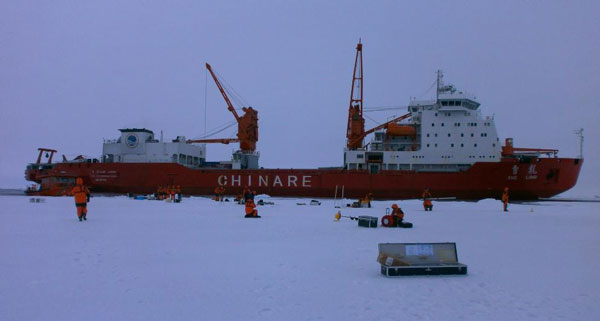
    The journey of the icebreaker Xue Long from Iceland to China, via the Arctic Ocean, has been successful so far. With the decreasing sea ice extent, the research ice-breaker has been able to sail through the Central Arctic Shipping Route without a support from nuclear powered vessel.

    Due to such an ice conditions, the research ice-breaker was able to operate via Fram Strait and carry on a high Arctic region to the east.

    Arctic sea ice extent fell to 4.10 million square kilometers on August 26, 2012. This was 70,000 square kilometers below the September 18, 2007 daily extent of 4.17 million square kilometers.

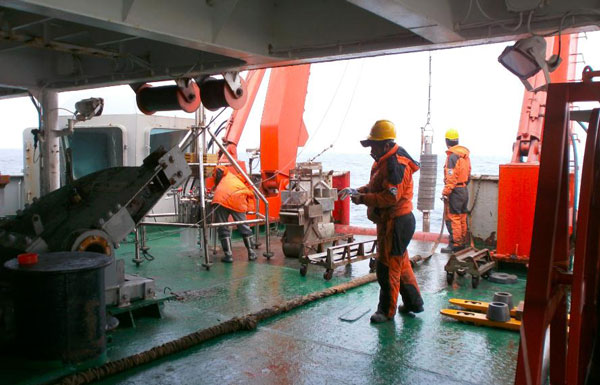
    Geological research: Gravity core launched in the Iceland Sea.

    Oceanographic, biological, geological and geophysical research was carried out in the Iceland Sea and Greenland Sea on the route north and meteorological observations are maintained throughout the expedition.

    Various satellite images are received for navigation through the sea ice.

    Benthic samples, from the shore lines of Icelandic waters were taken in order to prove benthos great increase in region that extends away from the land mass.

    Benthic sampling techniques are essential to habitat mapping studies since they provide the ‘truth’ data on the actual composition of the seafloor. When they are commonly used in conjunction with either a remote sensing or an acoustic technique, they are said to ‘ground truth’ seafloor classifications.

    Benthic sample from the Iceland Sea

    If samples are collected in high enough densities over survey areas they can be used to establish distributions and define habitats.

    Biological and geological/physical samples taken by the Geological Team from the Xue Long are to be taken separately from different grabs.

    Sailing out from Iceland, the Snow Dragon reached the region east of Jan Mayen, where in the good weather it was possible to see the Beerenberg volcano.

    It is the world’s northernmost sub aerial active volcano. The volcano is topped by a mostly ice-filled crater about 1 km (0.6 mi) wide, with numerous peaks along its rim including the highest summit, Haakon VII Toppen, on its western side.

    The upper slopes of the volcano were observed to be largely ice-covered, with several major glaciers including five which reach the sea.

    No scientific research was conducted by teams, nevertheless the elevation was difficult to be missed.

    Currently the vessel is heading up North, aiming to cross the North Pole. The ice conditions were reported as being almost 3 meters thick. The Snow Dragon is partly being followed by the Norwegian coast guard.

    Please, see the route of the Chinese research ice breaker on Interactive Mapping System.

    Source

    CHINARE5

  • The Snow Dragon bound for North Pole

    The Snow Dragon bound for North Pole

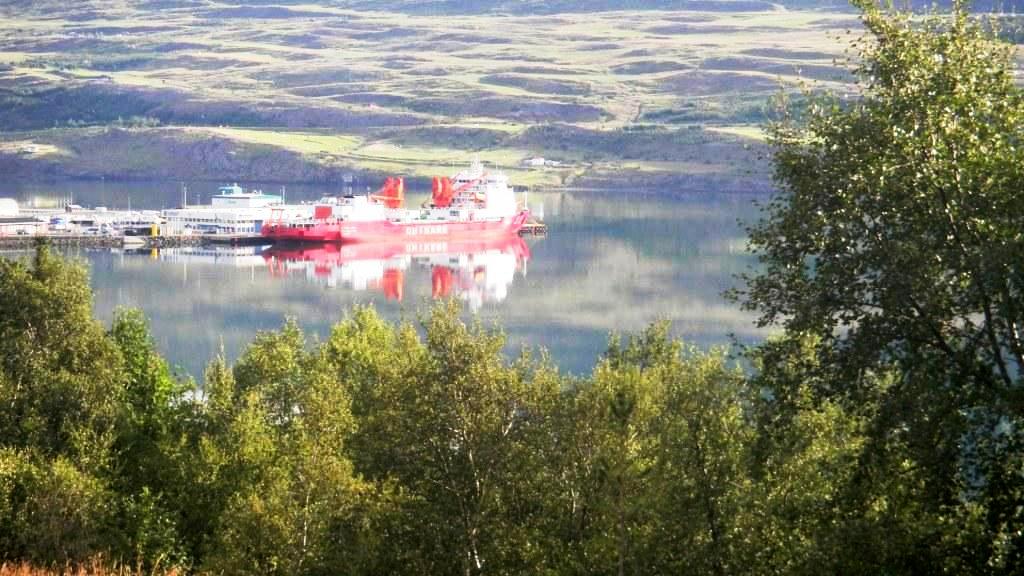
    Xuelong stationed in Akureyri, Iceland

    The Chinese research ice – breaker Xuelong, which left Akureyri in the northern part of Iceland, on Monday evening, is now on the way, to be the first non – Russian icebreaker to sail the transpolar route, straight across the top of the globe.

    Last week, the Snow Dragon completed the Northern Sea Route, reaching Reykjavik, Iceland on Saturday the 17th of August and then after spending the day in Akureyri, started the journey back to Asia.

    The scientists and the crew on board will try to prove that there is a future possibility of using Central Arctic Shipping Route for international navigation during the summer months.

    Currently, the vessel is just about to reach the Barents Sea.

    The M/V Xue Long is an A2-class ice-breaker with capability of breaking ice of 1.1 meters thickness. It was originally built as a cargo ship for Polar Regions by the Kherson Shipyard in Ukraine. After modifications in 1994 it became China’s first research ice-breaker. The vessel belongs to the Chinese Arctic and Antarctic research expeditions (CHINARE).

    The vessel is 167 meters long and 22.6 meters wide. It has a full-loaded draft of 9 meters, a full-loaded displacement of 21,250 tons and a cruising radius of 12,000 nautical miles. Two helicopters can be carried at the same time.

    Source

    Chinare5

  • Towards the North – Xuelong to reach Akureyri on Monday the 20th

    Towards the North – Xuelong to reach Akureyri on Monday the 20th

    Xuelong statistics

    On Monday, 20th of August 2012, the Snow Dragon, research ice – breaker from Polar Research Institute of China, is expected to anchorage in Akureyri in the northern part of Iceland.

    The venue will open for participants at 9.00 (Icelandic local time) with the speech given by the Chairman of Akureyri Town Council Geir Kristinn Aðalsteinsson and the Chinese Ambassador to Iceland – Su Ge.

    Recently, China has achieved dimensional developments of Arctic linkage, especially in understanding of the earth system and global climate change. To raise public and governmental awareness and interests Dr. Huigen Yang and Prof. Deyi Ma will give a presentation on “Chinese Polar Research and CHINARE 5” to highlight the main features of Chinese contribution to the Arctic science and promote international cooperation with regards to science and technology of polar research activities.

    The Icelandic Chinese science cooperation will be further discussed under the chairmanship of Dr. Thorsteinn Gunnarsson from Icelandic Centre for Research (RANNIS).

    China makes big efforts to understand Arctic environmental changes and nature´s evolution, therefore conjugate observation of dayside aurora and new Icelandic – Chinese Joint Aurora Observatory project will be presented and explained by Dr. Hu and Dr. Björnsson to encourage the exploration of unknown frontiers in the deep universe.

    The Snow Dragon on the way to Iceland

    New perspectives on Arctic shipping cooperation will be given by Mr. Egill Nielsson and Prof. Zhang Xia from Polar Research Institute of China jointly with Ms. Embla Oddsdottir from Stefansson Arctic Institute who will introduce the harmonious culture of sustainable Arctic Shipping.

    The rector of the University of Akureyri – Dr. Stefán B. Sigurðsson will be given his closing remarks before whole group will participate the working lunch hosted by the Town of Akureyri.

    The Xuelong will be open for external visitors on Monday, 20th of August from 12.00 – 16.00 p.m. Introduction to the open day will be conducted by the mayor of Akureyri and Chinese ambassador. The visitors will get a chance to meet the staff from Akureyri town council, University of Akureyri,Stefansson Arctic Institute, Arctic Portal and Icelandic Arctic Cooperation Network.

    CHINARE 5 will leave northern Iceland on Monday´s evening, turning its rudder towards Shanghai.

    Please, see the full schedule of Chinare5 Open Day.

    Source

    Chinare5

  • The 5th Chinese National Arctic Research Expedition

    The 5th Chinese National Arctic Research Expedition

    The departure ceremonyIn beginning July of 2012 the Snow Dragon started its expedition to the Arctic. The voyage was launched from Qingdao in China. The 5th Chinese National Arctic Research Expedition (CHINARE 5) will sail for around 6 weeks before reaching Iceland in August.

    The voyage to Iceland will strengthen the two countries Arctic research cooperation further and during its stay in Iceland the public will have an opportunity visit the Snow Dragon.

    Xuelong, the Snow Dragon, is the icebreaker of the Polar Research Institute of China (PRIC). It is the largest non-nuclear powered icebreaker in the world. It was built as an ice-strengthened cargo ship, in Ukraine in 1993 but is now a floating laboratory with state of the art facilities and equipment for polar research. It was modified in 1994. The Xuelong is 167m long, almost 23 meters wide and the ice class is B1 level, it can break through 1.1m of ice, including 20cm of snow by 1,5 knots continuously.

    It is both a supply vessel for the four research stations PRIC has, one in Svalbard and three in Antarctica, and a scientific research platform in both Poles.

    This will be the fifth expedition of the icebreaker in the Arctic; the others took place in 1999, 2003, 2008 and 2010. Although CHINARE 1 and 2 were only one-year projects they provided a framework for comparative research in the future within the investigated areas. CHINARE 3 and 4 were conducted under the International Polar Year (IPY) and raised the knowledge level in China about the Arctic’s rapid changes.

    The Xuelong, research vessel for the 5th Chinese expedition, is equipped with advanced systems for self-contained navigation and for weather observation, both extremely important qualities for polar expeditions. There are also excellent facilities for the scientist.

    The icebreaker has a data processing center and seven laboratories with over 500sq meters of working space, it has operational equipment, a freezer to store samples, a low temperature cultivation room, a clean laboratory, a marine biological laboratory, a marine chemical laboratory, a geological laboratory, and a CTD winch, a biological winch, a geological laboratory, and a hallow-section device of EK-500 model.

    (Map: Arctic Portal) The Snow Dragon´s expected route.

    Furthermore it contains three operating boats and a helicopter for the transportation and research purposes in the Arctic and Antarctic regions.

    China is now designing a new research icebreaker, to be launched in 2014. It will be equipped with the most advanced appliances for marine, polar and astronomical research. The icebreaker will be stronger then the Xuelong, able to sail through rougher ice conditions.

    The scientists and staff on board the Snow Dragon work in several fields of research. The field work area is very broad and covers Bering Sea, Chukchi Sea, Chukchi Plateau, Canada Basin and the High sea of Norwegian Sea.

    Several research points will be re-visited, from the other four Chinese National Arctic Research Expeditions. Most of them are located in the Bering Sea, the Chukchi area and the Canada basin.

    However, the High Norwegian Sea will be explored by CHINARE for the first time. China is famous from their research stations in Ny Alesund and Svalbard. The opportunity to explore the Norwegian High Sea greatly contributes to the stations ‘scientific research.

    The main subjects of research in the expedition are divided into four fields: physical oceanography and sea ice, marine meteorology, marine geology, marine chemistry and atmospheric chemistry, marine biology and ecosystem research.

    The research´s main objectives are to include the survey of the marine environment and sea – ice – air system, geologic record of rapid changes in the marine environment and the research on the carbon flux, nutrients and bio geochemical cycle in the Arctic.

    (Photo: Getty Images) The Snow DragonHowever, what is more important, during the expedition, the scientists try to study the impact of Arctic changes on Chinese climate and investigate the Arctic ecosystem response to global change.

    Click here to read more about the research fields during the 5th Chinese Arctic expedition.

    The expedition is jointly organized by the Chinese Arctic and Antarctic Administration (CAA) and the State Oceanic Administration of China (SOA). The Polar Research Institution of China (PRIC) is the research body of CAA.

    Please, be referred to CHINARE Portal to find out more about the expedition. To read more about the Arctic shipping, please access the Shipping Portlet and visit Interactive Mapping System.

    Source: Chinare Portal

    Source:

    Chinare Portal

    See also:

    Click here to enter the Arctic Portal News Portlet