Tag: speech

  • Heiðar Guðjónsson about Arctic Circle

    Heiðar Guðjónsson about Arctic Circle

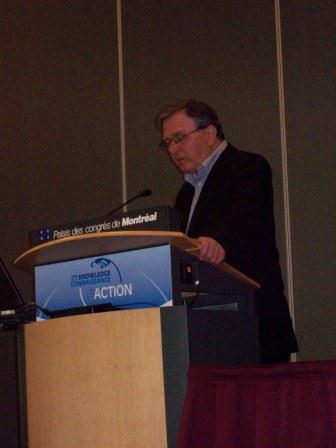
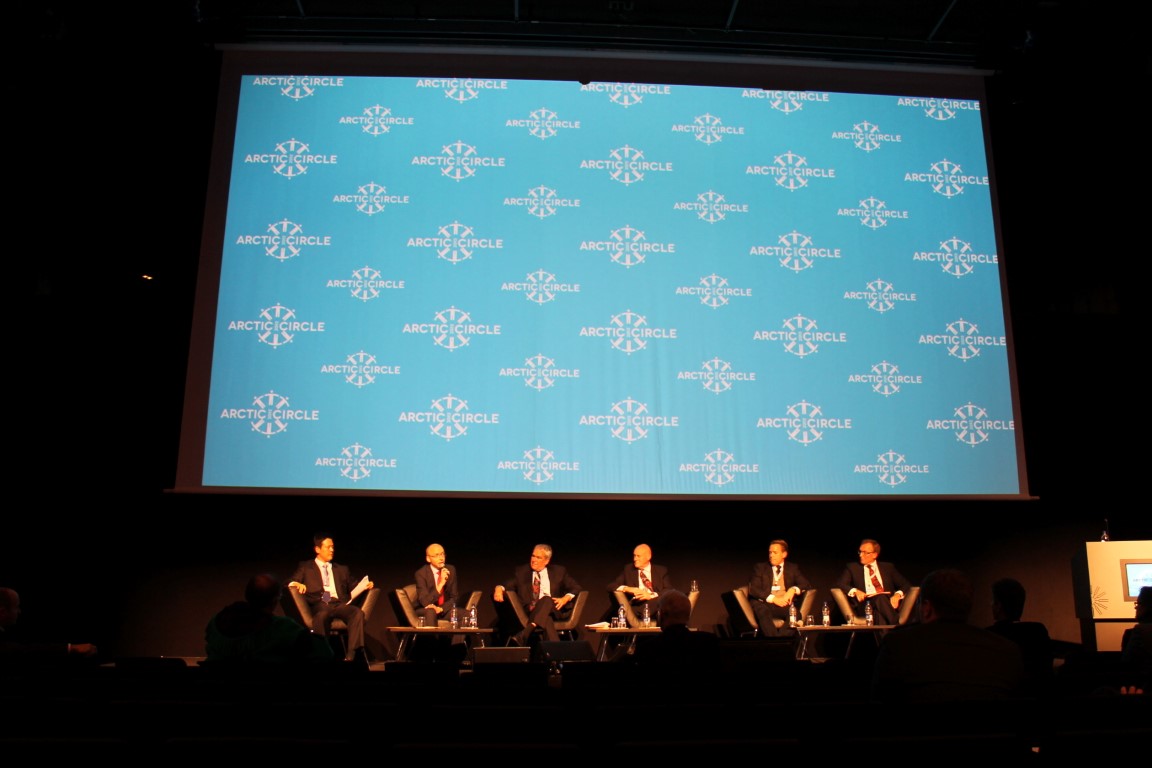
    Arctic Circle plenary session, Harpa, Reykjavik, Iceland

    Today, 16th of October, Heiðar Guðjónsson, the Icelandic economist and business specialist, gave a speech in Icelandic radio station Bylgian on outcomes from the Arctic Circle.

    He highlighted the opportunities that arise from melting Arctic sea ice not only for Iceland but also for other states to include Asian – Arctic partners such as China, Singapore and Korea.

    He stressed a need for economic cooperation between Arctic states with regards to Arctic natural resources exploration and exploitation.

    Arctic Circle took place in Reykjavik, the capital city of Iceland 12th – 14th of October 2013. It was established to facilitate dialogue and build relationships to address rapid changes in the Arctic.

    Participants in the Arctic Circle included a range of global decision-makers from all sectors, including political and business leaders, indigenous representatives, nongovernmental and environmental representatives, policy and thought leaders, scientists, experts, activists, students and media.

    Conference aims to strengthen the decision making process by bringing together as many international partners as possible to interact under one large “open tent”.

    The interview with Heiðar Guðjónsson can be accessed here (in Icelandic). To find out more about the Arctic Circle, please follow the link.
  • Putin speaks at the Arctic Forum

    Putin speaks at the Arctic Forum

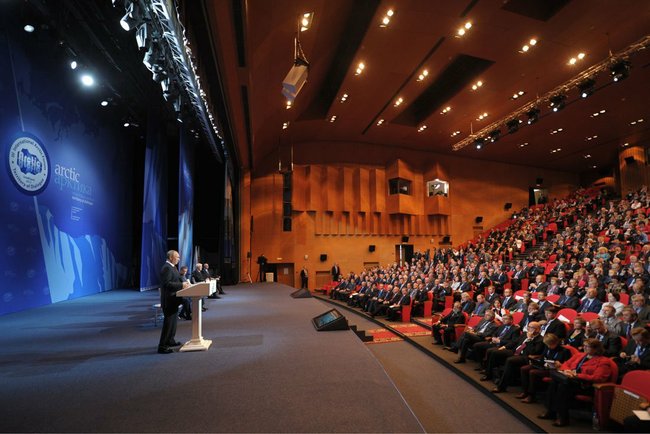
    Putin during his speech.

    President of Russia, Vladimir Putin, held a speech at the third international Arctic Forum, in Salekhard. The first such forum was held in Moscow in September 2010, the second – in Arkhangelsk in 2011.

    Click here for the Arctic Portal mapping system

    The main theme of the current forum is environmental security. The forum participants will discuss possible scenarios of climate change in the Arctic, the current level of pollution, the impact of its industrial development on indigenous peoples and a number of other issues.

    Taking part in the third international Arctic forum will also be President of Finland Sauli Niinist, President of Iceland Olafur Ragnar Grimsson, Russian Defence Minister Sergei Shoigu and many others.

    “Today more than ever, the Arctic needs particular care and attention. Russia, where the Far North regions make up almost a third of the country’s territory, is conscious of its responsibility for preserving the Arctic’s environmental stability,” Putin said in his speech.

    “Many of you here today know that we have adopted the Arctic Environmental Protection Strategy. We are using it as the base for drafting our State Programme for the Russian Arctic’s Social and Economic Development until 2020.”

    President Putin also underlined Russis intentions to clean up the Arctic, and said that the federal budget allocated 45 million US dollars to the cleanup.

    “I also note that we plan to extend considerably the network of nature conservation areas in the Arctic region. These specially protected natural areas currently make up around 6% of the Russian Arctic, nearly 322,000 square kilometres. Our plan is to increase this area several-fold.”

    Putin also stressed that coperation is high on the Russian agenda: “I want to reaffirm today Russia’s commitment to this declaration’s principles, and also to our desire to do everything possible to make the Arctic in practice a territory of partnership, cooperation and dialogue between countries and between the public at the broadest level.”

    Read Presidents Putin speech here.

  • French Arctic Marine Research introduced

    French Arctic Marine Research introduced

    Dr. Marie-Noëlle Houssais

    Today at the University of Akureyri, dr Marie – Noelle Houssais gave a speech on French contribution to the Arctic marine scientific research.

    For the past two decades France has been extremely active in contributing to main axes of Arctic marine research.

    Governmental and non – governmental organizations have been involved in monitoring and evaluating of the climate system, understanding the processes, underpinning its variability as well as estimating the future state of the Arctic and the potential impacts.

    Dr. Houssais highlighted socio – economic impacts of climate change in the Arctic to include marine transportation on northern sea routes, exploitation and extrication of marine living and non – living resources.

    France has a long history in both Arctic and Antarctic research activities and expeditions. Logistical support to polar activities in the country largely benefits Arctic and Antarctic projects.

    Dr. Marie Houssais is a Doctor of Sciences at Universitee Pierre et Marie Curie Paris Sorbonne (UPMC), an oceanographer physicist specializing in the polar regions. She was elected member of Scientific Council of the UPMC over the period 2008 – 2012. It was dr Houssais´ second visit to Iceland.

  • J.C. Gascard talks about new EU project

    J.C. Gascard talks about new EU project

    J.C. Gascard gives the speech on new EU Arctic - related  project

    J.C Gascard, representative from the LOCEAN in Paris, France, gives the speech on new EU project for Climate Change, Economy and Society (ACCESS) which is a joined call from different departments of European Commission.

    Under The University Pierre et Marie Curie coordination and involving 27 partners from 10 countries, the 4 years ACCESS project (Arctic Climate Change, Economy and Society 2011-2015) was selected in response to the first call ‘the Ocean of Tomorrow’ of the EU 7th Research and Development Framework Program (FP7-Ocean-2010) under Transport, Food, Agriculture and Fisheries, Energy, Environment, Socio-economic sciences and Humanities supervision.

    The main objective of ACCESS is to build the knowledge for a sustainable growth of sea-based activities in the Arctic a) by improving understanding of Arctic marine ecosystems’ response to a combination of natural and anthropogenic factors and b) by providing a scientific foundation for feasible, sustainable management measures supporting policies and related technologies.

    ACCESS will evaluate the latest Arctic climate change scenarios and establish their impacts on marine transportation (including tourism), fisheries, marine mammals and the extraction of hydrocarbons in the Arctic for the next three decades with particular attention to environmental sensitivities and sustainability.

    Understanding the socio-economic impacts of these changes on markets, economies and on European policy objectives along with their influence on Arctic governance, are key areas of research within ACCESS. An open and inclusive forum will give the opportunity to all stakeholders interested in the ACCESS consortium activities and cross-cutting research to interact with ACCESS.

  • Gro-Harlem wants bolder decision making

    Gro-Harlem wants bolder decision making

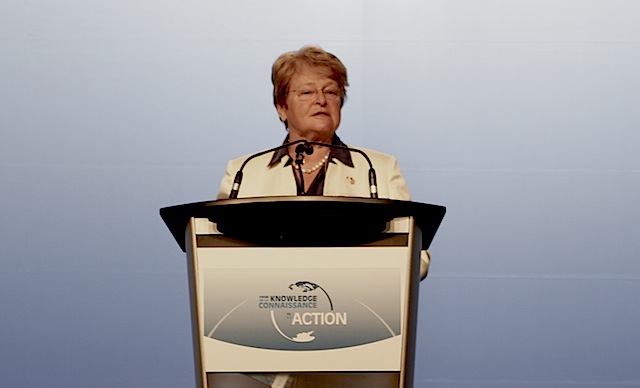
    Dr. Gro Harlem Brundtland making a speech

    Gro Harlem Brundtland said in her keynote speech at the IPY 2012 conference in Montreal that not enough has been done for the last 20 years in decision making regarding environmental issues. This years marks the 20 year anniversary of the Rio conference, where the all important Rio declaration was signed and ratified.

    Dr. Brundtland, the former prime minister of Norway and a special envoy of climate change to the United Nations, encourages for more cooperative research in polar sciences.

    “We also must ensure an easy access of data from the International Polar Year to the benefit of all researchers and communities,” she said before a crowd of over 2000 people in the Palais de Congrés in Montreal.

    “We must also develop and maintain the important research stations, where both all states and participants should work together,” she said, again encouraging cooperation.

    Talking about the progress after the Rio summit in 1992, she said that although some progress has been made, it is not enough. “Much has happened in 20 yeas, but not enough. Now, global warming is rapidly increasing, as well as the whorl population,” she said.

    Dr. Brundtlant also mentioned that in a report she delivered last January, it was projected that the world demand for resources world grow fast, especially for food, water and energy.

    “We need to identify what is important, the world needs to put scent on top for sustainability. The scientific research must point the way to the best decision making,” she said.

    Coming up this summer is the Rio+20 summit, where she sees reason for optimism. “We need bold decision making in the Rio summit.”

    She also identified polar research as more important then ever. “What is happening in the polar regions is more important for the whole world then we thought. Now we know its value,” she said.