Tag: students

  • UArctic Forum took place in Arkhangelsk

    UArctic Forum took place in Arkhangelsk

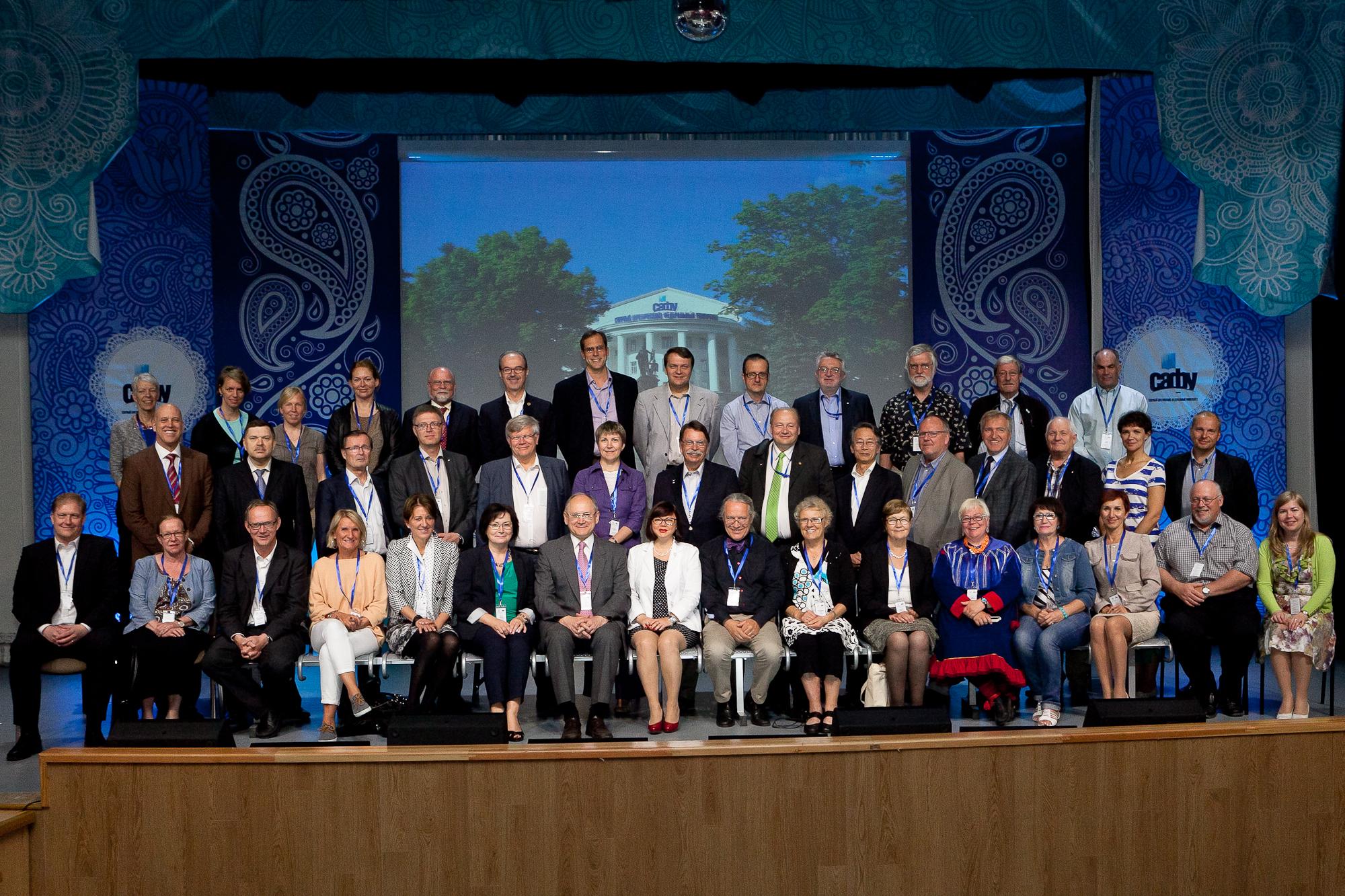
    Participants of UArctic Forum 2013

    26-30 June the 7th UArctic Rectors’ Forum took place in the Northern (Arctic) Federal University, Russia; Arkhangelsk hosted this Forum for the first time. Heads of universities, remarkable experts and students from eight countries discussed the development of the Arctic Region.

    The University of Arctic is a network of Arctic universities from different countries, not only northern ones. For example, there are Arctic universities in Japan and China. This proves the highest international interest to the Arctic and its resource potential.

    The Forum stressed such issues as logistics, development of infrastructure and transport system in high latitudes. The main task of the Forum was to discuss how the universities from different countries meet the “Arctic challenges”.

    The Forum was attended by 30 educational institutions involved in consortium of the University of Arctic. Representatives of foreign scientific foundations (such as NordForsk, program Fulbright etc.) contributed in the discussion about scientific cooperation and Arctic research.

    The participants shared views on international cooperation in the Arctic. They noted that northern territories have become an example of successful international cooperation for less stable regions. Russia gradually develops bilateral relations with traditional partners: Norway, Canada, and Finland. There are prospects for project development together with the USA, Denmark, Iceland, and Sweden. These prospects are connected to such issues as development of continental shelf, hydrography, and societal security.

    An important part of the Forum was devoted to environmental problems and climate change in the Arctic. For example, the effects of global warming make special requirements for certain types of work on the Arctic shelf and for hydro – meteorological support of navigation along the Northern Sea Route.

    Climate change will have both negative and positive impacts on the environment, economics and population of the Arctic region. Negative consequences of human activity change the environment, affect health and traditional way of life of local population. Positive effects of climate change also exist: heating costs reduce, and opportunities for agriculture, forestry navigation on the Northern Sea Route and extraction of mineral resources increase.

    There was a clear consensus among participants that universities should become regional research centers and formulate an Arctic agenda: initiate research and infrastructure projects in collaboration with business and government, train professional personnel for work in the Arctic. Joint research projects are also important since they give an opportunity to unite efforts of all UArctic member institutions.

    Source

    University of the Arctic

  • More scholarships for High North Studies

    More scholarships for High North Studies

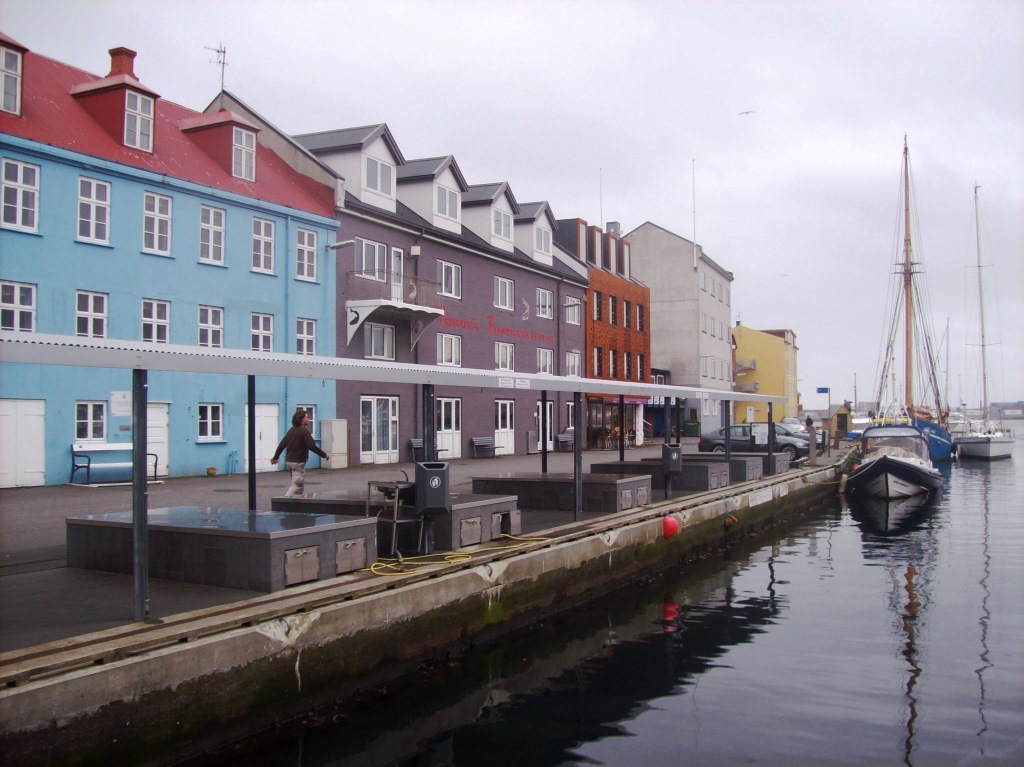
    Port Tromso - Northern Norway

    Students from the US, Canada and Russia have for five years been able to apply for scholarships for studies at seven universities and colleges in Northern Norway. In the program period for 2013-2016 also students from Japan and South Korea will have this opportunity.

    The goal of the Fellowship Programme for Studies in the High North is to contribute to increased academic collaboration and student mobility in the High North.

    The programme is open to the higher education institutions in northern Norway only: Finnmark University College, Harstad University College, Narvik University College, Nesna University College, Sami University College, University of Nordland, University of Tromsø and The University Centre at Svalbard (UNIS).

    These institutions will invite students at partner institutions in Canada, Japan, Russia, South Korea and the US to apply for High North Fellowships.

    The programme is mainly targeted at students at Master’s and Bachelor’s level but is also open to PhD students. Bachelor’s and Master’s students must take for-credit courses in Norway, while PhD students can come as research fellows.

    To learn more about the Program, please click here.

    Source

    Study in Norway

  • From everywhere but Antarctica!

    From everywhere but Antarctica!

    Field trip to Dynjandi

    A master’s program in Coastal and Marine management on the Western tip of Iceland sees students from all over the world engaging in Arctic studying. The University Center of the Westfjords hosts the program which is described as a cross-disciplinary program that prepares students for diverse positions in both the public and private sectors.

    Among courses thought are Iceland’s Environment and Natural Resources, Understanding the Coast and the Ocean, Underwater Heritage, Aquaculture and Marine Renewable Energy.

    The University of Akureyri cooperates with the studies, UNAK has specialized in fisheries science and related matters for many years.

    The program at the University Centre of the Westfjords has been running since 2008. Before the program started it sought recognition and quality control from the University of Akureyri which in the end is responsible for the diploma. The fifth years started this fall but in total 40 students have graduated, the first ones in 2010.

    The website also states: “Among the fields which the master’s program in Coastal and Marine Management prepares students to work in are resource and land use planning, environmental impact assessment, consulting work, teaching and research. The program is internationally oriented and taught in English, and both students and instructors come from a diverse range of countries.

    The master’s program in Coastal and Marine Management brings together people of different backgrounds who share their experience, knowledge, and ideas in a small-scale, creative and fertile intellectual environment, with the goal of finding ways of using natural resources in a sustainable way. We welcome new faces to join our exciting group of natural resource management specialists.”

    A total of 92 have started the studies, 40 graduated and 46 are currently studying. Only a few have have abandoned the studies. “The students love their graduation day; they have a whole fjord for themselves!” Dagný Arnarsdóttir, the Program director, told BB, a local newspaper. The graduation is held in Hrafnseyri in Arnarfjordur, famous for the waterfall Dynjandi.

    Field trip in the westfjordsAccording to program manager Ingi Björn Guðnason the program has used social media for advertisement to reach the right people. “We have used Google and Facebook ads to lead people to our website which has detailed information about the program. We have also used specialized websites for advertisement which show different programs for students who want to travel to study. Later we have been lucky that the word has simply spread out about the program which we can thank both the students who have a good experience from here and the teachers as well. They have helped advertising the studies in numerous ways. That is probably the most effective advertisement, positive feedback from the students who talk to their friends about it. This positive feedback has allowed us to cut back on advertisement costs which were running high in the beginning.”

    Ingi says that visits to the University Centers website have increased greatly after this program was founded. They have grown greatly and can reach 700 per day, but in total it has 95.000 visits for the last year.

    Structure

    The program has three semesters, fall, spring and summer, which runs from April to July. Next is a thesis but students need to post a detailed description of their intended study for acceptance of a concession committee. “This year we will have a specialized workshop for the thesis and the result is a thesis question. Most students are graduated within two years but if they want they can leave after the courses, which take 18 months,” Dagný says.
     

    Each course is thought in a session, ranging from 2 to 8 weeks. They include lectures and individual and group projects. “We also try to use new technology as much as we can. Tests in a class room can be necessary in some countries, but how knowledge is measured and assessed, can differ greatly. We try to offer real project in the field when we can. We also use role-play for example to discuss different aspects to subjects from different groups. I see different kinds of valuations for the Universities in the future. A new generation is coming up of both teachers and students are coming up and the schools will have to adjust.”

    Westfjords the focal point

    The location of the program is unique, in the West of Iceland, which has some of the most prosperous fisheries in the country, and breathtaking landscape. “We encourage students to do their projects about the area here and the result is that two out of three have written or done material about the Westfjords or its fisheries. Students have a reputation of wanting to give something back to the society here and by filling in gaps of knowledge about anything related to the studies, they do so, for example writing about sustainable coastal areas or exploitation and protection of the oceans and the coast. The students often have close cooperation with organizations and companies for their thesis work.”

    Puffin in Iceland

    Many nationalities

    “We get applications from all over the world but we have to limit the students to their capabilities with first grade or higher, their language skills (for example the TOEFL test) and if we can be assured that their material is authentic. Over the years most students have come from Canada but it’s getting more international and more Europeans have come in over the last two years. We have representatives from every continent now except for Antarctica!”
     

    “The students choose their projects in a number of manners, Icelanders tend to write a little bit more about Icelandic related projects, but international students do the same, they also write about Icelandic projects.”

    Diversity in teachers

    Since the program has very little structure, no permanent staff for example, the knowledge has to be sought from diverse backgrounds. Getting teachers and instructors over the years has run smoothly and they are both Icelandic and international. “This is a real sign of quality for us. We have very high standards and have specific goals to keep, and this shows quickly in the Icelandic university environment.”

    “After the studies the students have either continued to study, either doing PhD studies and other masters programs. Most often the students go to their homes for jobs related to the studies. Many of them have excellent jobs, a few work in project management, some are specialists in ministries, some in aqua centers or national parks. One runs the biggest national park in Canada, one has built a national Park in East Congo under very hard circumstances. And our students have kept in touch with the Westfjords and will be back with their families at some point! They help us in promoting the area, and Iceland.”

    Future prospect

    “The future will see the University Center promote the knowledge even better than before, for example by translation projects to Icelandic. Another aim is to maintaining the knowledge in the studies with the institutions in Iceland,” Dagný says.

    Sources

    Bæjarins Besta

    University Center of the Westfjords website


    See also:

    Click here to enter the
    Arctic Portal News Portlet
  • Programing to save the world

    Programing to save the world

    Team Hermes won the Imagine Cup in 2011.

    Students from all over the world are competing to change the world, with computer games. The Microsoft Imagine Cup finals will be held later this summer in Australia where students tackle the theme “Imagine a world where technology helps solve the toughest problems.”

    Imagine Cup is a student technology competition with three types of competition, software design, Game design for Xbox or Windows computers and Game design for phones. Every year, student competitors present creative technology solutions that address real-world challenges, and many of those solutions are in use today.

    The finals will be held in July in Sydney.

    The final projects are of different types, one team chose to make a video game about green energy and energy use. Roberts Quest is about a squirrel who embarks on a mission to clean up his city by gaining renewable energy sources. The team Radiant from Iceland made the game.

    The teams in the finals are from all over the world, for example from China, Brazil, Ukraine, Belgium, Iceland, Korea, France, Côte d’Ivoire, Dominican Republic, USA, Canada and Indonesia.

    A team from Microsoft’s 2011 Imagine Cup developed a process using a Windows Phone application to diagnose malaria.

    “It´s our world’s future innovators and technology leaders, our planet looks to you to lead the way in solving some of our greatest challenges. Lead with your mind and also with your heart, as both are required to make a difference,” says Jon Perera, Microsoft, General Manager, Academic Programs.

    Source

    Imagine Cup

    Morgunblaðið

  • Exchange Scholarships for Icelandic and Norwegian Students

    University of the Arctic

    Exchange Scholarships for Icelandic and Norwegian Students in Arctic Studies Application deadline: 15th May 2012, for the academic year 2012-2013

    The Ministers of Foreign Affairs of Iceland and Norway signed a three year Memorandum of Understanding in Akureyri on September 29, 2011, concerning co-operation in the field of Arctic scientific research. Exchange scholarships for Icelandic and Norwegian Students in Arctic Studies are one of the key activities in this co-operation.

    The scholarships in 2012/2013 will be 520€ per month for subsistence and a maximum 1.200 € travel grant. Minimum duration is one month and the maximum duration is 12 months.

    The eligibility criteria are the same as for Nordplus Higher Education grants for studies or work placements, with the addition that doctoral students are also eligible for support. Priority will be given to Master and Ph.D. students and students wishing to study at Norwegian and Icelandic universities that are members of the University of the Arctic network.

    Students should hand in their applications to the International office of their home institution.

    Following documents need to be part of the application:

    • Statement of purpose (500-1000 words) explaining the relevance of his or her planned studies or placement abroad for arctic research and education.
    • Scanned copy of approved learning agreement, at least by the home institution and preferably also by the host institution.
    • Transcript of records

    Source: University of the Arctic

  • Student registration open for Master’s level course on Adaptation to Globalization in the Arctic: The Case of Reindeer Husbandry

    Student registration open for Master’s level course on Adaptation to Globalization in the Arctic: The Case of Reindeer Husbandry

    Virtual Learning Tools

    The Virtual Learning Tools project is a cooperation between the Arctic Portal, University of the Arctic, APECS, ICR, SVS and Hsvest to create a virtual learning tool specifically designed for Northern residents. During this January a pilot course led by Phillip Burgess at the ICR will commence within the system, prior to a formal launch in June 2011.

    Below is the Course announcement released by the University of the Arctic:

    Climate variability, climate change and the societal/cultural transformations associated with globalization have been, and continue to be, responsible for major changes in the physical environment, the biota and the cultures of the indigenous and other communities in the Arctic.

    Human-ecological systems in the Arctic are particularly sensitive to change, perhaps more than in virtually any other region. This is due in part to the variability of the Arctic climate and the livelihoods of Arctic peoples. Production systems of Arctic peoples in variable and unpredictable climates are based on the sequential utilization of, often, a large number of ecological or climatic niches. The essence of such systems is flexibility and the distribution of risk through diversity.

    Understanding vulnerability requires assessment of systems’ ability to adapt to impact and the extent to which freedom to adapt is constrained. International law has established the right of indigenous people like reindeer herders to participate at all levels of decision making in issues that concern their rights, livelihoods and future, and it is therefore an issue to consider in discussing adaptation.

    The course uses reindeer husbandry as a case based study for understanding rapid change in the Arctic. The cumulative impacts of climate change and globalisation on reindeer husbandry will be looked at and examined in terms of their impacts on the livelihood. Key drivers of change, vulnerability and adaptation will be identified and tools and barriers for adaptation for reindeer herders will assessed.

    The course has been created in a joint collaboration between IPY EALÁT, the EALÁT UArctic Institute for Circumpolar Reindeer Husbandry, the International Centre for Reindeer Husbandry, the Sami University College, Kautokeino, Norway, the Thule Institute, the University of Oulu Finland and the UArctic.

    This course is a following up of the ACIA Report to the Arctic Council and is a delivery from IPY EALAT # 399 consortium with its diverse activities from 2007 -2010 including workshops, lectures, seminars, speed talks, outreach and research activities which were all video recorded for teaching purposes.

    The course development has been supported by the Nordic council of Ministers Arctic co-operation funding (2006-2009, Thematic Network on Global Change in the Arctic, 2009- 2011, Arctic Virtual Learning Tools).

    Course is open for students registered in any of the University of Arctic member organizations (www.uarctic.org). There will be no pre selection to the course but 20 students will be accepted in the order of registration. Please note that for successful completion of the course, students will need to have sufficient English language reading, writing and comprehension skills.

    Acceptance for the course with login and technical information will be emailed directly to students in December 2010. The course is hosted by the University of Oulu, Finland (Faculty of Humanities & Thule Institute).

    The deadline for registration is December 10th, 2010 and enrollment and further information registration is only available online at www.vlt.is

  • Year of the Inuit 2010

    Year of the Inuit 2010

    2010 Year of the Inuit is an educational campaign spearheaded by Inuit Tapiriit Kanatami, the national organization representing Canadian Inuit. Its goal is to increase awareness among the general Canadian population about issues facing the Inuit of Canada and celebrate Inuit accomplishments and achievements.

    This project includes a number of educational events and projects such as;

    Inuit

    Inuit Qaujisarvingat: The Inuit Knowledge Centre:

    Mary SimonThe Inuit Qaujisarvingat is a centre that is intended to bridge the gap between Inuit knowledge and Western science and build capacity among Inuit to respond to worldwide growing interest in Arctic issues. In early January national Inuit leader Mary Simon, president of Inuit Tapiriit Kanatami, formally announced the creation of the centre in Ottawa. Associated to the event Mary Simon was quoted by CBC News saying “We could actually do the research that is related to the North and the Inuit from the centre so that’s it’s more related to what we feel are the priority areas”. Further involvement of indigenous people as researchers is clearly something to rejoice over and watching the future growth of the Inuit Knowledge Centre will be very interesting.

    A Taste of the Arctic: An Evening Celebrating Inuit Culture

    “A Taste of the Arctic” was the kickoff event for the 2010 Year of the Inuit. Presented by ITK at the National Gallery of Canada, it was a fundraising dinner for the Arctic Children and Youth Foundation. It featured a presentation by Susan Aglukark and performances by Takralik Partridge and the Ottawa Inuit Children’s Centre. The inaugural ITK Award for Excellence in Arctic Journalism was presented to CBC Television’s Peter Mansbridge.” The event was attended by approximately 250 people including a number of high-level officials.

    Inuit Tapiriit Kanatami & Students on Ice scholarship:

    The students on Ice program is intended to provide youth from across Canada and the world the opportunity to participate in ship-based educational adventures in the two polar regions. Students on Ice educates and inspires the next generation of polar scientists, researchers, and environmental leaders by introducing them to these magical regions and increasing their understanding and respect for nature. From 2000 Students on Ice have enabled almost 1000 high school and university students from thirty countries have been able to visit the polar regions.

    Polar Bear

    Students on Ice in cooperation with the International Polar Year Federal Programs Office of Canada, Inuit Tapiriit Kanatami, and First Air will offer fully-funded scholarships for Canadian youth to participate in the upcoming Arctic Expedition. Those eligible for the grant are high school students between the age of 14-18. The scholarships will be distributed between Aboriginal youth and other students from across the country.

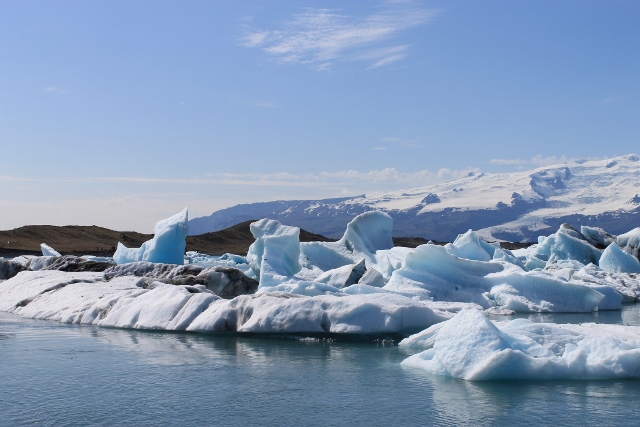
    Glacier

    Selection Criteria:

    • Applicant must be a Canadian citizen between 14 and 18 years old at the time of application. Applicant must currently be attending high school at the time of application.
    • Applicant must submit a completed application form with 2 letters of reference.
    • Applicant must submit a copy of Aboriginal Status if the applicant is an Inuit, First Nations, or Métis beneficiary
    • Applicant must submit a completed application form with 2 letters of reference.
    • Applicant must understand that this is an educational expedition, not a vacation. He/she must be committed to participate fully in all aspects of the education program.
    • Applicant must demonstrate some or all of the following qualities: strong academics and/or passion for learning, interest in the environment; leadership qualities and/or potential to develop these qualities; a desire to make a difference, become a polar ambassador, and an environmentally responsible citizen.
    • Applicants must act as ambassadors for his/her community and must be prepared to share their journey with the community and country before, during, and after the expedition. Students will be expected to be available for media interviews and to submit journal entries for the SOI Expedition Website and other blogs.
    • Applicant must have current Government-issued identification (with photo, if possible). Ex: Health Card, Driver’s License, Birth Certificate.

    Download the Students on Ice Arctic Scholarships application form in English