Tag: Svalbard

  • Starved polar bear perished in Svalbard

    Starved polar bear perished in Svalbard

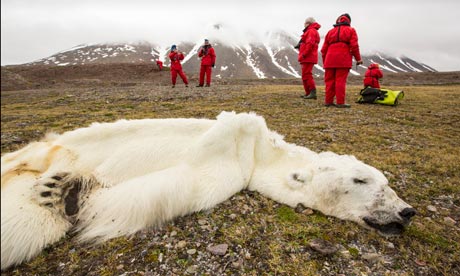
    Polar bear dead of starvation

    A starved polar bear found found dead in Svalbard as “little more than skin and bones” perished due to a lack of sea ice on which to hunt seals, according to a renowned polar bear expert.

    Climate change has reduced sea ice in the Arctic to record lows in the last year and Dr Ian Stirling, who has studied the bears for almost 40 years and examined the animal, said the lack of ice forced the bear into ranging far and wide in an ultimately unsuccessful search for food.

    “From his lying position in death the bear appears to simply have starved and died where he dropped,” Stirling said. “He had no external suggestion of any remaining fat, having been reduced to little more than skin and bone.”

    The bear had been examined by scientists from the Norwegian Polar Institute in April in the southern part of Svalbard, an Arctic island archipelago, and appeared healthy. The same bear had been captured in the same area in previous years, suggesting that the discovery of its body, 250km away in northern Svalbard in July, represented an unusual movement away from its normal range. The bear probably followed the fjords inland as it trekked north, meaning it may have walked double or treble that distance.

    Polar bears feed almost exclusively on seals and need sea ice to capture their prey. But 2012 saw the lowest level of sea ice in the Arctic on record. Prond Robertson, at the Norwegian Meteorological Institute, said: “The sea ice break up around Svalbard in 2013 was both fast and very early.” He said recent years had been poor for ice around the islands: “Warm water entered the western fjords in 2005-06 and since then has not shifted.”

    Stirling, now at Polar Bears International and previously at the University of Alberta and the Canadian Wildlife Service, said: “Most of the fjords and inter-island channels in Svalbard did not freeze normally last winter and so many potential areas known to that bear for hunting seals in spring do not appear to have been as productive as in a normal winter. As a result the bear likely went looking for food in another area but appears to have been unsuccessful.”

    Research published in May showed that loss of sea ice was harming the health, breeding success and population size of the polar bears of Hudson Bay, Canada, as they spent longer on land waiting for the sea to refreeze. Other work has shown polar bear weights are declining. In February a panel of polar bear experts published a paper stating that rapid ice loss meant options such the feeding of starving bears by humans needed to be considered to protect the 20,000-25,000 animals thought to remain.

    The International Union for the Conservation of Nature, the world’s largest professional conservation network, states that of the 19 populations of polar bear around the Arctic, data is available for 12. Of those, eight are declining, three are stable and one is increasing.

    The IUCN predicts that increasing ice loss will mean between one-third and a half of polar bears will be lost in the next three generations, about 45 years. But the US and Russian governments said in March that faster-than-expected ice losses could mean two-thirds are lost.

    Attributing a single incident to climate change can be controversial, but Douglas Richardson, head of living collections at the Highland Wildlife Park near Kingussie, said: “It’s not just one bear though. There are an increasing number of bears in this condition: they are just not putting down enough fat to survive their summer fast. This particular polar bear is the latest bit of evidence of the impact of climate change.”

    Ice loss due to climate change is “absolutely, categorically and without question” the cause of falling polar bear populations, said Richardson, who cares for the UK’s only publicly kept polar bears. He said 16 years was not particularly old for a wild male polar bear, which usually live into their early 20s. “There may have been some underlying disease, but I would be surprised if this was anything other than starvation,” he said. “Once polar bears reach adulthood they are normally nigh on indestructible, they are hard as nails.”

    Jeff Flocken, at the International Fund for Animal Welfare, said: “While it is difficult to ascribe a single death or act to climate change it couldn’t be clearer that drastic and long-term changes in their Arctic habitat threaten the survival of the polar bear. The threat of habitat loss from climate change, exacerbated by unsustainable killing for commercial trade in Canada, could lead to the demise of one of the world’s most iconic animals, and this would be a true tragedy.

    Source
    Guardian

  • Svalbard for petroleum activities?

    Svalbard for petroleum activities?

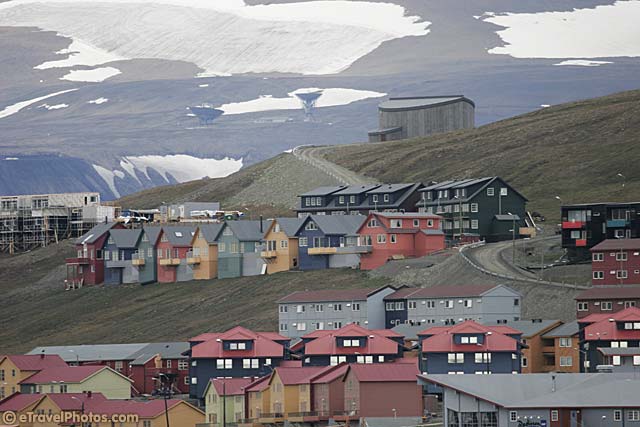
    Longyearbyen, Svalbard

    The Norwegian government is looking into the possibility of using Svalbard for oil and gas infrastructure. The unique nature of Svalbard has until now been thought to fragile for any kind of petroleum work.

    The increased petroleum activities in the northern seas are reaching Svalbard but it is said to be influenced heavily by geopolitics, politics, commercial interests and environmental protection.

    The Norwegian Ministry of Environment has asked for Svalbard to be evaluated as a world heritage site by UNESCO.

    In relation to that work, it will be assessed what impacts it would have on Svalbard to be any kind of use for petroleum activities in the northern Barents sea, these include logistics, supply, and land bases, says Eldbjørg Waage Melberg from the oil ministry.

    Oil analyst and former Secretary of State for Petroleum and Energy, Hans Henrik Ramm, believes it will be a huge mistake to look away from new business opportunities on Svalbard.

    „You must use balance different interests, including industrial opportunities. It is not reasonable to adopt protective measures to limit future choices, especially if it involves the transfer of decision making from Norway, as one does by seeking World Heritage status,” says Ramm.

    Norway produces coal in Svalbard but tourism and research are high on the agenda on the archipelago, as well as the Svalbard University Center.

    Sources

    Tekniske Ukeblad

    UNESCO

  • Norway shows military presence

    Norway shows military presence

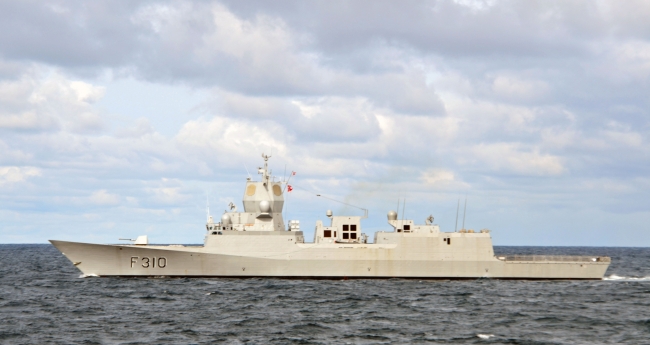
    KNM Thor Heyerdahl.

    Norway has decided to strengthen its security around Svalbard by sending its most modern warship to the archipelago.

    “Our main task is to show presence on Svalbard and in the surrounding waters”, Captain Per Rostad says to the Armed Forces’ web site.

    During the mission the frigate will conduct a series of drills, with other military units and the Norwegian Sea Rescue.

    Norway will send their best ship to Svalbard at least once a year but it has previously shown its presence when the Chinese icebreaker Xuelong sailed near Svalbard this summer.

    Source

    Barentsobserver

  • Abnormal heat in Svalbard

    Abnormal heat in Svalbard

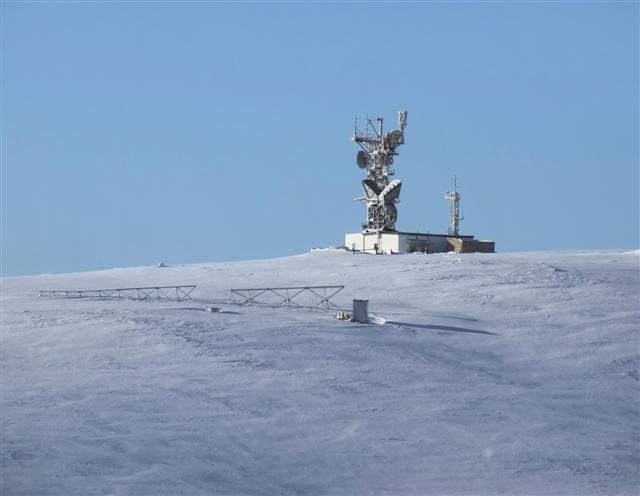
    Polar station in Svalbard

    The temperatures in Svalbard this year have been abnormal. The average temperature in the first three months of the year is around -13°.

    Now it has been around -2°, 11° above the normal number. But the inhabitants have also experienced record heat, avalanches, rain and ice-free fjords.

    The warmest day so far this year was February 8, with +7°C. Longyearbyen has had 90 millimeters of precipitation so far this year, nearly twice the normal.

    But this is nothing compared to Ny-Ålesund, where 97 percent of the normal annual precipitation came during the first 80 days of the year.

  • New drill for permafrost in Svalbard

    New drill for permafrost in Svalbard

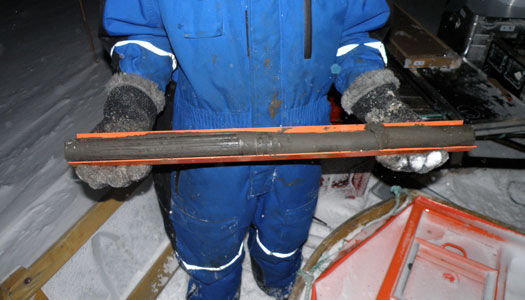
    Permafrost core

    The PAGE21 project, a new EU 7th framework collaborative research project which Arctic Portal proudly is a part of, will expand knowledge of permafrost in the Arctic. Drilling starts next week in Adventdalen, Svalbard.

    A total of 18 institutions from 11 countries are involved and UNIS is in charge of the field campaign in Adventdalen outside Longyearbyen that starts next week.

    The five main research field sites are Zackenberg in North Eastern Greenland, Abisko in Northern Sweden, Adventdalen and Ny-Ålesund in Svalbard, and Samoylov Island and Kytalyk in Russia. The individual key field research sites are collecting field data on the permafrost, such as determining its temperature, its amount of ice, the origin of the ice, and the distribution of permafrost landforms in the study areas.

    A new specially designed hydraulic drill rig has been bought for drilling. UNtil now the drilling has been hand made, down to only 2 meters. The new drill is able to collect cores from the permafrost in both sediments and bedrock down to potentially 50 m depth.

    The drill in testing in Svalbard

    The drilling that starts next week will collect up to 110m of permafrost cores from ice-wedge polygons, pingos and solifluction sheets in Adventdalen.

    The PAGE21 project combines field measurements of permafrost processes, pools, and fluxes, with remote sensing data and global climate models at local, regional and, for the first time, pan-Arctic scales.

    The output from this research will help to advance our understanding of permafrost processes at multiple scales, resulting in improvements in global numerical permafrost modelling and the ensuing future climate projections.

    Source: UNIS

  • Warm in Svalbard

    Warm in Svalbard

    Longyearbyen, Svalbard

    Svalbard is heating up, fast. Last week the heat was 1 °C, highly unusual for this time of year.

    Some call it a “strange winter” but the Average temperature over the last 30 days was minus 5,8 °C, in tial 9,3 °C above the normal.

    This is according to the weather data statistics for Longyearbyen made by the Norwegian Metrological Institute.

    Sea ice around Svalbard has also been unusually low.

    This corresponds to news saying that 2011 was a record in Arctic temperature.

    Sources

    BarentsObserver

    Norwegian Metrological Institute

  • Rabies intrudes Svalbard

    Rabies intrudes Svalbard

    Svalbard

    Rabies has been found in a polar fox and two reindeer in Svalbard. The archipelago has never before seen the disease which can be deadly for humans if infected.

    The disease can be infected by bite or other means and therefore the Governor of Svalbard has urged the public to avoid contact with dead animals or any animals that are behaving abnormally.

    At present, seven people have been administrated post-exposure prophylaxis. No human cases of rabies have ever been diagnosed in the area. The hospital in Longyearbyen offers rabies vaccination to the population

    Svalbard has a population of 2.700 people of which 2.200 are in Longyearbyen and some 500 in the Russian settlement of Barentsburg.

  • Polar bear attack in Svalbard

    Polar bear attack in Svalbard

    Polar Bear

    One person has deceased and four injured severely in a polar bear attack in Svalbard this morning. The incident happened at Von Postbreen, about 40 km from Longyearbyen.

    The injured were brought by helicopter to the hospital in Longyearbyen. They were then moved to Tromsö in Norway before transferred back home to Britain.

    A 17 year old male from Britain deceased and four others were seriously injured. They were travelling with a group of 80 with the British Schools Exploring Society, a youth development charity based in London.

    The bear was shot and killed after the attack. Although polar bears are common in Svalbard, they rarely attack people. From 1971, a total of five have been killed by polar bears on the archipelago.

  • Svalbard – At the End of the World

    Svalbard – At the End of the World

    Svalbard map

    If you would travel to the end of the world, where would you go? For some world ends in south, but if you would head north you would most likely end up in Svalbard, a group of islands between 74° – 81° N in the Arctic Sea.

    The islands were first discovered in the 16th century by a Dutch explorer Willem Barents and visited by many other nationalities during the next 300 years. Russian trappers were first to winter on the islands between 1715-1850. Norwegians on the other hand did not start regular hunting on the islands before the mid 19th century.

    Until the beginning of the 20th century, Svalbard, as the islands are called today, was “no mans land”. Many negotiations were held to establish a sovereignty over the islands and finally in 1920, a Spitsbergen Treaty was signed establishing a Norwegian sovereignty over the islands. In the Treaty, Svalbard was made a part of the Norwegian Kingdom, giving though all the signatory nations unrestricted right to natural resource exploitation. Due to this right small “foreign” mining communities have been established on the islands over the years, the biggest being the Russian settlement in Barentsburg with today some 500 inhabitants.

    Svalbard archipelago is 63 000 sq.km some 60% being covered by glaciers. Largest islands are Spitsbergen (37 673 sq.km), Nordaustlandet, Barentsøya, Edgeøya and Prins Karls Forland. Largest settlements on the other hand are Longyearbyen, Norwegian administrative centre, with 2 080 inhabitants, Barentsburg, Russian mining community, with 500 inhabitants, Ny-Ålesund, Norwegian international research centre, with 40 inhabitants, Sveagruva, Norwegian mining community, with 210 commuters and Hornsund, Polish research station, with 8 inhabitants.

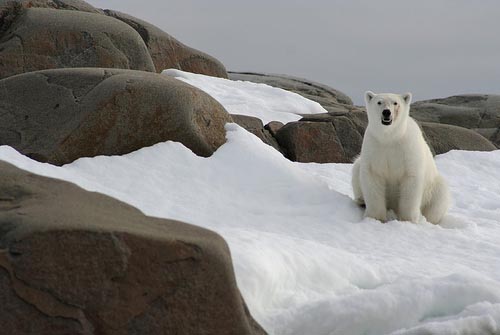
    Polar bear in Svalbard

    Despite of its harsh climate, Svalbard is a home for some Arctic animals. Svalbard Reindeer, Arctic fox, Polar Bear and southern Vole (a foreigner that has settled on the islands) inhabit the islands in addition to wide range of sea mammals and 36 species of birds that nest on the rocky mountain cliffs. Polar bear used to be hunted, but was protected in 1973 and today only 3-4 polar bears are killed yearly. Though the islands are well above the tree-line and only 6-7% of the land area is covered by vegetation a great variety of flowers can also be found in the islands.

    The main industries in Svalbard are mining, tourism and research. For long period the only industry found in the islands was mining, but recently eco-tourism and international research have become increasingly important.

    It is estimated that around 70 000 tourists visit the islands every year arriving either by plane or by sea. Great majority of the visitors are Norwegian, but mainland Europeans are increasingly visiting the islands as well. Most of the tourist, apart from the cruise liners visiting Svalbard for a day or two as part of a longer cruise, come to the archipelago for the extraordinary nature and extreme conditions. Different kinds of organized outdoors activities are among the most popular tourist attractions in addition to archaeological and mining museums, which can be found in Longyearbyen, Barentsburg, Ny-Alesund and Bear Island.

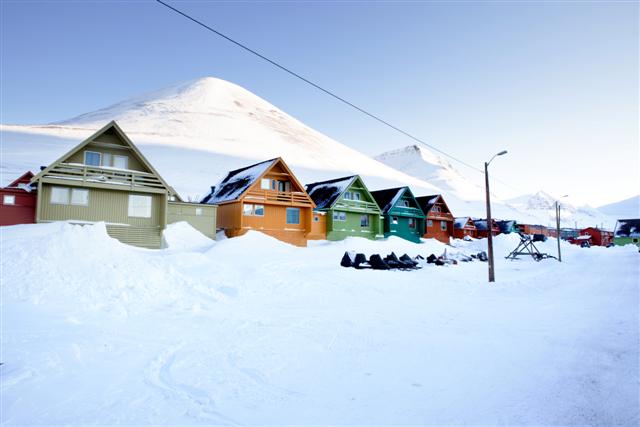
    Longyearbyen, Svalbard

    Svalbard is one of the main areas for Arctic research. Due to its geographical situation it offers an ideal insight in to the Arctic reality. Norway is by far the largest research nation in Svalbard accounting almost for half of the research days on the islands. Russians, Germans and Polish account together for another 40%, together with Norwegians accounting for 84% for the Svalbard research. Norway operates also a University Center in Svalbard (UNIS) which offers higher education at the undergraduate, graduate and postgraduate level in Arctic Biology, Arctic Geology, Arctic Geophysics and Arctic Technology. Yearly, approximately 350 students come to Svalbard for a shorter or longer period half being Norwegian students and half international students.

    Though at the end of the world, Svalbard offers a variety of interesting opportunities for work, education and travel for those interested in the Arctic. To learn more about Svalbard please visit the following homepages: