Tag: Trans arctic agenda

  • Why is this a global issue?

    Why is this a global issue?

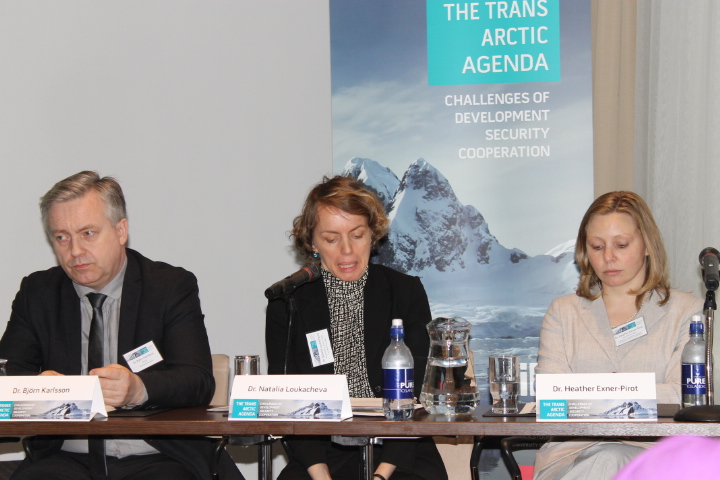
    Dr. B. Karlsson, Dr. H. Exner - Pirot and Dr. N. Loukacheva during the first session of Systems and Societies workshop.

    Second day of ”The Trans – Arctic Agenda: Challenges of Development, Security and Cooperation” has divided participants into three parallel sessions i.e. environment, economy, systems and societies.

    Although the Arctic is remote and lacks dense populations, it is under threat from environmental stresses largely originating in distant regions. The physical constitution of the Arctic dictates how the region reacts to environmental changes. With water occupying about two fifths of the area north of the 60th parallel, the region is essentially an ocean surrounded by land.

    Three main issues regarding the Arctic environment are climate change, changes in biological diversity, and the use of toxic substances. The effects of these changes are becoming increasingly evident in the North, affecting largely the people in the northern territories.

    Economic development and transfer of political power to the indigenous communities, establishing their fundamental rights to sovereignty was the matter for the dispute during the event as well as the risk managment and the international capability to face security challenges.

    The conference will continue until 18.00. After the closing remarks, participants will be hosted by the President of Iceland in his residence in Reykjavik.

    Please, click here to see the detailed schedule of the ”Trans – Arctic Agenda”.

    Source

    Institute of International Affairs – University of Iceland

  • Trans – Arctic Agenda starts today!

    Trans – Arctic Agenda starts today!

    Nexus

    Today, 18th of March 2013 a high-level seminar hosted by the Institute for International Affairs and Centre for Arctic Policy Studies, University of Iceland (IIA/CAPS), and the Stockholm International Peace Research Institute (SIPRI) – in cooperation with the Swedish and Icelandic Ministries for Foreign Affairs, starts in Reykjavik. The event will be held at Radisson Blu Hotel Saga.

    Keynote addresses by HE Mr. Carl Bildt, Minister for Foreign Affairs of Sweden and HE Mr. Össur Skarphéðinsson, Minister for Foreign Affairs of Iceland will be given at 18.00 in Radisson Blu Hotel Saga in Katla Conference Room.

    ”Nexus” Association invites to join their ”101 Arctic” a tech – in event on basic Arctic issues. This part of the event will take place at 14.00 in the conference hall of Icelandic National Museum. The event is open for the public.

    For more information, please visit the website of the Institute of International Affairs – University of Iceland.

    Source

    Institute of International Affairs Centre for Small State Studies – University of Iceland

  • Trans Arctic Agenda: Challenges of Development, Security, Cooperation

    Trans Arctic Agenda: Challenges of Development, Security, Cooperation

    University of Iceland

    On Monday, 18-19 March 2013 a high-level seminar hosted by the Institute for International Affairs and Centre for Arctic Policy Studies, University of Iceland (IIA/CAPS), and the Stockholm International Peace Research Institute (SIPRI) – in cooperation with the Swedish and Icelandic Ministries for Foreign Affairs. The event will be held at Radisson Blu Hotel Saga.

    Keynote addresses by HE Mr. Carl Bildt, Minister for Foreign Affairs of Sweden and

    HE Mr. Össur Skarphéðinsson, Minister for Foreign Affairs of Iceland

    The Arctic, where ice has so far been a barrier, could become an open bridge in the future between widely separated and different nations. Ice melting at sea and on land will open up new trans-Arctic transport routes and give access to new mineral and fishery resources, even while it disrupts traditional habitats.

    Whether fast or slow, these changes will affect first and foremost the countries around the North Pole who already cooperate through the Arctic Council. Yet the Arctic is also part of the wider world. New transport routes and tourism will attract both suppliers and customers from outside the region. Possible new Arctic energy production will affect the global energy balance and be affected by it. A badly managed Arctic would be a legitimate concern for the whole international community.

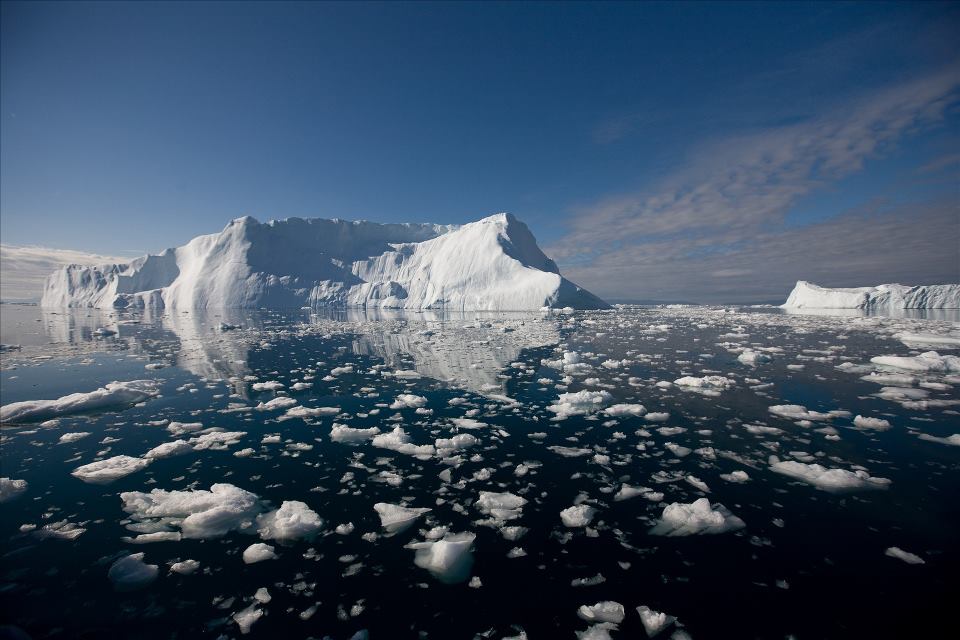
    Arctic coast and sea ice

    The Trans-Arctic conference will bring together experts and policy-formers from all the large and small nations most interested in Arctic developments. It will not look for national differences but for common agendas. It will ask if current governance methods are coping with the growing agenda or if not, what more could be done to ease cooperation at the state, business, and popular levels. It will end with special emphasis on the roles of the small Nordic states, and of Iceland itself – the only sovereign nation to lie entirely within the Arctic.

    Further information and a conference programme is available on the website of the Institute of International Affairs at: www.ams.hi.is

    The conference is open to all but we kindly ask you to register your attendance for planning purposes by sending us an email at ams@hi.is. no later than March 15.

    Sources

    Institute of International Affairs
    Centre for Small State Studies

    University of Iceland