Tag: Tromsø

  • Development for the People of the North

    Development for the People of the North

    Leona Aglukkaq during her speech

    The overarching theme of the Canadian chairmanship for the Arctic Council will be Development for the People of the North. Upcoming president Leona Aglukkaq declared this in a speech at the Arctic Frontiers conference in Tromsø.

    Canada will have three sub-themes. The first will be Responsible Arctic Resource Development, second is Safe Arctic Shipping and the third one Sustainable Circumpolar Communities.

    Aglukkaq introduced herself at the conference as Canada takes over from Sweden as the Chair of Arctic Council this year. Aglukkaq is a member of the parliament in Canada for Nunavut, growing up in the small community Gjoa Haven.

    “The traditional knowledge and expertise of the people living in the Arctic was crucial to the success of discovering a new frontier for Amundsen. And I believe it will also be the key to the future success of the Arctic Council.”

    “The quickly changing state of the Arctic region will present a new frontier for all of us in the next few years. We will be faced with challenges and opportunities – some will be positive, some perhaps not. But if we are to successfully navigate the future of the Arctic, we must build a bridge between the traditional knowledge of the people who live there, and the new realities of the present.”

    Aglukkaq has already met with Northern Canadians about the Canadian chairmanship and its priorities and since December she has met with all the Arctic Council states.

    “My discussions with my counterparts, members of the business community and representatives of the Sami have been very productive and informative. I heard a clear message during all of my domestic and international consultations: the well-being and prosperity of people living in the North must be at the forefront of Canada’s Arctic Council priorities.”

    Source
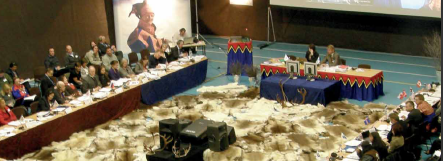
    Speech by Leona Aglukkaq

  • Gold and Thorium found in Tromsö

    Gold and Thorium found in Tromsö

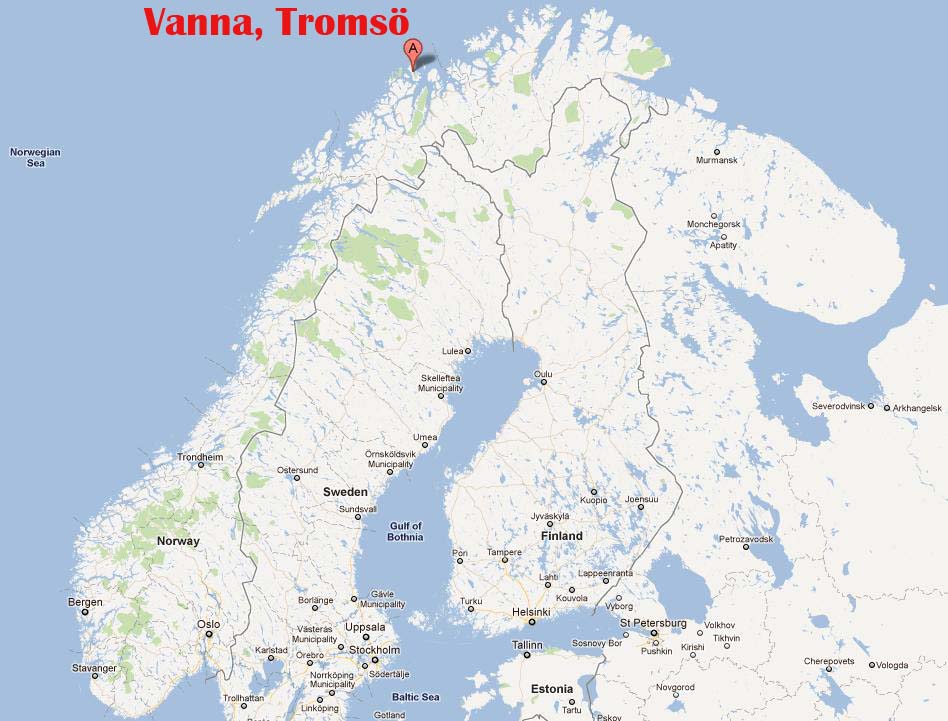
    Map of Vanna, Tromsö

    High gold prices have led to extensive search for the material. In northern Norway a new gold discovery could become very valuable, but the expedition not only found gold.

    In Vanna in Tromso, Norway, industrial chemicals were newly found; one of them is Thorium, a rare earth element.

    Thorium is a natural radioactive chemical element which countries plan to use for their nuclear power for various reasons, including its safety benefits, its high absolute abundance and relative abundance compared to uranium.

    It was discovered in 1828 and named after Thor, the god of thunder.

    Other material includes copper, platinum, nickel, zinc, lead and especially gold.

    Airplanes and helicopters were used for the studies the found was confirmed with further studies.

    Although the discovery has been made, there is no confirmation as of yet if production in the area will begin. Despite a lot of interest in the area, the amount still has to be calculated more accurately, the availability, distance to markets, capital, environmental, local interests, and many more will have to be taken into consideration first.

    Source: Aftenposten

  • Arctic Portal in Arctic Frontiers Conference

    Arctic Portal in Arctic Frontiers Conference

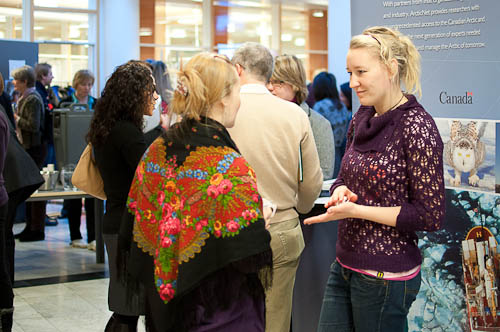
    Arctic frontiers in TromsoArctic Frontiers Conference 2010 in Tromso, Norway was the 4th international Arctic meeting platform for stimulating and motivating pan-Arctic integration. This year’s Arctic Frontiers theme was “Living in the High North”, and had special focus on challenges to the development of sustainable communities.

    The Conference is traditionally divided in to two sections; Policy section and Science section. This years Policy section had two sessions concentrating on Changes in strategies for the Arctic and Sustainable communities in the Arctic. The Science section was on the other hand divided in to four parts, each part representing different aspects affecting Arctic communities. Part I dealt with changes in ice and snow on land, in the seas, and in the ground (the cryosphere) and the distribution of Earth ?s heat and water. Part II concentrated on sustainable communities in the north focusing on the themes of economy, self-governance, well-being and health, while Part III covered issues on changing Marine Biodiversity in the Arctic.

    This years Part IV was of special interest of the Arctic Portal and its partners, the session dealing with E-learning in the High North. The aim of the E-learning part of the conference was to exchange knowledge and research about E-learning in the Arctic communities and regions and specify the learning processes, pedagogy, and appropriate information technologies relevant to distant learners in these communities.

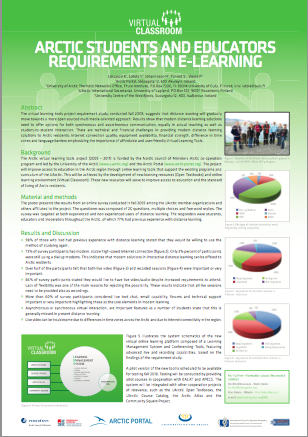
    Virtual Classroom posterThe Arctic Portal together with the University of the Arctic, University Centre of the Westfjords, International Centre for Reindeer Husbandry and Association of Polar Early Career Scientists is developing an online system that supports distance learning in the Arctic. This so called Virtual Classroom will be a virtual learning solution with a two-way communication between the teacher and students with open discussions and capabilities for classroom participation and real-time interaction. The Virtual Classroom will be accessible from any computer, giving that way inhabitants of small rural communities an opportunity to study without having to relocate to larger communities with traditional distance learning equipment / schools.

    The Arctic Portal, together with other project partners, participated in the Arctic Frontiers Part IV poster session introducing results from their user requirement survey conducted in fall 2009. The survey examined the needs and requirements of students and educational staff in UArctic member institutions, providing the project group as well the Arctic Frontiers a valuable information on how the users of theses systems experience current technology and pedagogical preferences.

    The main outcomes of the survey were that a real time interaction with the teacher and other students is highly appreciated. Many students felt that one of the downsides of distance learning is the lack of real time interaction within the class. In addition, many people thought that an access to a recorded lectures was highly preferable to enhance the learning experience. On the other hand, many students expressed their satisfaction with the contemporary distance learning arrangements, since it gave them an opportunity to organize their time and studies as they preferred independent of the schedule of the school.

    To learn more about the Virtual Learning project, please visit the homepage of the project

  • Arctic Council Ministerial Meeting in Tromsø

    Arctic Council Ministerial Meeting in Tromsø

    Arctic Council

    During this week 27th of April – 1st of May, Tromsø in Northern Norway will be the capital of the Arctic as the city is the venue for The Arctic Councils biennial Ministerial Meeting. Besides this event the Norwegian minister of Foreign Affairs, Mr. Jonas Gahr Støre, together with former US Vice-president, Mr. Al Gore, have called several of the worlds foreign ministers to a conference about the global warming. The conference entitled “Melting Ice: Regional Dramas, Global Wake-Up Call” takes place.

    The two meetings will gather around 400 of the worlds leading experts and politicians on Arctic matters. In addition round 80 journalists and photographers have announced their participation.

    At the end of the ministerial meeting the Chairmanship will be handed over to the Danish delegation. The new chair of the Arctic Council will be MFA Per Stig Møller

    Parts of the “Melting Ice” Conference are broadcasted live at the Arctic Portal Webcast, along with parts of the Arctic Council´s Ministerial Meeting. All videos presented will be archived at the Webcast Archive.

    About the Arctic Council

    Starting in the late 1980s, international cooperation in the Arctic has increased to the extent that a new regional identity is emerging, with numerous political initiatives and new fora.
    The so-called Murmansk Speech by President Mikhail Gorbachev of the Soviet Union is often regarded as the initiating event for current regional cooperation in the Arctic. It had still the Soviet rhetoric on peace but reflected more the processes of glasnost and perestroika in the Soviet Union through its six proposals. The first two were about establishing a nuclear-weapon-free zone in northern Europe and reducing military activities. The others discussed confidence-building measures in northern seas, civilian cooperation in developing natural resources, coordination of scientific research, cooperation in environmental protection, and opening the Northern Sea Route to foreign ships.

    SAO meeting in Kautokeino

    SAO Meeting, Kautokeino, Norway, November 19. – 20. 2008

    Intergovernmental Arctic cooperation officially started in 1989 with the Rovaniemi process in the wake of Mikhail Gorbachev’s Murmansk speech. At the first ministerial meeting in Rovaniemi, Finland, of the eight Arctic states, which also included three northern indigenous peoples organizations, the Arctic Environmental Protection Strategy (AEPS) was signed in June 1991. The initial focus on environmental protection gradually expanded to related fields, notably sustainable development. In 1996, the Arctic states replaced the AEPS with the Arctic Council as a high-level intergovernmental forum for Arctic international cooperation that would include as Permanent Participants a certain number of transnational northern indigenous peoples organisations. Therefore the Arctic Council was established as a high level intergovernmental forum to provide a means for promoting cooperation, coordination and interaction among the Arctic States. The Arctic Council deals with common Arctic issues, with the involvement of the Arctic Indigenous communities and other Arctic inhabitants. These issues are, in particular, sustainable development and environmental protection in the Arctic.

    For further information, please visit the Arctic Council homepage and Melting Ice: Regional Dramas, Global Wake-Up Call Conference homepage.

    Reference

    Arctic Human Development Report
    The Arctic Council

  • Arctic Indigenous Languages Symposium

    The Arctic Indigenous Languages Symposium will be held in Tromsø, Norway on 19-21 October 2008.

    On the Arctic Indigenous Languages website are published the goals of the symposium and the their vision statement. The vision statement and the goals are:

    The symposium is an exciting initiative that will bring together indigenous peoples from throughout the circumpolar region to build on each other’s knowledge and experience in protecting and revitalizing our indigenous languages.

    The symposium aims to be a forum where Arctic indigenous peoples can learn from one another and develop practical ways to revitalize our languages so they remain strong for generations to come.

    The languages symposium was mandated by the Salekhard Declaration, 2006, which stated that “Ministers representing the eight Arctic States, convening in Salekhard, Russia, for the Fifth Ministerial meeting of the Arctic Council, … Recognizing the cultural diversity in the Arctic represented by more than 40 distinct peoples, cultures and languages … Hereby:”

    Please check back to the Arctic Indigenous Languages website for the latest details on the symposium and many insightful background articles as well as video clips showing individuals from several Arctic peoples speaking their indigenous languages.

    To view Live Webcast from the symposium, please click here, on the Arctic Portal Webcast area. It is also possible to view the recordings of the symposium at the Arctic Portal Webcast Archive.

    “To enhance and promote Arctic Indigenous languages and all the Arctic knowledge contained therein”.

    Their objectives are:

    1. To share best practices from across the Arctic and elsewhere on enhancing and promoting Arctic Indigenous languages.
    2. To engage policy-makers and indigenous experts in discussion of the state of the languages and on revitalization strategies.
    3. To explore the role of language in understanding, maintaining, and increasing Arctic-specific knowledge.
    4. To investigate the many ways language is transmitted through cultural expressions, stories, and literature across the Arctic.
    5. To provide guidance and recommendations on circumpolar-wide language issues to the Arctic Council and indigenous peoples, as well as other bodies such as:

    Arctic states
    UNESCO
    UNPFII
    Other legislative jurisdictions responsible for Arctic Indigenous language policy
    Other interested groups, such as universities and research institutes.