Tag: UArctic

  • UArctic Forum took place in Arkhangelsk

    UArctic Forum took place in Arkhangelsk

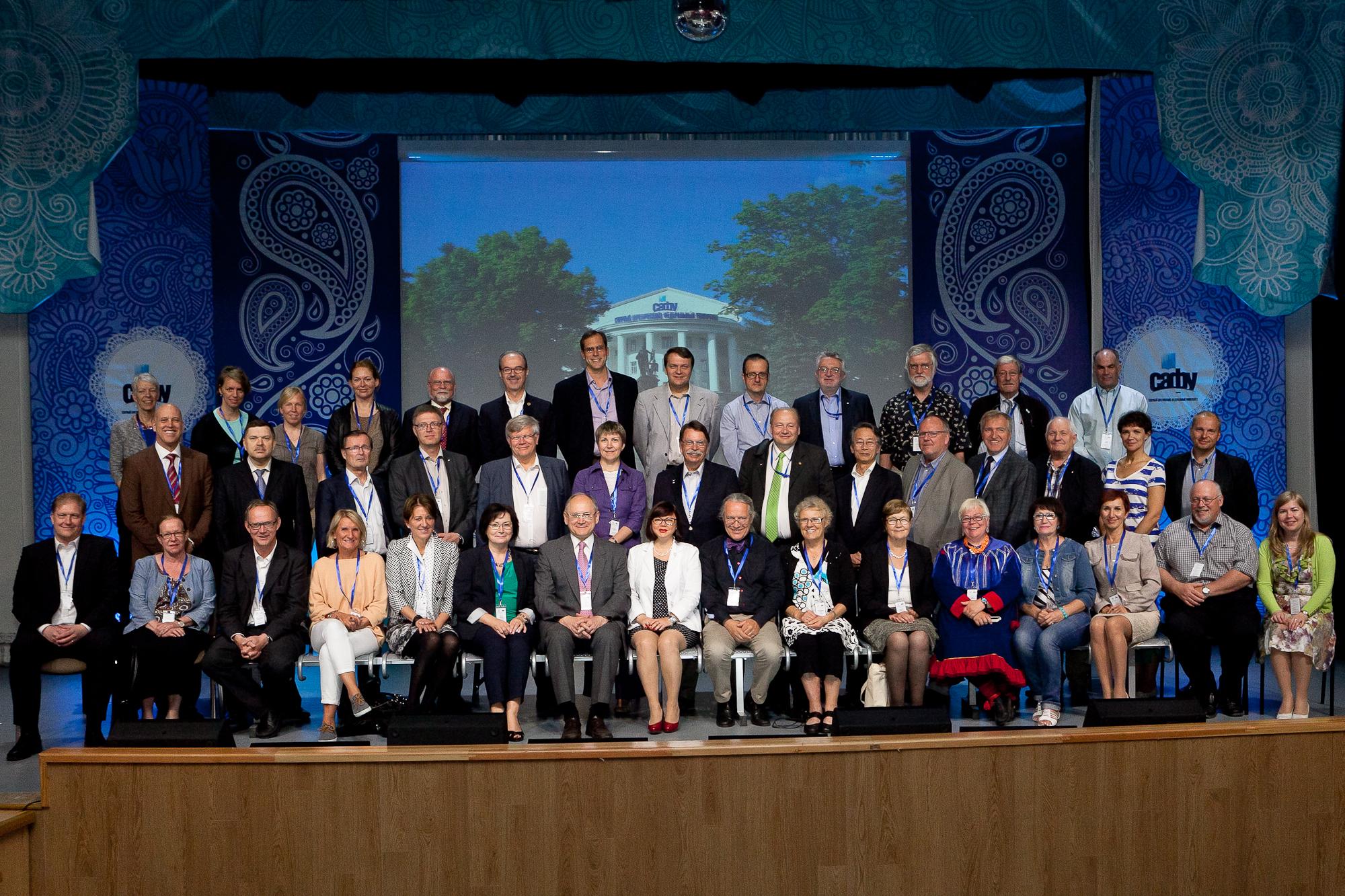
    Participants of UArctic Forum 2013

    26-30 June the 7th UArctic Rectors’ Forum took place in the Northern (Arctic) Federal University, Russia; Arkhangelsk hosted this Forum for the first time. Heads of universities, remarkable experts and students from eight countries discussed the development of the Arctic Region.

    The University of Arctic is a network of Arctic universities from different countries, not only northern ones. For example, there are Arctic universities in Japan and China. This proves the highest international interest to the Arctic and its resource potential.

    The Forum stressed such issues as logistics, development of infrastructure and transport system in high latitudes. The main task of the Forum was to discuss how the universities from different countries meet the “Arctic challenges”.

    The Forum was attended by 30 educational institutions involved in consortium of the University of Arctic. Representatives of foreign scientific foundations (such as NordForsk, program Fulbright etc.) contributed in the discussion about scientific cooperation and Arctic research.

    The participants shared views on international cooperation in the Arctic. They noted that northern territories have become an example of successful international cooperation for less stable regions. Russia gradually develops bilateral relations with traditional partners: Norway, Canada, and Finland. There are prospects for project development together with the USA, Denmark, Iceland, and Sweden. These prospects are connected to such issues as development of continental shelf, hydrography, and societal security.

    An important part of the Forum was devoted to environmental problems and climate change in the Arctic. For example, the effects of global warming make special requirements for certain types of work on the Arctic shelf and for hydro – meteorological support of navigation along the Northern Sea Route.

    Climate change will have both negative and positive impacts on the environment, economics and population of the Arctic region. Negative consequences of human activity change the environment, affect health and traditional way of life of local population. Positive effects of climate change also exist: heating costs reduce, and opportunities for agriculture, forestry navigation on the Northern Sea Route and extraction of mineral resources increase.

    There was a clear consensus among participants that universities should become regional research centers and formulate an Arctic agenda: initiate research and infrastructure projects in collaboration with business and government, train professional personnel for work in the Arctic. Joint research projects are also important since they give an opportunity to unite efforts of all UArctic member institutions.

    Source

    University of the Arctic

  • MobilityDK is now open for applications

    MobilityDK is now open for applications

    Spring in Faroe Islands

    UArctic is launching a MobilityDK pilot model, which provides travel support for student, teacher, and researcher mobility activities.

    MobilityDK is a part of the UArctic Danish Mobility Project, the goal of which is to support mobility for the Kingdom of Denmark’s Arctic education activities, and mobility from the Kingdom of Denmark to Arctic educational activities in different areas of the Arctic through the UArctic network.

    Financial grants are being offered in two separate categories. Teaching and research staff as well as students mobility provides financial support from and to Danish, Greenlandic and Faroese members of UArctic.

    The goal of the mobility is to support broad institutional networking within UArctic, contributing to the development of mobility agreements, joint research projects, joint education programs, and activities of Thematic Networks.

    Furthermore, the staff mobility is to promote initiation of new Thematic Networks with engagement from Danish, Greenlandic and Faroese institutions.

    The goal of the mobility is to support broad institutional networking within UArctic, contributing to the development of mobility agreements, joint research projects, joint education programs, and activities of Thematic Networks. Furthermore, the staff mobility is to promote initiation of new Thematic Networks with engagement from Danish, Greenlandic and Faroese institutions.

    The deadline for applications is August 15th 2013 and all decisions will be made by August 30th.

    MobilityDK is a pilot program to provide with financial support for mobility of students, teachers and researchers within the Kingdom of Denmark.

    The model is supported by the Danish Agency for Science, Technology and Innovation.

    For more information and to apply, please visit University of the Arctic.

    Source

    UArctic

  • UArctic plans future students portal

    UArctic plans future students portal

    arctic landscape during summer

    UArctic’s GoNorth program hosted a special workshop for members’ marketing and recruitment staff in conjunction with the Finnish International Educators Days, held in Levi May 20-23, 2013.

    The expert-led workshop sessions were designed to help staff at member institutions better promote themselves to potential students through the UArctic network and promoting the North as a destination of study.

    The direct outcome of the workshop is planning of a new UArctic student-focussed website, being developed through the ‘Global Access to Higher Education in the North’ project, funded by the Norwegian Ministry of Foreign Affairs.

    The project is a collaboration between the GoNorth Office at the University of Tromso, the UArctic International Secretariat at the University of Lapland, and the Northern (Arctic) Federal University.

    UArctic is a decentralized organization, bringing together higher educational institutions from all over the High North.

    Source

    University of the Arctic

  • 2013 meeting of the Council of UArctic

    2013 meeting of the Council of UArctic

    UAF campus

    The 16th meeting of the Council of University of the Arctic will take place at the University of Alaska, Firebanks (UAF), June 3-5th, 2013.

    Hosted by the University of Alaska Fairbanks, this year’s Council meeting will run from Monday, June 3rd through to Wednesday, June 5th, with an optional day trip to Denali National Park on June 6th (see Council 2013 – Preliminary program).

    Besides regular Council business, the 2013 Council meeting program will include a “UArctic Today – Introduction to UArctic” session which should be of particular interest to new members and new delegates; a couple of sessions to review and discuss the draft UArctic Strategic Plan 2020; side-meetings for Council Committees and Program Teams, as well as for North2north coordinators and partners (these meetings are by invitation only); and a members Networking session.

    To complete registration, access the UAF’s website. The information on the meeting venue, accommodation, travel arrangements and ideas for the things to do in interior Alaska are all available here.

    Fairbanks serves as the hub city for Alaska’s interior and a gateway to Arctic Alaska. Home to approximately 100,000 residents, Fairbanks has a diverse economy that includes mining, military, tourism, the University of Alaska Fairbanks and regional offices for state and federal agencies. The people of Fairbanks are known for their friendliness, self-sufficiency, dedication to community and pride in Alaska.

    Please, consult the Council’s website for more information.

    Source

    University of teh Arctic

  • UArctic´s Thematic Network

    UArctic´s Thematic Network

     UArctic´s network (Photo: UArctic)“In the North, for the North, by the North” – the motto of the University of the Arctic. It was founded in 2001 and is an international cooperative network consisting of universities, colleges and other organizations with an interest in promoting education and research in the Arctic.

    The overall goal of the University of the Arctic is to create a strong, sustainable circumpolar region by empowering indigenous peoples and other northerners through education, mobility and shared knowledge.

    One aspect of UArctic is it´s Thematic Networks. That increases cooperation between the member institutions on specific topics. Among the topics are Arctic Coastal and Marine Issues, Arctic Medicine, Energy in New Time, Global Change, Northern Agriculture, Northern Tourism and others.

    Each network has a leader and these leaders meet regularly to discuss what they have done, what they want to do and to get ideas and thoughts from their colleagues.

    The last meeting was in Akureyri, Iceland, late in January of 2012. Arctic Portal was there and captured videos of the meetings. Here are interviews with various people around the meeting.


    Lars Kullerud, president of UArctic, talks about the school, the thematic network and the meeting in Akureyri:
    http://www.youtube.com/watch?v=ouylRLLW_E0

    Kirsi Latola, director of Thematic Networks:
    http://www.youtube.com/watch?v=AjP33oblHYI

    Professor Karen Tanino, Dept. Plant Sciences, College of Agriculture and Bioresources, University of Saskatchewan , talks about Northern Agriculture Thematic Network.
    http://www.youtube.com/watch?v=fbY7-W91GOI

    Peter Weiss, Director of the University Center of the Westfjords, talks about the Arctic Coastal and Marine Themtic Network.
    http://www.youtube.com/watch?v=2ieCJU4Ro88

    Tomi Knuutila, University of Lapland, Finland, talks about Thematic Network Digital Media and Media Arts.
    http://www.youtube.com/watch?v=TtR0_yNm4pM

  • UArctic regrets Canada decision

    University of the Arctic 10 Years

    The University of the Arctic has released a statement following the decision by the government of Canada to cut its funding.

    The detailed statement quotes its president Lars Kullerud, stating the decision is regrettable, and it means that “at least two of UArctic’s signature programs – the Circumpolar Studies undergraduate program and the north2north student mobility program – now face significant challenges.”

    As already reported, The Canadian government cut the annual UArctic budget from $700,000 down to about $150,000.

    Here is a statement, in full, from the University of the Arctic:

    The recent decision by the Government of Canada to dramatically cut funding to the University of the Arctic will have a impact on not only  the ability of Canadian students to participate in UArctic programs,  but also thousands of other students around the circumpolar world who  benefited from them. UArctic has already taken steps, however, to  ensure the continuity of service of programs like Circumpolar Studies. The undergraduate program Circumpolar Studies has a unique history, in  which Canadians and Canadian institutions have played a key role.

    The curriculum was developed through the collective efforts of scientists, indigenous experts, and academics from across the circumpolar region who shared a vision that northerners should have a common understanding of the region that derives from their own perspectives, rather than from southern capitals. Much of this work to first develop, and later collective efforts to ensure update and further strengthen local input and quality, has been supported by the Government of Canada, and led by the University of Saskatchewan for UArctic members.

    The value of the work done in Canada can be seen clearly across the  pole in places like Bodø, Norway, Fairbanks, Alaska, Prince George, Thunder Bay and Nunavut in Canada, Rovaniemi, Finland and Yakutsk,  Russia where students who live and study in the North are taught the same Circumpolar Studies Program. At the Northeastern Federal University in Yakutsk, Russia, for example, every first year student  takes BCS100 – Introduction to the Circumpolar World – which resulted  in over 3000 students there learning from the same material as their  colleagues in Canada, Alaska, and the Nordic countries.

    The main impact of this cut in funding is that the University of  Saskatchewan, which has provided tremendous support to UArctic by hosting the Undergraduate Office first under Dean Greg Poelzer and most recently under Hayley Hesseln, is no longer financially able to  continue in that role. With USask’s assistance, UArctic is now transitioning the significant work done by the Undergraduate Office to the Northeastern Federal University (NEFU) in Yakutsk, which will take over the hosting of the Undergraduate Office with Claudia Fedorova being named the new dean.

    According to Hesseln, the root of the funding decision does not lie in any ill will on the part of the federal or territorial governments, nor certainly from any of the participating institutions, but rather from differing visions of how higher education in Canada’s territorial North should be developed. UArctic President Lars Kullerud agrees, stating that “Canada should pursue a physical university north of 60° – as exists in every other circumpolar country. The experience in other Arctic countries has shown that the best way for northern universities to demonstrate their value and deliver quality and relevant education is through cooperation in the University of the Arctic network. The vast majority of UArctic activities are led by institutions north of 60°. That some in Canada see these options as mutually exclusive has had the unfortunate effect of disrupting agreement between the territorial and federal governments that was the key to ongoing financial support for UArctic in Canada.”

    The UArctic International Academic Office (IAO) at Northlands College in LaRonge, Saskatchewan has worked closely with the Undergraduate Office to track students who complete the necessary requirements to earn a ‘Confirmation of Completion’ in Circumpolar Studies. To date, 174 students have graduated with a completion document, including fourteen from Northlands College itself.  Glenys Plunz, Director of IAO, has seen the impact of these graduates up close in her own community in northern Saskatchewan. Plunz notes that, “the significance of the Circumpolar Studies to a student from a small northern community is immeasurable, not only because of the academic achievement, but because the program has special relevance to them as northerners. Such offerings are equally relevant to the provincial North as for the territories.”

    Key to the success of these ‘circumpolar classrooms’ is the north2north mobility program. Lakehead University in Thunder Bay, Canada has helped coordinate Canadian students to go on student exchanges through north2north to Russia and the Nordic countries.  Lakehead professor Chris Southcott explains, “Canadian participation in north2north is key to the whole program, as it is based on exchanges between different regions of the Circumpolar North. Without  the resources to send a Canadian student to Iceland or Russia, it  becomes difficult for Canadian institutions to accept reciprocal exchanges from partners in those countries.”

    Figures from north2north exchanges back Southcott’s assessment, with Canada being the destination of choice for a quarter of all north2north students in 2010.  The elimination of mobility funding in Canada is especially unfortunate when many of Canada’s fellow member-states in the Arctic Council are making student and faculty exchanges an important part of their respective Arctic strategies. A Canadian student who has participated in both programs directly attributes his UArctic experience to his ability to secure his current job as a research analyst in the Canadian North. Harry Borlase, originally from Labrador, explains, “UArctic programs like BCS and north2north combine classroom learning with real life northern living.

    It’s exactly that combination that paints the big picture and prepares  you for your working career in the North.” UArctic President Lars Kullerud concludes, “The funding decision from Canada is regrettable, and means that at least two of UArctic’s signature programs – the Circumpolar Studies undergraduate program and the north2north student mobility program – now face significant challenges. However, UArctic is a circumpolar community of institutions  committed to cooperation in northern higher education, and will do all it can to support education opportunities in the North. Our Canadian members remain committed with their own resources to continue to be strong partners in this work while we wait for a resolution of the funding impasse in Canada.”

    The University of the Arctic is a cooperative network of over 130 universities, colleges, and other organizations committed to higher education and research in the North. Our members share resources, facilities, and expertise to build post-secondary education programs that are relevant and accessible to northern students. Our overall goal is to create a strong, sustainable circumpolar region by empowering northerners and northern communities through education and shared knowledge.

  • UArctic funds slashed in Canada

    UArctic funds slashed in Canada

    Lubov Radnaeva, secretary of the UArctic council and Lars Kullerud, president of the UArctic.

    The Canadian government has slashed its funding to the University of the Arctic from 710.000 to 150.000. Subsequently Canada will lose the office it hosted at the University of Saskatchewan, which was staffed by UArctic’s dean of undergraduate studies, Hayley Hesseln.

    Since UArctic’s launch in 2001, Aboriginal Affairs and Northern Development had contributed more than $4 million a year to UArctic – money that went, among other things, to develop its undergraduate circumpolar studies program, now offered through Nunavut Arctic College.

    Hesseln said the flow of money stopped when territorial governments expressed interest in pursuing their own institutions, and the vision of what a northern university should be.

    “We’ve reached a point where the federal government is interested in funding the University of the Arctic, but the territories want to do their own thing,” she said according to Nunatsiaq Online.

    The result is that Canada will have little say in the UArctic network’s curriculum development, she said, while Canadian students will have a more difficult time accessing its programs, offered through 33 Canadian universities.

    Founded in 2001, the network now boasts 121 institutions, 33 of them Canadian. UArctic has had more than 10,000 registrations for its courses since 2002, said Hesseln.

    “You have a lot of aboriginal students in the North and they don’t do as well when they come to a large southern institution. They will be more successful taking these courses online in their own communities.”

  • UArctic to produce next generation of polar researchers

    UArctic to produce next generation of polar researchers

    Lars Kullerud and Yelena Kudryashova

    The University of the Arctic’s research Office will be the place to find the next generation’s polar researchers, famous polar researcher Artur Chilingarov has stated. The formal opening of the office was at the International Arctic Forum in Arkhangelsk.

    Chilingarov is the Russian President’s special aide on Arctic and Antarctic affairs is appointed scientific leader of the University of the Arctic’s first research office.

    UArctic President Lars Kullerud sees the establishment of a research office as a critical step in creating a collective capacity for UArctic members to coordinate northern research.

    “Our goal is to educate students from northern universities for future positions in the Arctic Council and other international institutions,” said UArctic President Lars Kullerud at the opening.

    UArctic is a cooperative network of universities, colleges, and other organizations committed to higher education and research in the North. UArctic has members more than 140 member institutions in all eight Arctic states.

    The members share resources, facilities, and expertise to build post-secondary education programs that are relevant and accessible to northern students.

    UArctic is a decentralized organization, with offices, programs and other functions hosted at member institutions in the Circumpolar North. The administration is located at the University of Lapland in Rovaniemi, Finland. But until now the network has not had its own office for research.

    The University of the Arctic and Arctic Portal work close together on numerous projects.

  • UArctic reaches further north

    UArctic reaches further north

    Arkhangelsk on a map

    The University of the Arctic has opened a research center in Russian city Arkhangelsk.

    The Northern Arctic Federal University (NArFU) is seen as a critical step in creating a collective capacity for UArctic members to coordinate northern research, says UArctic president Lars Kullerud.

    The office will strengthen both the University and Russia. Kullerud notes that many UArctic members in the North are perceived as smaller actors, and risk being marginalized by larger institutions from outside the region when it comes to high level research projects.

    The new office will help to promote the collective capacity of these members and strengthen the role of northern institutions in Arctic research.

    The Research Office will be officially opened during the Arctic Forum in Arkhangelsk organized by the Russian Geographical Society The Research Office will first host a small seminar the previous day with UArctic and key external partners to discuss
    potential opportunities.

    UArctic

  • UArctic 10 Years – A History

    UArctic 10 Years – A History

    In Rovaniemi 8th of June 2011, the Council of the University of the Arctic (UArctic) celebrates the tenth anniversary of its launch, which was held in the same city in 2001. The occasion is being marked by a special seminar organized at the University of Lapland on the theme of Green Growth and the Arctic.

    The occasion is being marked by a special seminar organized at the University of Lapland on the theme of Green Growth and the Arctic, with keynote speeches from Ólafur Ragnar Grímsson (President of Iceland), Hannele Pokka (Permanent Secretary of Finland’s Ministry of the Environment), Gustaf Lind (Sweden’s Arctic Ambassador), and J. Okalik Eegeesiak (President of the Qikiqtani Inuit Association). The seminar discussions examined the question of whether a ‘Green Growth’ opportunity exists for the Arctic, or whether the destiny of the North is to remain an area of resource extraction.

    The Chair of the UArctic Council, Jim McDonald of the University of Northern British Columbia remarks, “It is only appropriate that the University of the Arctic returns to Rovaniemi to mark the first decade of its remarkable growth and development. Lapland has been the crucible for many important circumpolar processes. It should be noted that UArctic’s tenth anniversary coincides – not coincidentally – with the twentieth anniversary of the Rovaniemi process that began in 1991 with the Arctic Environmental Protection Strategy, which led to the establishment of the Arctic Council. The decisions taken here pave the way for our organization’s next ten years.”

    UArctic locationsThe history of UArctic goes long back, to a proposal made to the Senior Arctic Officials of the Arctic Council to look into the establishment of an ‘Arctic university.’ The subsequent work performed by the Circumpolar Universities Association laid the groundwork for the network and activities that exist today.

    On June 12, 2001, the University of the Arctic officially came into being. At a Launch event in Rovaniemi, Finland, two hundred people gathered to celebrate the realization of this dream. The organization was established with the principles of interdisciplinarity, circumpolarity and diversity. Its strength based on support not only by institutions of higher education and governments, but also that of northern indigenous peoples. In the first years after the launch, UArctic’s core programmatic activities were established with the Circumpolar Studies undergraduate program and the north2north mobility program. Enrollments in Circumpolar Studies and north2north exchanges now number many hundred, and these first students are already making their mark in northern science and public leadership.

    The UArctic International Secretariat was established at the University of Lapland, Finland, in 2001, and soon afterwards UArctic hired President Lars Kullerud to lead the activities and overall development of UArctic. UArctic’s administration was gradually distributed to offices in almost all Arctic countries. The establishment of Thematic Networks in 2005 marked a new direction in UArctic’s programmatic delivery, supporting new research and educational cooperation among smaller groups of members with common interests and expertise. This development was also supported by increased graduate-level programs including PhD networks and field schools.

    UArctic thematic networksThe University of the Arctic’s importance as an international actor was demonstrated in the role it played in the 2007-2008 International Polar Year, helping to coordinate the education and outreach activities resulting from the IPY’s international scientific research projects. The UArctic Rectors’ Forum first met in 2007, which provided a new opportunity for the leadership of the circumpolar region’s higher education institutions to address areas of common interest. To better serve its members, UArctic developed the GoNorth program to promote student recruitment to northern higher education institutions and the UArctic Catalogue as joint listing of course and program information from all members.

    UArctic has accomplished much to date in creating an empowered and sustainable North. It is telling that the organization’s original vision, goals and values remain valid today, while it has grown to meet additional needs and serve more areas of the Circumpolar North. The success of the organization can truly be seen, however, in the large numbers of students who have benefited from educational opportunities that would not have been possible without the University of the Arctic and the collective efforts of its members.

    Source: UArctic