Tag: virtual learning tools

  • VLT in the Circle

    VLT in the Circle

    the circle reindeer

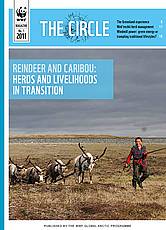
    A coverage about the Virtual Learning Tools (VLT) is in the latest issue of the Circle, which is a magazine produced by the WWF Global Arctic Programme. An interview is in the issue with Philip Burgess from the International Centre of Reindeer Husbandry (ICR). Philip is one of the instructor and organizer of the Masters program that is taught at the VLT, “Adaptation to Globalization in the Arctic: The Case of Reindeer Husbandry”.

    In the article, he mentions the pros of participating in an online course such as the one taught at the VLT environment “The flexibility of the online environment allows students to follow the course according to their own schedules (and time zones!) through a weekly live lecture which is also archived for later viewing”.

    The rapid technology is creating a smaller world, as Philip states in the article: “On a recent occasion, I was sitting I Toronto, Canada while a professor was delivering a lecture in Tromsø, Norway. Students were participating from Russia, Norway, Finland, Sweden, the UK, the US and Canada. But we were all together in a shared digital room (although perhaps it should be called a digital lavvu, or chum)”.

    The Circle is published four times a year. Each issue focuses on one specific Arctic-related subject, the topic in the newest edition being ocean acidification. The latest issue has a focus on reindeer herding and caribou, entitled Reindeer and Caribou: Herds and Livelihood in Transition. This edition focuses on a number of themes that are current in the world of reindeer and caribou. Articles cover global warming, wild reindeer in Siberia, oil and gas impacts on Nenets reindeer husbandry and the impact of wind power development on reindeer herding districts in Sweden.

    Latest Issue of the Circle – Reindeer and Caribou: Herds and Livelihood in Transition

    Virtual Learning Tools

  • Student registration open for Master’s level course on Adaptation to Globalization in the Arctic: The Case of Reindeer Husbandry

    Student registration open for Master’s level course on Adaptation to Globalization in the Arctic: The Case of Reindeer Husbandry

    Virtual Learning Tools

    The Virtual Learning Tools project is a cooperation between the Arctic Portal, University of the Arctic, APECS, ICR, SVS and Hsvest to create a virtual learning tool specifically designed for Northern residents. During this January a pilot course led by Phillip Burgess at the ICR will commence within the system, prior to a formal launch in June 2011.

    Below is the Course announcement released by the University of the Arctic:

    Climate variability, climate change and the societal/cultural transformations associated with globalization have been, and continue to be, responsible for major changes in the physical environment, the biota and the cultures of the indigenous and other communities in the Arctic.

    Human-ecological systems in the Arctic are particularly sensitive to change, perhaps more than in virtually any other region. This is due in part to the variability of the Arctic climate and the livelihoods of Arctic peoples. Production systems of Arctic peoples in variable and unpredictable climates are based on the sequential utilization of, often, a large number of ecological or climatic niches. The essence of such systems is flexibility and the distribution of risk through diversity.

    Understanding vulnerability requires assessment of systems’ ability to adapt to impact and the extent to which freedom to adapt is constrained. International law has established the right of indigenous people like reindeer herders to participate at all levels of decision making in issues that concern their rights, livelihoods and future, and it is therefore an issue to consider in discussing adaptation.

    The course uses reindeer husbandry as a case based study for understanding rapid change in the Arctic. The cumulative impacts of climate change and globalisation on reindeer husbandry will be looked at and examined in terms of their impacts on the livelihood. Key drivers of change, vulnerability and adaptation will be identified and tools and barriers for adaptation for reindeer herders will assessed.

    The course has been created in a joint collaboration between IPY EALÁT, the EALÁT UArctic Institute for Circumpolar Reindeer Husbandry, the International Centre for Reindeer Husbandry, the Sami University College, Kautokeino, Norway, the Thule Institute, the University of Oulu Finland and the UArctic.

    This course is a following up of the ACIA Report to the Arctic Council and is a delivery from IPY EALAT # 399 consortium with its diverse activities from 2007 -2010 including workshops, lectures, seminars, speed talks, outreach and research activities which were all video recorded for teaching purposes.

    The course development has been supported by the Nordic council of Ministers Arctic co-operation funding (2006-2009, Thematic Network on Global Change in the Arctic, 2009- 2011, Arctic Virtual Learning Tools).

    Course is open for students registered in any of the University of Arctic member organizations (www.uarctic.org). There will be no pre selection to the course but 20 students will be accepted in the order of registration. Please note that for successful completion of the course, students will need to have sufficient English language reading, writing and comprehension skills.

    Acceptance for the course with login and technical information will be emailed directly to students in December 2010. The course is hosted by the University of Oulu, Finland (Faculty of Humanities & Thule Institute).

    The deadline for registration is December 10th, 2010 and enrollment and further information registration is only available online at www.vlt.is

  • Arctic Portal in Arctic Frontiers Conference

    Arctic Portal in Arctic Frontiers Conference

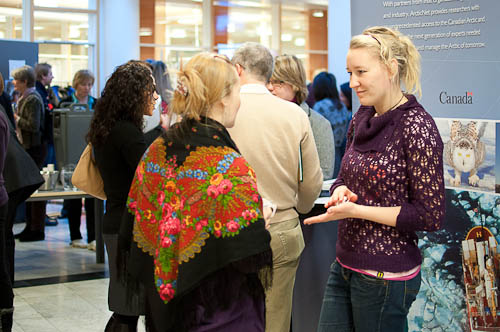
    Arctic frontiers in TromsoArctic Frontiers Conference 2010 in Tromso, Norway was the 4th international Arctic meeting platform for stimulating and motivating pan-Arctic integration. This year’s Arctic Frontiers theme was “Living in the High North”, and had special focus on challenges to the development of sustainable communities.

    The Conference is traditionally divided in to two sections; Policy section and Science section. This years Policy section had two sessions concentrating on Changes in strategies for the Arctic and Sustainable communities in the Arctic. The Science section was on the other hand divided in to four parts, each part representing different aspects affecting Arctic communities. Part I dealt with changes in ice and snow on land, in the seas, and in the ground (the cryosphere) and the distribution of Earth ?s heat and water. Part II concentrated on sustainable communities in the north focusing on the themes of economy, self-governance, well-being and health, while Part III covered issues on changing Marine Biodiversity in the Arctic.

    This years Part IV was of special interest of the Arctic Portal and its partners, the session dealing with E-learning in the High North. The aim of the E-learning part of the conference was to exchange knowledge and research about E-learning in the Arctic communities and regions and specify the learning processes, pedagogy, and appropriate information technologies relevant to distant learners in these communities.

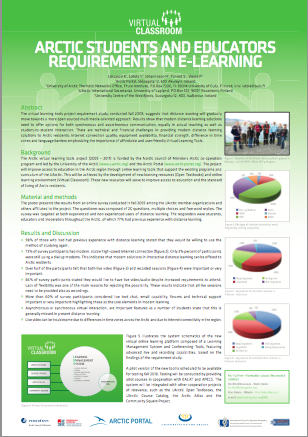
    Virtual Classroom posterThe Arctic Portal together with the University of the Arctic, University Centre of the Westfjords, International Centre for Reindeer Husbandry and Association of Polar Early Career Scientists is developing an online system that supports distance learning in the Arctic. This so called Virtual Classroom will be a virtual learning solution with a two-way communication between the teacher and students with open discussions and capabilities for classroom participation and real-time interaction. The Virtual Classroom will be accessible from any computer, giving that way inhabitants of small rural communities an opportunity to study without having to relocate to larger communities with traditional distance learning equipment / schools.

    The Arctic Portal, together with other project partners, participated in the Arctic Frontiers Part IV poster session introducing results from their user requirement survey conducted in fall 2009. The survey examined the needs and requirements of students and educational staff in UArctic member institutions, providing the project group as well the Arctic Frontiers a valuable information on how the users of theses systems experience current technology and pedagogical preferences.

    The main outcomes of the survey were that a real time interaction with the teacher and other students is highly appreciated. Many students felt that one of the downsides of distance learning is the lack of real time interaction within the class. In addition, many people thought that an access to a recorded lectures was highly preferable to enhance the learning experience. On the other hand, many students expressed their satisfaction with the contemporary distance learning arrangements, since it gave them an opportunity to organize their time and studies as they preferred independent of the schedule of the school.

    To learn more about the Virtual Learning project, please visit the homepage of the project