It is assumed from the existence of Stone Age rock carvings of whales that Neolithic folk knew of them, though it is not clear if their knowledge was from animals washed up or stranded on beaches, or weather they hunted whales, using boats to drive them to shore for killing. That technique, still used in the Faroe Islands today, was certainly in use in the 9th century Norway.
The construction of Whale Alley on Yttygran Island, which dates from a later, though still early, period, indicates that the ancestors of today’s Inuit were also hunting whales many centuries ago.
By the 16th century Basque fisherman from Spain, who has hunted whales in the Bay of Biscay and were already fishing cod near Newfoundland, began to hunt whales in that area. From written accounts and archaeological evidence they hunted around 450 whales annually. The species were Northern Right Whale and the Bowhead whale.
Harpoon is actually a Basque word and the Spaniard techniques were used by others because of their success. Around Bear Island and Svalbard many nations flocked to hunt whales, among them British and Dutch ships.
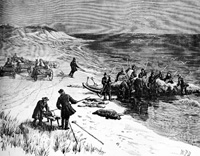
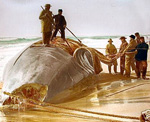
Large ships transported men to the whaling area, from the ships the men used rowing boats to get to the whales. The men killed the whale and towed it to the shore where the blubber was rendered and poured into barrels. The barrels were then loaded back to the big ship.
The shore station became larger and larger; a famous one on Spitsbergen in Svalbard can still be seen today, Dutch station Blubber Town. The infamous station is thought to have portrayed everything a town of 10.00 people needed, a bakery, a dance hall, a gambling hall and a brothel. The Archeological evidence suggest that this view is far from the truth, portraying a small town of 200 people at most, housed in barrack-like rooms, and an absence of clergy and women.
The Danes, French and Germans all sent ships to Svalbard to hunt whales. With British and Dutch ships growing as well, the whale stocks soon depleted. By the 1640´s the catch barely covered the cost of the voyage and Blubber Town was abandoned. Whaling in Jan Mayen also soon depleted after British and Dutch hunted until the stock fell immensely.
These meant greater distances had to be covered to hunt the whales. That resulted in more dangerous voyages and both ships and men were lost. In 1830 a total of 19 of 91 British ships were lost during whaling, 12 more were seriously damaged and 21 more failed to kill a single whale. Further loss of ships in the near future put an end to British whaling in the area.
Bowheads were also found in the Pacific. Because of huge amount of whale killing the Bowheads in the Bergin Strait found in the 1850´s were left in peace. At the same time Americans were hunting Sperm Whales both in the Atlantic and the Pacific. They had problems as well as the British and the whaling was dangerous for the Americans as well. Their losses and the development of petroleum industry that offered cheap alternative to whale oil meant an end to American whaling.
But better ships and a call for whale products for fashion meant that whaling did not stop at all. Americans put up a whaling station in Alaska, hunting Bowhead.
The figure how many Bowheads were killed vary between sources, but the most likely number is 120.000 to 150.00 in the whales eastern range (The Atlantic and Hudson Bay), around 20.000 in the Sea of Okhotsk and also around 20.000 in the Bering Sea.
The result was disastrous for the whale stocks. The Atlantic stock was counted in hundreds after whaling stopped but Pacific numbers were higher.
Today it is estimated that the Atlantic Bowhead population is still no more than 500-6000 animals (perhaps 450 on the western side, no more then 100 in the east). In the Pacific the number of Bowhead whales is thought to be around 6000-8000.
For the Northern Right whale the numbers are even worse, only around 400 animals are thought to live in the Atlantic and only around 100 in the Pacific. Stocks of the species are growing very slowly.
Treatment of the whales was thought to be very cruel. Some were towed for days while still alive and harpooning did not always kill the animals immediately.
For the whales in the waters of the Arctic fringe, the pursuit was equally relentless. The Sperm whale was the main target at first, Rorquals are another specie that was hunted after development in equipment, Steam boats and explosive harpoons, invented by Norwegian Sven Foyn, helped. Rorquals were mostly hunted in the southern waters but also in the Arctic fringe.
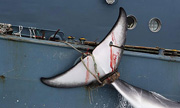
In 1986 the International Whaling Commission halted whale hunting. Japan, Norway and Iceland have issued scientific permits as part of their research programmes and therefore still hunt whales.
Recent discussions have centered on accusations that such permits have been issued merely as a way around the moratorium decision; these have been countered by claims that the catches are essential to obtain information necessary for rational management and other important research needs. All proposed permits have to be submitted for review by the Scientific Committee following Guidelines issued by the Commission but the ultimate responsibility for their issuance lies with the member nation, according to the IWC website.
The Scientific Committee comprises around 200 scientists, some nominated by member governments and others invited especially by the Committee itself.
Disputes arose but Iceland, Japan and Norway claim that stocks in their waters is sufficient for harvesting without endangering the populations. Opponents disagree and say that population numbers are disputed, and they whales should have the benefit of the doubt.
The main species the three whaling nations hunt are Minke whale, Fin whale and Humpback whales.
In Iceland in 2007, 39 common minke whales were caught under special permit in accordance with the original research proposal. A total of 200 common minke whales have been caught since the start of the research programme in 2003.
Japan has issued scientific permits every year in recent years. In the current year, permits are for the JARPA II programme (850±10% Antarctic minke whales, 50 fin whales and 50 humpback whales) and the JARPN II programme (340 minke, 50 Bryde’s, 100 sei and 10 sperm whales) are allowed.
Norway has not sent a scientific permit for a few years.
The IWC set catch limits for stocks subject to aboriginal subsistence whaling.
That means native people in Alaska (USA), Chukotka (Russia), Washington State (USA) and Greenlanders cam hunt whales, along with St Vincent and The Grenadines.
Alaskans and the people in Chukotka can land 280 bowhead whales in 2008-2012 (67 each year at the most) and a total of 620 gray whales in the same time period (140 each year at the most).
In St. Vincent and the Grenadines the number of humpback whales in the four year period is 20.
Greenlanders can land in these four years 12 east common minke whales, 2 west bowhead whales, in the time period of 2010-2012 they can land 16 west Greenland fin whales, 178 west common minke whales and 9 west Greenland humpback whales.
Sources: The Arctic by Richard Sale & IWC website
 The IWC has since the late 1970s been dominated by countries largely opposed to commercial whaling. Since 1986 there has been a moratorium on whaling, functioning as an all out ban on commercial whaling with an exemption of indigenous subsistence whaling and whaling for scientific purposes. This decision was not based on advice from the Scientific Committee ( an advisory committee within the IWC) and has been disputed by pro whaling nations ever since.
 Under the chairmanship of William Hogarth, compromise talks began formally a year ago but have yielded little results so far, as nations have taken a strong stances and have not been willing to budge an inch making negotiations futile.