Tag: Yamal Peninsula

  • Sabetta port becomes a reality

    Sabetta port becomes a reality

    Computer image of future Sabetta port

    Construction of Sabetta port, a key component in the huge Yamal LNG project, is now planned to start this summer.

    It is predicted that the Sabetta port will become one of the biggest in the Russian Arctic. Located in the Yamal Peninsula, it will boost shipping in the icy waters of the Ob Bay and the Northern Sea Route.

    Project Manager – Maksim Minin officially announced that the project has been delivered to the contractor and is ready to be reviewed by the state expert panel.

    The new port, a joint initiative of the Novatek company and Russian federal authorities, will be a key component in the development of the gas-rich Yamal Penisula. Linked with the South Tambey field and a major projected LNG plant, the port will be built to handle more than 30 million tons of goods per year.

    Sabetta port is planned to be operational all-year-round, despite the highly complex ice conditions of the Ob Bay.

    The total investments in the Sabetta port project amount to 75 billion RUB (€1,82 billion). The Russian government is investing 49 billion RUB (€1,19 billion) while private investments amount to 25 billion RUB (€607 million).

    The Yamal LNG project is developed by the JSC Yamal LNG, a joint venture of Novatek (80%) and Total (20%), and in close cooperation with the Federal Agency of Sea and River Transport and the Rosmorport state enterprise.

    Source
    Barents Observer

  • Russia opens second largest gas field

    Russia opens second largest gas field

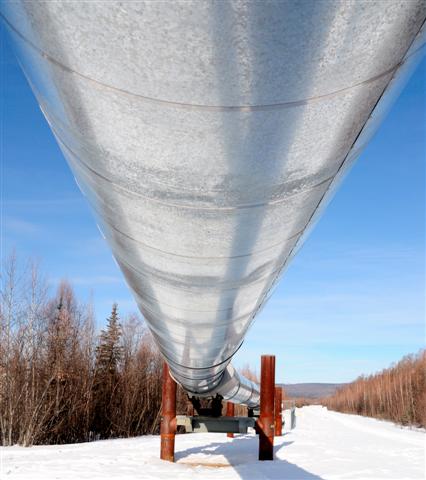
    Russian oil pipeline

    Russia opened its latest gas production site this week. President Vladimir Putin formally opened the commercial production at the Bovanenkovo field on the Yamal peninsula in extreme northwestern Siberia.

    The discovery of the site by the Soviets in the early 1970s created excitement and frustration in equal measure. The excitement was because of the huge potential, the frustration because of the severe ice conditions, permafrost and remoteness.

    Now the site has opened up and Russian energy giant Gazprom estimates to be 4.9 trillion cubic meters (177 trillion cubic feet) of natural gas in the field – making it one of the world’s three largest deposits.

    “The field will produce 115 billion cubic meters (4,060 billion cubic feet) of gas and that will go up to nearly 140 billion,” Putin told the field’s workers by live video.

    “This is nearly the equivalent of how much we export to Europe,” Putin stressed.

    The giant field is second in size in Russia only to Gazprom’s Urengoi deposit to the south. It is a part of an Arctic project that Gazprom has been pinning its hopes on as older wells run dry.
    Source:
    AFP
    See also:
    Gas in the Arctic

    Arctic Energy Portlet

  • Russian megaport in the making

    Russian megaport in the making

    Arctic shipping

    A new port in the Yamal Peninsula will be on of the biggest Arctic ports when ready. Russia is building the Sabetta port and are hopeful it will boost Arctic shipping, especially in the Northern Sea Route.

    The new port, a joint initiative of the Novatek company and Russian federal authorities, will be a key component in the development of the gas-rich Yamal Penisula. Linked with the South Tambey field and a major projected LNG plant, the port will be built to handle more than 30 million tons of goods per year.
    The new port is planned to be operational all-year-round, despite the highly complex ice conditions of the Ob Bay.

    In a first phase, the port will by summer 2014 be developed to handle the deliveries of modules to the LNG plant. In the second phase, the port will be developed as a terminal handing LNG tankers, Novatek informs.

    The construction of the port was officially marked in a ceremony attended by Novatek Board Chairman Leonid Mikhelson, Russian Minister of Transport Maksim Sokolov and other prominent guests. In his speech, Minister Sokolov maintained that the construction of the Sabetta port marks the start of a new period in Russian Arctic shipping, one which “by year 2030 could lead to the boost of hydrocarbon shipments to 50 million tons per year from the Ob Bay alone”, a press release from the ministry reads.

    Source

    Barents Observer