Category: News & Press Releases

Arctic Portal News Portlet

  • Fourteen polar bears in one town in Nunavut

    Fourteen polar bears in one town in Nunavut

    Polar bears in the arctic

    A total of 14 polar bears were seen last week in the small town of Igloolik, in Canada’s eastern Arctic territory of Nunavut.

    The town is now en route to make a long term plan because of the unusual high number of sightings of bears.

    The town has met with the Hunters and Trappers Association, the Department of Environment and the Royal Canadian Mounted Police last week to coordinate their response. There is now a list of three experienced people on call to respond if a polar bear is spotted near town.

    Regular patrols are also in effect in the town, by snowmobile, all-terrain vehicles and trucks.

    “Early in the morning, right at lunch, when everybody’s returning after lunch, and then when the kids are being let out after school – there’s good coverage of people patrolling the community to make sure there’s no bears,” Conservation Officer Jimmy Kennedy said.

    Of the 14 bears, four were killed and one shot and wounded.

    Many communities in the Canadian Arctic have plans because of polar bears seeking in towns and Igloolik plans to seek help from towns in their planning.

    Source

    Alaska Dispatch

  • Two Russian nuclear submarines lifted from the Arctic Ocean

    Two Russian nuclear submarines lifted from the Arctic Ocean

    rusted old oil barrels

    Russia intents to lift up two nuclear submarines who sunk in the Arctic. The submarines are the nuclear powered K-27 and K-159, who sunk in the Kara Sea and the Barents Sea.

    Click here to see a map of sunken nuclear submarines in the Arctic.

    The release of the strategic development of Russia’s Arctic zone saw this proposal, but according to the draft several measurements are included to clean the Arctic waters of pollution.

    There will also be action to remove dangerous waste left behind after the military units on Franz Josef Land, New Siberian Islands and Bely Island.

    The K-27 submarine was dumped in the Kara Sea in 1980 and is lying on 75 meters depth. K-159 sank in the Barents Sea during towing in 2003 and could be laying up to 250 meters under the surface of the sea.

    A joint Russian-Norwegian expedition to the K-27 earlier this autumn concluded that the submarine is not yet leaking radioactivity but that it is urgent to lift it for safe decommissioning.

    International assistance will be needed since Russia does not the capacity to complete the operation on its own. When Kursk was raised in 2001 Dutch companies lifted the submarine.

    Source:

    Barents Observer

    Izvestia

  • Agreement to sign oil spill response treaty

    Agreement to sign oil spill response treaty

    Össur signed the agreement

    The eight member states of the Arctic Council have agreed to sign a binding treaty concerning response for potential oil spills in the Arctic.

    This was agreed yesterday in a meeting in Reykjavík, Iceland.

    The joint defense and response agreement will be developed over the coming months.

    The specific meeting about this issue in Reykjavík saw 70 representatives talk about the issue, with the conclusion of agreeing to sign a binding agreement, with the joint responsibilities.

    The cooperation will amongst other things, touch on information sharing and response exercises. The countries already have various equipment and knowledge on the issue, but it might be different between countries how well they are prepared.

    “This is a huge agreement,” foreign minister of Iceland, Össur Skarphéðinsson, told Fréttablaðið newspaper.

    “This agreement is historic and a very important step for us, because this agreement has been one of the cornerstones of Iceland’s Arctic policy in recent years and I especially welcome that the agreement is signed in Reykjavík,” he added.

    Source

    Fréttablaðið

  • Palm trees in latest SCAR newsletter

    Palm trees in latest SCAR newsletter

    SCAR newsletter for October

    The latest issue of the SCAR newsletter is now available. SCAR is the Scientific Committee on Antarctic Research, an inter-disciplinary committee of the International Council for Science (ICSU).

    The latest issue looks back at the XXXII SCAR Meetings and Open Science Conference in July and forward to the XI SCAR Biology Symposium next July.

    The newsletter is news and announcement feature from SCAR, which includes articles, news stories, polar and APECS events and this issue even has a story about palm trees in Antarctica!

    Click here to read the newsletter.

  • French Arctic Marine Research introduced

    French Arctic Marine Research introduced

    Dr. Marie-Noëlle Houssais

    Today at the University of Akureyri, dr Marie – Noelle Houssais gave a speech on French contribution to the Arctic marine scientific research.

    For the past two decades France has been extremely active in contributing to main axes of Arctic marine research.

    Governmental and non – governmental organizations have been involved in monitoring and evaluating of the climate system, understanding the processes, underpinning its variability as well as estimating the future state of the Arctic and the potential impacts.

    Dr. Houssais highlighted socio – economic impacts of climate change in the Arctic to include marine transportation on northern sea routes, exploitation and extrication of marine living and non – living resources.

    France has a long history in both Arctic and Antarctic research activities and expeditions. Logistical support to polar activities in the country largely benefits Arctic and Antarctic projects.

    Dr. Marie Houssais is a Doctor of Sciences at Universitee Pierre et Marie Curie Paris Sorbonne (UPMC), an oceanographer physicist specializing in the polar regions. She was elected member of Scientific Council of the UPMC over the period 2008 – 2012. It was dr Houssais´ second visit to Iceland.

  • Millions to exploration near Jan Mayen

    Millions to exploration near Jan Mayen

    Map of the Jan Mayen area.

    The Norwegian Government plans to map, do seismic surveys and other geological data acquisitions outside Jan Mayen and in the Barents Sea in 2013. A total of 17.6 million Euros have been allocated to the project.

    Minister of Petroleum and Energy Ola Borten Moe wants to continue surveys in the parts of the Barents Sea that were opened for such activity through the Norwegian-Russian Agreement on delimitation of the Barents Sea and Arctic Ocean that came into force on July 7 2011, according to the Barents Observer.

    The proposed area in question is the Norwegian side of the dividing line in the Barents Sea where the Russian and Norwegian borders are. Norway has already conducted seismic acquisition in the southern parts of the new area in the Barents Sea.

    The agreement has specific obligations for cooperation in case there are found any cross-border petroleum deposits. If a deposit extends across the delimitation line, the parties shall enter into an agreement for the exploitation of the deposit as one unit.

    “Norwegian petroleum industry is doing very well. There is a high level of exploration activity, new large discoveries are being made and developed and a lot of work is done to improve recovery at producing fields”, Minister of Petroleum and Energy Ola Borten Moe says to the Ministry’s web site. 

    He also added that although initial surveys had been conducted, a long time could pass until production starts.

    Source:

    Barents Observer

    Norwegian Ministry of Energy

  • Cod still moving north

    Cod still moving north

    Cod catch rates

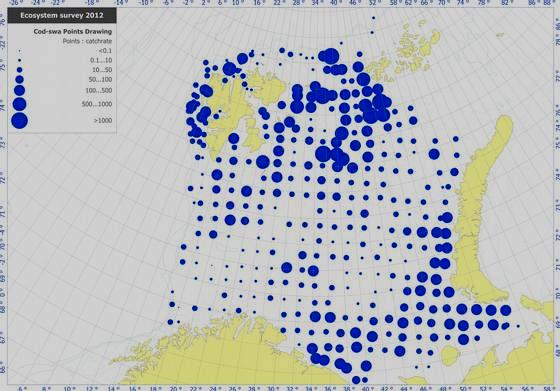
    Arctic Cod is still moving northward and recent findings recorded the furthest distribution of the species. Arctic Cod was recorded at 82 degrees and 30 minutes north this year, by the Russian research vessel Vilnjus.

    “The cod is moving northward and eastward. It also looks like it has enough food,” oceanographer Harald Gjøsæter.

    Gjøsæter was the expedition leader in the Barents Ocean and he says that the stocks are still growing.

    But the movement north is due to two things, Gjøsæter says. “The water is warm enough for the Cod and there is enough food,” he says.

    The scientists use both trawl and acoustic instruments to map the fish stocks in the Barents Sea, and the studies show that the distribution of cod stocks and the capelin stocks are overlapping each other. “The capelin stocks are also strong. “

    Gjøsæter also states that quotas for next year need to be precise but he is optimistic that the stocks are in good condition.

    Source

    Norwegian Institute of Marine Research

    Barents Observer

  • Xuelong returns after historic voyage

    Xuelong returns after historic voyage

    Xuelong in the port of Shangai

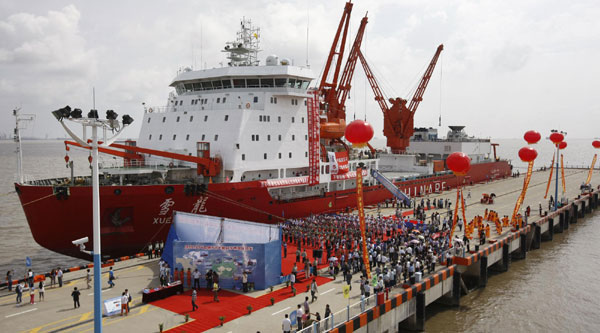
    The historic voyage of the Xuelong, the Chinese icebreaker, was concluded yesterday when it returned to Shanghai. Xuelong, or the Snow Dragon, is the first Chinese vessel to complete a high-latitude voyage across the Arctic Ocean.

    The Xuelong travelled 18.500 nautical miles during the three month voyage, including 5370nm in the Arctic Ocean.

    A statement from the Polar Research Institute of China states that the expedition team has successfully performed various scientific research tasks. A total of 119 crew members were on board.
    The researchers conducted a systematic geophysical survey, installed an automatic meteorological station, as well as launched investigations on oceanic turbulence and methane content in the Arctic area.

    They also held academic exchanges with their counterparts in Iceland, and the two groups conducted a joint oceanic survey in the waters around Iceland.

    The CHINARE5, Chinas Fifth National Arctic Research Expedition, left the Chinese port of Qingdao on the 2nd of July. It arrived in Iceland in August and spent four days in the country, opening the ship to the public both in Reykjavik and Akureyri, as well as co-operating on symposiums in both towns.
    “It’s the longest Arctic expedition we’ve ever had in terms of both sailing time and distance,” said Chen Hongxia, a professor at the State Oceanic Administration’s First Institute of Oceanography, who participated in the voyage.
     

    “Unfortunately we didn’t reach the North Pole because Xuelong’s icebreaking capability isn’t strong enough,” said Wang Shuoren, political commissar of the icebreaker.

    China is designing a new icebreaker, which is scheduled to go into operation in 2014.

    Source

    China Daily

  • New wind park opened in Norway

    New wind park opened in Norway

    Chairman of the municipal government Svein Ludvigsen opens the wind park

    One of the biggest wind parks inside the Arctic Circle was opened yesterday in Northern Norway. It is located in Vannøya, near Tromsø. The park can produce energy for around 7000 households.

    The wind park can produce around 138 GWh per year. It includes 18 wind power generators and a new 34 km long power line. The project was produced by the company Troms Kraft.

    The mills are 125m high and have taken 10 years to build.

    „Today is a historical day, not only for Troms Kraft but for the owners, Karlsoy and the whole region, company director Anna Maria Aursund said at the opening ceremony on Tuesday. The cost is around 750 million NOK (€100 million).

    Troms Kraft also plans to extend the wind park with offshore turbines placed in the nearby waters.

    Several wind projects are on the drawing board in neighboring countries Sweden and Finland, including a megaproject in Sweden which will be one of the biggest on-shore wind power parks in all of Europe.

    Source:

    Nordlys

  • Arctic oil production questioned

    Arctic oil production questioned

    Oil pollution in the sea

    The chief executive of the energy company Total warns against oil drilling in the Arctic. He says that oil spills would destroy the image of companies.

    Total has had many oil projects in the Arctic, and still has several exploration projects concerning gas, which the executive, Christophe de Margerie, says is easier to deal with than oil spills.

    “Oil on Greenland would be a disaster,” de Margerie told the Financial Times. “A leak would do too much damage to the image of the company”.

    Financial Times states that this is the first time an oil major has publicly spoken out against offshore oil exploration in the region.

    Although not mentioning the fragile nature and environment in the Arctic, rather highlighting the image of the company concerning damage in oil spills, environmentalists are happy with the comments.

    de Margerie emphasized that he was not opposed to Arctic exploration in principle.

    The Financial Times also reports that Royal Dutch Shell had to postpone until next year an attempt to drill into oil-bearing rock off the Alaskan coast after a piece of safety equipment was damaged during testing. It has spent $4.5bn and seven years preparing to drill.

    Many companies are exploring and drilling for oil in the Arctic, ExxonMobil, ENI of Italy and Statoil of Norway amongst them, as well as Russian Giants Gazprom.

    Total’s Arctic projects are concentrated in Russia. As well as its stake in Shtokman, it has interests in a number of onshore developments, such as a big liquefied natural gas venture in Russia’s far north known as Yamal LNG. It also operates a Siberian oilfield called Kharyaga.

    According to a 2008 study by the US Geological Survey, the Arctic contains just over a fifth of the world’s undiscovered, recoverable oil and gas resources.

    Source:

    Financial Times