Category: News & Press Releases

Arctic Portal News Portlet

  • Iceland supports China in Council efforts

    Iceland supports China in Council efforts

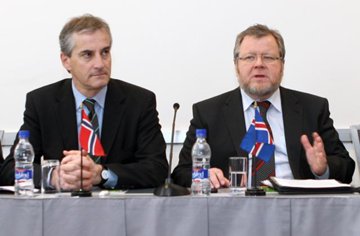
    Össur Skarphéðinsson and Jonas Gahr Störe

    Iceland supports China in its effort to become a permanent observer in the Arctic Council. Norway opposes.

    China currently has an ad-hoc observer status along with the European Union, Italy, Japan and South Korea. They all have to send request to observe each meeting, but they are usually granted.

    China, EU, Italy and South Korea were all denied a permanent observer status in 2009.

    Permanent observers receive invitations for most Arctic Council meetings and they have an easier way to participate in Council-related projects.

    Iceland is now trying to smooth the stiff relations between China and Norway. Össur Skarphéðinsson, the foreign minister of Iceland, has spoken to both the premier of China, Wen Jiabao, and his colleague from Norway, foreign minister Jonas Gahr Støre, about the issue.

    Össur hopes for a better understanding between the nations.

    He states that the Arctic Council is in the process of creating obligations for states to fulfill if they wish to receive the permanent observer status.

    Sources

    Fréttablaðið

  • Big ideas in Faroe Islands

    Big ideas in Faroe Islands

    Faroe Islands

    The Faroe Islands are certainly small, but their force is growing. They have big ideas for the future, contrasting the few number of 50.000 inhabitants, both regarding oil and shipping.

    Next week a Chinese delegation will visit the islands with the view of cooperation regarding a large hub-port. Minister Johan Dahl confirmed this and says that they will also speak about the potential oil and gas exploring in their EEZ.

    “I want to talk to them about a potential hub-port,” Dahl confirmed. Iceland has also looked at the possibility of a hub-port and other locations are also under consideration for Arctic shipping.

    Next week the drill Cosl Pioneer will make shore in the Faroes. He will drill down to 5km, the deepest ever in the history of the islands.

    Oil companies have explored the area and remain hopeful that the black gold can make the Faroese nation one of the wealthiest ones in the world. At least per capital.

    Three companies are behind the project, Statoil has 50% of the rights, ExxonMobil from the USA has 49% and Atlantic Petrolium from the Faroes has 1%.

    The area is called Brugdan 2 and south-west of the Faroe Islands.

    Source

    Oljan

  • Arctic Portal confirmed member of UArctic

    Arctic Portal confirmed member of UArctic

     Arctic Portal and the University of the Arctic

    Arctic Portal has been formally accepted as a member of the University of the Arctic. This was confirmed today at the 15th UArctic Council meeting in Tromsö, Norway.

    Arctic Portal is proud to receive this honor, joining several established institutions and universities all over the world in the prestige UArctic member list.

    UArctic and Arctic Portal have worked together on numerous issues for a long time and it is warmly welcomed to strengthen our bond even further.

    UArctic is “a cooperative network of universities, colleges, and other organizations committed to higher education and research in the North. Our members share resources,facilities, and expertise to build post-secondary education programs that are relevant and accessible to northern students. Our overall goal is to create a strong, sustainable circumpolar region by empowering northerners and northern communities through education and shared knowledge.”

    Arctic Portal

    University of the Arctic

  • Hot water surrounded by ice

    Hot water surrounded by ice

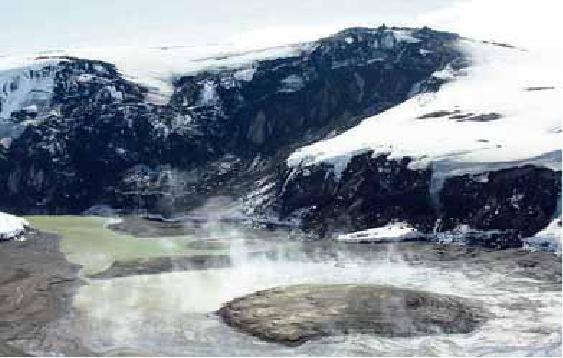
    Hot water surrounded by ice.

    Great melt will occur this year in Europe’s largest glacier, Vatnajökull in Iceland. This is the result of an expedition by Icelandic scientist recently.

    Magnús Túmi Guðmundsson, professor in geography at the University of Iceland, says that the western part of the glacier will melt rapidly. This is due to the volcanic activity in Grímsvötn last year.

    Elevation of land near the glacier was also measured a total of 3cm per year because of the glacier shrinking.

    The consequences are for example raised levels in glacier lagoons and glacier rivers.

    A lagoon which formed after the eruption was researched, which includes a river which was measured 45°Celcius. The lagoon is therefore hot. A few hundred meters was at 25-40° Celsius. Like average bathwater to some.

    “The eastern part of the lagoon is also pretty hot, considering it is surrounded by icebergs.

    Magnús also notes that ash will continue to blow this summer, especially during the dry season. “People in Reykjavík can often still see ash on their cars, that’s ash form Eyjafjallajökull and Grímsvötn. This will take years to stop.”

    Source

    Morgunbladid

  • May ice edge below average

    May ice edge below average

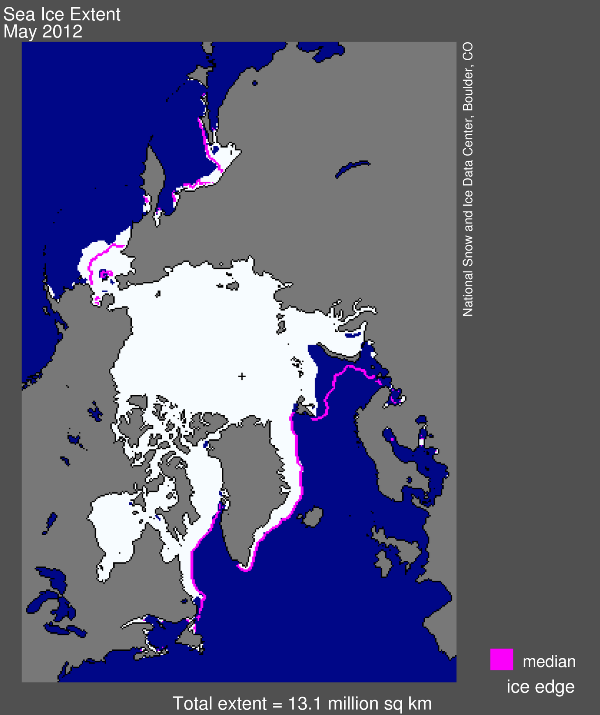
    Sea ice extent in May 2012

    The Arctic sea ice melting season is in full force and the ice edge in May was below average. The ice edge reached near average in late April but the melt happened rapidly in May.

    The Arctic Ocean was fully frozen in May as can be seen on the picture on the right, from the National Snow and Ice Data Center.

    The Arctic sea ice extent for May 2012 averaged 13.13 million square kilometers (5.07 million square miles). This was 480,000 square kilometers (185,000 square miles) below the 1979 to 2000 average extent.

    Ice cover remained extensive in the Bering Sea, continuing the pattern observed this past winter and spring. The anomalously heavy ice conditions were countered by unusually low extents in the Barents and Kara Seas, resulting in Arctic-wide ice conditions that remained below normal. By the end of the month, open water areas had begun to form along some parts of Arctic Ocean coast.

    For May, the Arctic as a whole lost 1.62 million square kilometers (625,000 square miles) of ice, which was 180,000 square kilometers (69,500 square miles) more than the 1979 to 2000 average.

    Air temperatures for May were higher than usual over the central Arctic Ocean and the Canadian Archipelago. Over the Bering Sea, Hudson Bay, and parts of the East Greenland and Norwegian seas, temperatures were slightly below average.

    Source

    NSIDC

  • Postdoctoral Researcher wanted at Oulu

    Postdoctoral Researcher wanted at Oulu

    Oulu Finland

    The Department of Geography at the University of Oulu in Finland is looking for a Postdoctoral Researcher/Senior Research Fellow for the next five years.

    The five-year period begins 1st September 2012 or upon agreement and the applications are open until the 2nd of July.

    The research profile of the successful candidate should complement the focus of the Physical Geography Research Group (PGRG) at the Department of Geography. The PGRG focuses on analysing geomorphological, biogeographical and hydrological phenomena in high-latitude and high-altitude environments, namely in boreal, sub-Arctic, Arctic and mountainous landscapes.

    The key research subjects are geomorphological processes (including permafrost), geodiversity, biodiversity, species distribution modelling and tree line ecotone under global change. Methodologically, the main focuses are geoinformatics, spatial analysis and statistical modelling.

    Studies are often based on comprehensive field data sets. The PGRG includes one professor, one to three postdoctoral researchers, three to five doctoral students, research assistant(s) and over ten Master students.

    The required qualifications for the successful candidate include a doctoral degree and high quality scientific competence, teaching experience in Physical Geography as well as evidence of international collaboration in the field in question, and success in acquiring supplementary (extramural) funding.

    For further information contact Professor Jan Hjort, Department of Geography, tel. +358-29-448-1704, jan.hjort(at)oulu.

    See more here.

    Source

    Uni. of Oulu

  • Programing to save the world

    Programing to save the world

    Team Hermes won the Imagine Cup in 2011.

    Students from all over the world are competing to change the world, with computer games. The Microsoft Imagine Cup finals will be held later this summer in Australia where students tackle the theme “Imagine a world where technology helps solve the toughest problems.”

    Imagine Cup is a student technology competition with three types of competition, software design, Game design for Xbox or Windows computers and Game design for phones. Every year, student competitors present creative technology solutions that address real-world challenges, and many of those solutions are in use today.

    The finals will be held in July in Sydney.

    The final projects are of different types, one team chose to make a video game about green energy and energy use. Roberts Quest is about a squirrel who embarks on a mission to clean up his city by gaining renewable energy sources. The team Radiant from Iceland made the game.

    The teams in the finals are from all over the world, for example from China, Brazil, Ukraine, Belgium, Iceland, Korea, France, Côte d’Ivoire, Dominican Republic, USA, Canada and Indonesia.

    A team from Microsoft’s 2011 Imagine Cup developed a process using a Windows Phone application to diagnose malaria.

    “It´s our world’s future innovators and technology leaders, our planet looks to you to lead the way in solving some of our greatest challenges. Lead with your mind and also with your heart, as both are required to make a difference,” says Jon Perera, Microsoft, General Manager, Academic Programs.

    Source

    Imagine Cup

    Morgunblaðið

  • Clinton to assure US interest in the Arctic

    Clinton to assure US interest in the Arctic

    Hillary Clinton

    Secretary of State Hillary Clinton will assert U.S. interest in the Arctic this weekend. She is visiting Tromsö in Norway where she will empathize US´s interests in the Arctic.

    According to Reuters, a senior Oslo-based diplomat said of Clinton: “Her aim is to emphasize that the U.S. is keeping its eye on the Arctic and remains very keen. Big firms are investing big money and she wants to say ‘I can do more than one thing at a time, the world is not just Pakistan, Afghanistan and Iraq’.”

    Recently Clinton said that as the Arctic warmed: “It is more important that we put our navigational rights on a treaty footing and have a larger voice in the interpretation and development of the rules. You will see China, India, Brazil, you-name-it — all vying for navigational rights and routes through the Arctic.”

    Although the United States now recognizes the UNCLOS, which defines the rights and responsibilities of nations in their use of the world’s oceans, as a codification of customary international law, it has not ratified it.

    Clinton has previously said she wants the US to do so, but it remains in doubt as of yet.

    The outcomes of the trip to Tromsö will not be of significant political interest, but Clinton will meet “different key persons on Arctic research.”

    Sources

    Reuters

    ABS

    Nordlys

  • Flying barbeque helps reindeer herders

    Flying barbeque helps reindeer herders

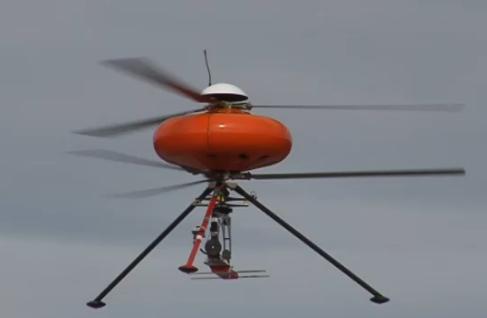
    Minicopter, Flying barbeque

    Reindeer herders in Lapland are using new technology to find lost livestock, a flying barbeque. It may seem strange but when looking at the picture, one can understand the name.

    The flying barbeque is actually a minicopter, a flying object with an attached camera. The machine is designed in France and can fly as high as 150 meters.

    It can survey the landscape in hunt for the reindeer for up to 10 kilometers. Many reindeers have radio transmitters around their necks and if the herders lose their reindeers to predators, they can be found via the transmitter.

    The remote control steers well and testing has been good. “All our experiences up to now have been positive,” said project director Jari Nykänen of Eastern Lapland technical college.

    “The neck transmitter has been found further away than when searches are conducted at ground level,” he says but lost reindeers can be very costly for the reindeer herders.

    Every year herders lose up to 20,000 reindeer to predators. On average, just a fifth of these are found.

    “Even one lost reindeer that isn’t found represents a loss of several thousand euros,” said Heikki Härmä of Kallioluoma Reindeer Owners Association.

    Despite the losses, few businessmen currently operate small ‘minicopters’. The sector is expected to explode over the next few years. The devices are especially suited to aerial filming.

    Other parties are also interested in the object; both filmmakers and the police have shown an interest.

    Sources

    Yle

  • Putin urges Shtokman decision

    Putin urges Shtokman decision

    Oil tanker

    Russian president Vladimir Putin urges oil companies to make their final decision on the Shtkoman gas project. The Shtokman area is one of the riches gas wells in the world.

    Putin met with Statoil´s CEO, Helge Lund, on Friday, but Gazprom (owned by the Russian government) is the leading player in the field. Statoil (owned by the Norwegian government) holds a 24 percent share of the Shtokman Development AG, the joint venture responsible for the project. Gazprom holds 51 percent, while Total (from France) holds 25 percent.

    This ownership could change in the nearest future.

    “You have a very good and big project with Gazprom” Putin said to Lund. “The huge production assets of Shtokman have global significance and we have to make active progress,” Putin said, according to the Barents Observer.

    Statoil could exit from the project and discussions with Gazprom are taking place. Speculations surrounding Shell to take over from Statoil have emerged.

    Reports say that Gazprom wants to get rid of Statoil, due to conflicting views on the project development model.

    Statoil has officially supported Gazprom’s intention to skip the project’s pipeline part and instead develop Shtokman as a 100 percent LNG project.

    Statoil has long stressed that project development costs need to be reduced and that tax breaks must be introduced. The development costs for the project’s first phase have reportedly grown to about $30 billion, up from the originally planned $20 billion.

    Statoil has invested around $1.5 billion in the Shtkoman project, which it could lose if pulling out.

    Source

    Barents Observer