Category: News & Press Releases

Arctic Portal News Portlet

  • Greatest warming in Scandinavia

    Greatest warming in Scandinavia

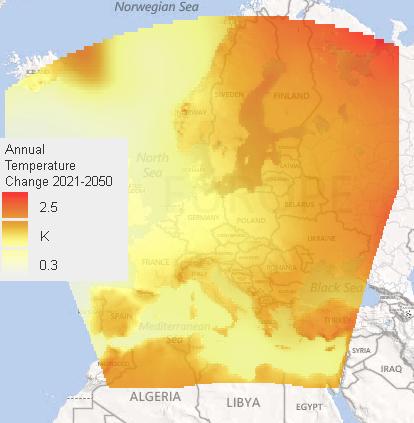
    Annual Temperature Change 2021 - 2050

    Predictions of the European Environmental Agency of global warming have been released. Records have already confirmed a warmer Europe and the future predictions say that Europe will be on average 1.5° C warmer in the period 2021-2050 than the period 1960-1990.

    According to the EEA, higher temperatures lead to an increase in number of heat waves and droughts, which have great impact on water supply, agriculture production and human health.

    The highest warming is projected over the eastern Scandinavia, and southern and south-eastern Europe. All areas of the continent will warm by a minimum of approximately 0.4° C and a maximum of 2.5° C, the projections indicate.

    Looking further ahead to the period 2071-2100, the models predict that Europe will be on average 3 °C warmer than 1960-1990. In north eastern Scandinavia the temperature change could be up to 6° C higher than the reference period, while the Mediterranean basin and parts of Eastern Europe will also see much bigger changes than elsewhere. All areas are expected to see average annual temperatures at least 1.5° C warmer than the reference period.

    Interestingly, there are great differences between summer and winter – the maps show the winters will see the greatest change in Scandinavia and Eastern Europe, while the biggest temperature increases in the summer will be around the Mediterranean.

    The website also states that while a few degrees increase may not seem significant, it is important to note that these are average annual temperatures, potentially masking large extremes. For example, during the period 2021 – 2050 summer in some parts of the Mediterranean is expected to be upto 2.5° C warmer than 1961-1990.

    Source
    EEA

  • Polar bear shot near Nuuk

    Polar bear shot near Nuuk

    The polar bear shot caught the attention of the people in Nuuk

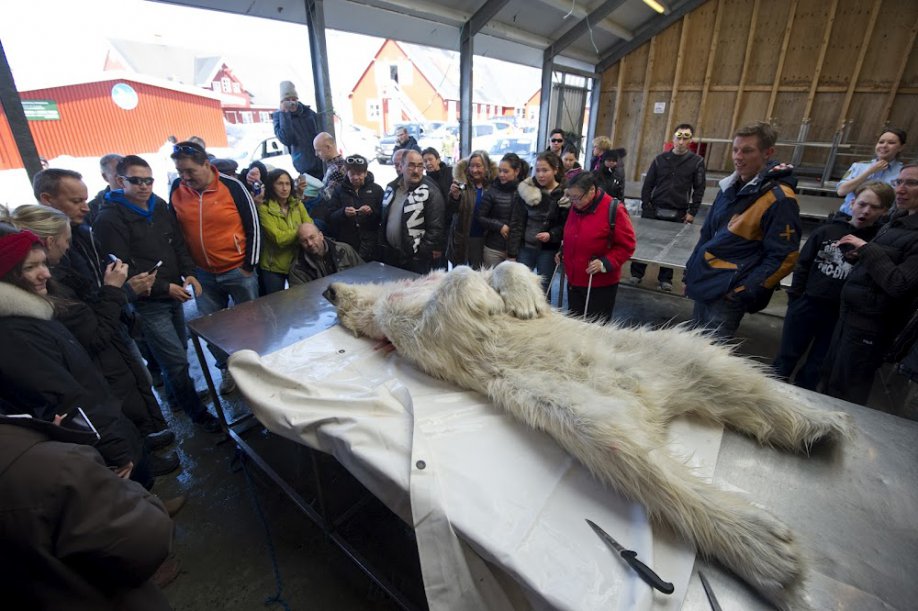
    A polar bear was shot near Nuuk in Greenland this week. It is rare that polar bear come this close to the capital.

    Two brothers spotted the bear, at first they thought it was a huge dog. A closer look identified the bear.

    The male polar bear smelled the brothers who ran to safety. The bear clawed the house but then moved away, and approached Nuuk.

    He was shot due to safety of the inhabitants.

    Many people have looked at the bear since it was shot, as can be seen on the pictures with the story below.

    Sources

    Sermitsiaq

  • Long swim ahead for polar bears

    Long swim ahead for polar bears

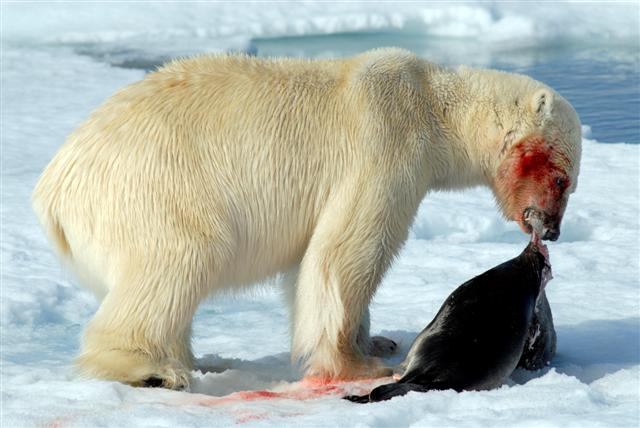
    Polar bear that caught a seal

    The summer is near and the Arctic sea ice has started its retreat. This means hard work for the polar bears in the Arctic.

    Their hunts for food has begun after the winter exile and are now swimming more than ever to eat.

    A research conducted for five years, between 2004 and 2009, shows that the average distance they swam was 154 kilometers.

    Scientist used GPS technology to track 52 adult female polar bears in the Beufort Sea near Alaska. They managed to track 50 swims in total.

    One case studied by the researchers tracked a female polar bear as she swam continuously for more than nine days, covering a distance of more than 687 kilometers. The bear lost 22 per cent of her body mass during the trip. Her cub died during the journey.

    However, many cubs do survive the long swims, says Anthony Pagano, a lead author of the study. He told the Barents Observer:

    “We were able to recapture or observe 10 of these females within a year of collaring, and six of these females still had their cubs,” Pagano said in a press release. “These observations suggest that some cubs are also capable of swimming long distances. For the other four females with cubs, we don’t know if they lost their cubs before, during, or at some point after their long swims.”

    The study, published in the latest issue of the Canadian Journal of Zoology, is the first to use GPS to track polar bears’ long-distance swims. With declining levels of Arctic ice, these long swims could become more and more common.

    There are about 25,000 polar bears in the Arctic. A 2004 survey of the Barents Sea polar bear population found about 3,000 polar bears in the region.

    Source

    Barents Observer

  • New APECS director appointed

    New APECS director appointed

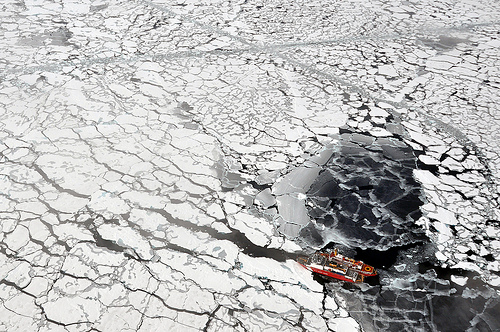
    arctic sea ice

    APECS, the association of polar early career scientists, has appointed a new director, Alexey Pavlov.

    Alexey will be in charge of guiding the development and administration of the organization, along with overseeing and managing all APECS activities, finances and events, recruitment of volunteers and members, and interacting with APECS mentors, advisors, and supporters.

    Alexey highlights international & interdisciplinary collaboration as a key reason he is looking forward to taking on the role of APECS Director. “Collaboration with many interdisciplinary groups has brought me the opportunity to feel the environment of Polar Regions and to better understand current and upcoming challenges facing Polar research,” he said.

    “I’m looking forward to spending the next years of my life above the Arctic Circle and to ‘Shaping the Future of Polar Research’ with even more APECS members and mentors.”

  • J.C. Gascard talks about new EU project

    J.C. Gascard talks about new EU project

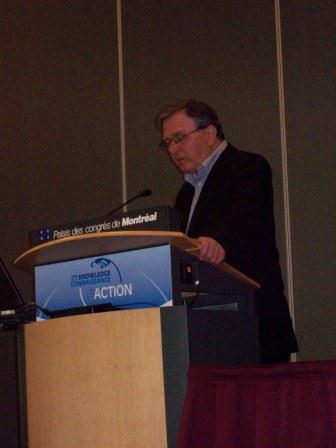
    J.C. Gascard gives the speech on new EU Arctic - related  project

    J.C Gascard, representative from the LOCEAN in Paris, France, gives the speech on new EU project for Climate Change, Economy and Society (ACCESS) which is a joined call from different departments of European Commission.

    Under The University Pierre et Marie Curie coordination and involving 27 partners from 10 countries, the 4 years ACCESS project (Arctic Climate Change, Economy and Society 2011-2015) was selected in response to the first call ‘the Ocean of Tomorrow’ of the EU 7th Research and Development Framework Program (FP7-Ocean-2010) under Transport, Food, Agriculture and Fisheries, Energy, Environment, Socio-economic sciences and Humanities supervision.

    The main objective of ACCESS is to build the knowledge for a sustainable growth of sea-based activities in the Arctic a) by improving understanding of Arctic marine ecosystems’ response to a combination of natural and anthropogenic factors and b) by providing a scientific foundation for feasible, sustainable management measures supporting policies and related technologies.

    ACCESS will evaluate the latest Arctic climate change scenarios and establish their impacts on marine transportation (including tourism), fisheries, marine mammals and the extraction of hydrocarbons in the Arctic for the next three decades with particular attention to environmental sensitivities and sustainability.

    Understanding the socio-economic impacts of these changes on markets, economies and on European policy objectives along with their influence on Arctic governance, are key areas of research within ACCESS. An open and inclusive forum will give the opportunity to all stakeholders interested in the ACCESS consortium activities and cross-cutting research to interact with ACCESS.

  • Future for Arctic marine use

    Future for Arctic marine use

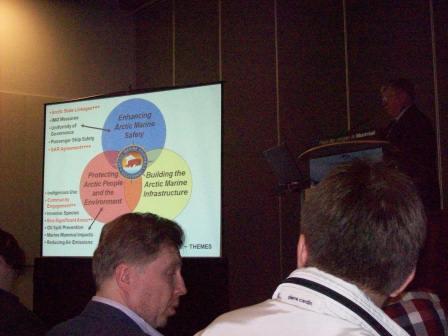
    L. W. Brigham gives the speech on outcomes from AMSA report

    On Wednesday, 25th of April 2012, during the IPY Conference prof. Brigham gave a speech on key drivers and futures for Arctic Marine use.

    He stressed globalization, climate change and geopolitics as key drivers of the profound change in the Arctic. For the Arctic Ocean and marine traffic, this change is driven primarily by Arctic natural resource development and marine tourism. This was one of the key findings of work done by the Arctic Marine Shipping Assessment (AMSA) of the Arctic Council during 2005-09. The scenarios creation effort in AMSA indicated that the two most important (and uncertain) drivers, of many, were (A) the level of natural resource development and trade, and (B) governance (the degree of stability of rules and regulations for Arctic marine navigation).

    Mr Brigham highlighted, that nowadays we see expanded Arctic marine transport systems evolving in offshore Russia, Norway, Greenland, and potentially in the U.S. maritime Arctic in summer 2012. Existing year-round marine transport to the world’s largest nickel mine (Norilsk Nickel) in Northwest Russia, and seasonally to the world’s largest zinc mine in northwest Alaska (Red Dog) are well established. Plans are being made to link a large, high grade iron ore mine on Baffin Island in Canada to European steel producers. All of these marine systems indicate much greater links of the Arctic to the global economy.

    Recent experimental voyages across the Russian maritime Arctic by tankers and bulk carriers confirm plausible, summer marine routes eastbound from northern Norway and the Russian Arctic to markets in China. Cruise ship traffic by medium and large ships continues to increase in western Greenland. Importantly, continued Arctic sea ice retreat creates greater marine access throughout the Arctic Ocean for science and commercial marine operations; longer navigation seasons during the summer are a reality today.

    One of the key factors that must be kept in mind is, despite the extraordinary changes in Arctic sea ice thickness, extent and character (moving to a future Arctic Ocean without multi-year ice), the Arctic Ocean will remain fully or partially ice-covered during the winter and much of the spring and autumn. Polar class ships will be required for future operations once a mandatory Polar Code of Navigation is promulgated by the International Maritime Organization.

    Action is also being taken by the Arctic Council and the Arctic states to address future Arctic marine use: a new binding Arctic Search and Rescue Agreement gained approval in 2011, and a new Arctic Oil Spill Task Force is developing a second instrument to address this critical issue. There is little doubt globalization of the Arctic and regional climate change are closely coupled, and they will have immense influence over future marine use and the strategies developed to protect Arctic people and the marine environment.

  • A new port in Nuuk

    A new port in Nuuk

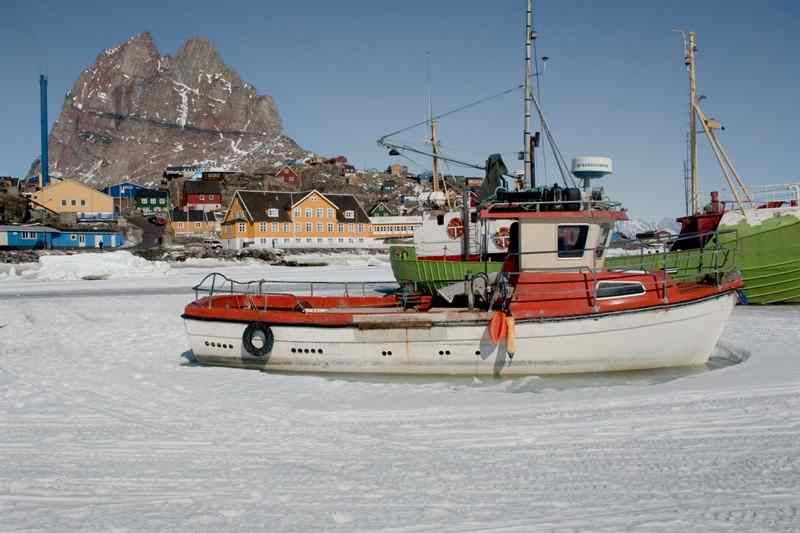
    Ships in Greenlandic ice.

    The government of Greenland is building a new port in the capital, Nuuk. The old port is too small for the future activities in Greenlandic waters.

    The new port, to be opened in 2014, will be both a container port with storage facilities and a hub-port for service of oil exploration.

    The new port will be run by a company owned by four partners, the government of Greenland, the municipality of Sermersooq, the Royal Arctic Line shipping company and the port of Ålborg in Denmark.

  • A million dollar prize

    A million dollar prize

    Arctic Inspiration prize grant announced

    A new award was introduced today here at the IPY 2012 conference in Montréal, Canada. The new price is for 1 million Canadian Dollars. The price is the Arctic Inspiration prize.

    It will be rewarded annually to a group or individual who makes an extraordinary contribution of gathering Arctic knowledge and their plans to implement this knowledge, for the benefit of the Canadian Arctic, its peoples and therefore Canada as a whole.

    The award will be given to teams working in the Canadan Arctic, but the teams can be from anywhere in the world. The first prose will be rewarded in December this year.

  • Gro-Harlem wants bolder decision making

    Gro-Harlem wants bolder decision making

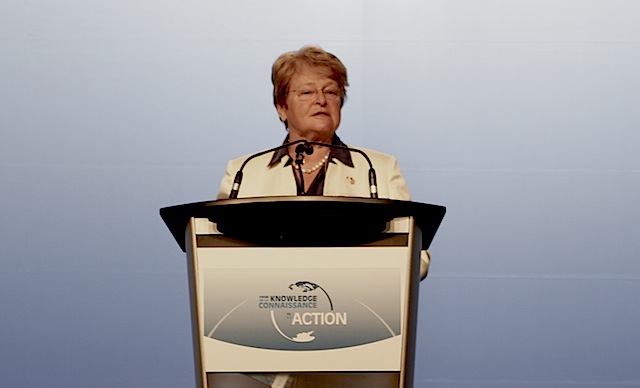
    Dr. Gro Harlem Brundtland making a speech

    Gro Harlem Brundtland said in her keynote speech at the IPY 2012 conference in Montreal that not enough has been done for the last 20 years in decision making regarding environmental issues. This years marks the 20 year anniversary of the Rio conference, where the all important Rio declaration was signed and ratified.

    Dr. Brundtland, the former prime minister of Norway and a special envoy of climate change to the United Nations, encourages for more cooperative research in polar sciences.

    “We also must ensure an easy access of data from the International Polar Year to the benefit of all researchers and communities,” she said before a crowd of over 2000 people in the Palais de Congrés in Montreal.

    “We must also develop and maintain the important research stations, where both all states and participants should work together,” she said, again encouraging cooperation.

    Talking about the progress after the Rio summit in 1992, she said that although some progress has been made, it is not enough. “Much has happened in 20 yeas, but not enough. Now, global warming is rapidly increasing, as well as the whorl population,” she said.

    Dr. Brundtlant also mentioned that in a report she delivered last January, it was projected that the world demand for resources world grow fast, especially for food, water and energy.

    “We need to identify what is important, the world needs to put scent on top for sustainability. The scientific research must point the way to the best decision making,” she said.

    Coming up this summer is the Rio+20 summit, where she sees reason for optimism. “We need bold decision making in the Rio summit.”

    She also identified polar research as more important then ever. “What is happening in the polar regions is more important for the whole world then we thought. Now we know its value,” she said.

  • High security at IPY in light of protest

    High security at IPY in light of protest

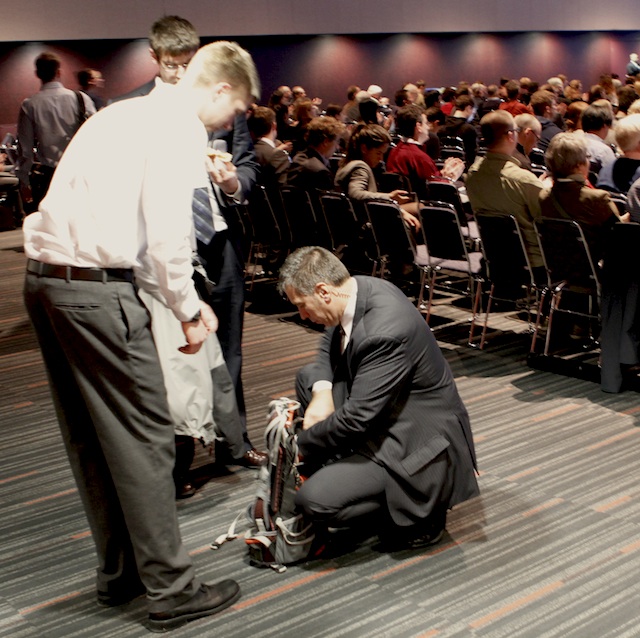
    High Security at IPY in Montreal

    The security at the IPY 2012 conference is very high, especially today. the last few days have been underlain by protesters here in downtown Montreal.

    The students are protesting the decision of the government of Québec to raise the tuition fees. The fees will rise of 500 Canadian dollars for the next five years.

    Around 100 people have been arrested in the protest which has seen the police using teargas to distribute protesters.

    Arctic Portal has learned that the Quebec government has been raising taxes, especially on both the health care system and now education. Together they are around 70% of the income of the government.

    The government wants to ensure the quality of the education system and therefore it feels the need to raise the tuition fees.

    There are many security guards around the conference, searching bags and ensuring everything is safe. There were great concerns of protesters smuggling in the conference rooms to protest Jean Cherast, the Premier of Québec.

    The tensions in the conference room were high but no protest was carried it whilst Cherast made his speech.