Category: News & Press Releases

Arctic Portal News Portlet

  • Exhibition and science lab in Lenin

    Exhibition and science lab in Lenin

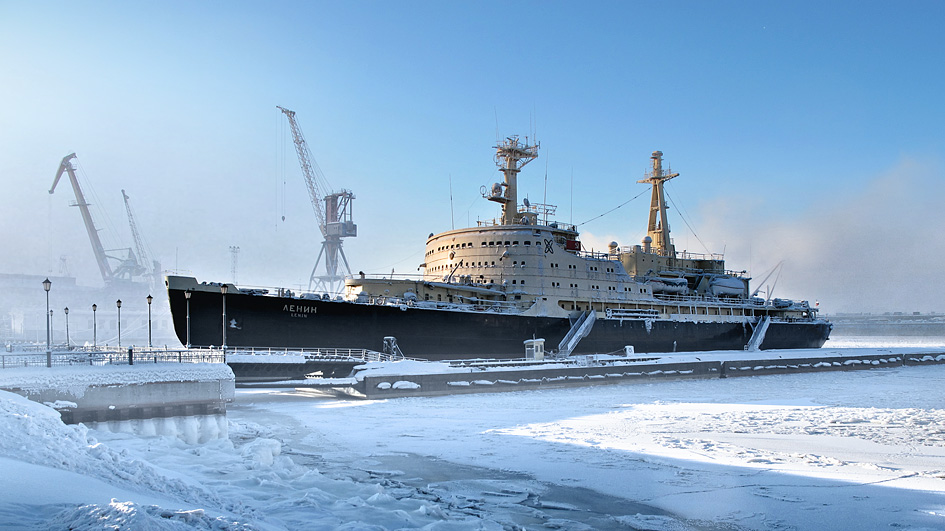
    The Lenin icebreaker.

    A Russian icebreaker will be modified into a floating museum. The icebreaker Lenin will serve the purpose of being a science and historical exhibition.

    The Arctic Centre of the University of Lapland, Polaria in Tromsö and Atomflot in Murmansk have been granted 1.2 million euros by Kolarctic ENPI CBC program for the project.

    The Arctic Centre will be the lead partner and act as the main exhibition producer in the project Arctic Expo Centre – Nuclear-Powered Icebreaker Lenin – ICE.

    The aim of the project is to develop new exhibitions and innovative communication tools as a means to improve the information on local and cross-borders concerns. This will help to facilitate a mutual understanding among neighboring people about common issues and the Arctic. As the exhibition is planned on board Icebreaker Lenin, the goal is also to tell about the technology and history of icebreaking.

    “Through exchange of expertise and share of experiences each member will increase the opportunities to develop its own exhibition and activities such as education package for teachers and pupils on certain issues, special tours for tourists”, says chief executive producer Nicolas Gunslay, Arctic Centre.

    “The goal is to raise awareness on topics related to the Arctic marine environment, climate change, and globalization,” he added.

    The icebreaker Lenin was launched in 1957 and is the world’s first nuclear powered surface ship and the first nuclear powered civilian vessel. It had a crew of 240 persons while in operation.

    He left service in Russia in 1989.

  • Abnormal heat in Svalbard

    Abnormal heat in Svalbard

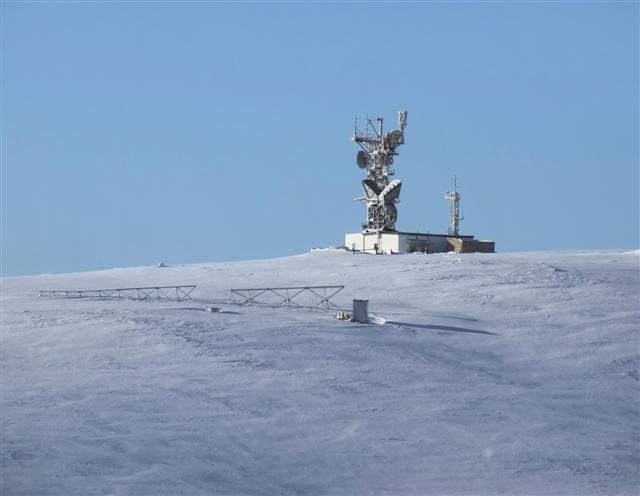
    Polar station in Svalbard

    The temperatures in Svalbard this year have been abnormal. The average temperature in the first three months of the year is around -13°.

    Now it has been around -2°, 11° above the normal number. But the inhabitants have also experienced record heat, avalanches, rain and ice-free fjords.

    The warmest day so far this year was February 8, with +7°C. Longyearbyen has had 90 millimeters of precipitation so far this year, nearly twice the normal.

    But this is nothing compared to Ny-Ålesund, where 97 percent of the normal annual precipitation came during the first 80 days of the year.

  • Over 600 Anglers rescued in Russia

    Over 600 Anglers rescued in Russia

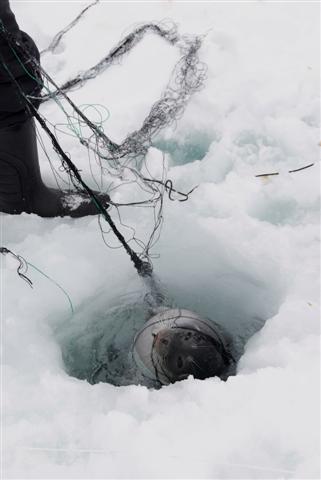
    fishing through ice

    Over 600 anglers, fisherman who were angling through the ice, have been rescued after an ice sheet broke off. The Russians were not harmed.

    The emergencies ministry said that 48 people were involved in the rescue operation, two helicopters and 11 ships weere used to fetch the people of the moving ice sheet.

    Fishing through bore-holes on ice-bound waters is a popular winter pastime in Russia.

    Taymuraz Kasayev, of the emergencies ministry, said the area’s residents had been told to stay away from the ice.

    “We warned people through the media that going out on to the ice on this stretch of the coastline is extremely dangerous and is not allowed,” he told the NTV television channel.

    One of the rescued anglers, Vladimir Vasilenko, said he had ventured on to the ice floe knowing that the windy conditions might pose a risk.

    “The wind was blowing from the shore, and it was clear that something might happen, but people were still going out, so we did too,” he said.

    “It was the excitement, of course. We also heard on the radio that it would be the last chance for fishing on the ice. And so we rushed out to go fishing.”

  • NASA research plane in the Arctic

    NASA research plane in the Arctic

    NASA research plane in the arctic

    NASA has sent an Earth Resources (ER-2) high-altitude science aircraft to Iceland to study the Greenlandic ice-sheet.

    The specially designed aircraft will carry out research for about 4 weeks in the high North. It will be based in Keflavík International Airport in Iceland.

    A statement from the US embassy of Iceland details the purpose of its mission:
    “The mission will assist global warming research by developing better methods to measure the melting of the ice in Polar regions. The ER-2 aircraft will fly high-altitude missions over Greenland in April to test the accuracy of a newly developed laser, the Multiple Altimeter Beam Experiment Lidar, or MABEL. The laser simulates a similar instrument planned for NASA’s IceSat-2 environmental satellite scheduled for launch in 2016.”
    According to NASA, this is a part of a much larger mission called Operation IceBridge. Conducted in the Arctic in March and April and the Antarctic during October and November, NASA says, the mission is “the largest survey of Earth’s polar ice ever flown.”

    The plane is a science laboratory in the air. It routinely flies around 70.000 feet and above, twice the height of a regular commercial airplane.

    NASA ER-2s have played an important role in Earth science research because of their ability to fly into the lower stratosphere at subsonic speeds, enabling direct stratospheric sampling as well as virtual satellite simulation missions. The aircraft’s unique capabilities enable studies such as stratospheric ozone concentrations over Antarctica and the Arctic.

  • U.S interest in Icelandic energy

    U.S interest in Icelandic energy

    University of Akureyri seen from the sky

    The University of Akureyri hosted a Law Forum today, open for the public. Eric Green, Deputy Chief of Mission at the U.S Embassy in Reykjavik and Gregory P. Sims, Regional Political Officer at the U.S Embassy in Oslo, discussed the U.S foreign policy with regards to Iceland and the Arctic region.

    Eric Green has held the position of the Deputy since August 2011. Before coming to Iceland, he specialized as Minister Counselor for Political Affairs at the U.S Embassy in Moscow. Gregory P. Sims is regional political officer at the U.S. Embassy on Oslo. He joined the State Department in 1988 and has specialized in Russian politics and transnational issues.

    The U.S representatives addressed the issue of U.S interest in Arctic natural resources, but did not clearly stated names of the companies which might be interested in possible oil and gas drilling around the Jan Mayen archipelago. They stated that the planned exploration in the area would cause no significant impacts on the Arctic fish and other wildlife as all current operations around the Arctic are being conducted in environment friendly manner.

    The floor was opened for the discussion to all participants and the proposal for establishing the human rights working group within the Arctic Council was made.

    Participants also discussed the U.S policy with regards to Icelandic domestic affairs. The impact of U.S military base on Iceland´s community was recalled and challenges for new business opportunities on the south cost were mentioned. It was stated that the U.S companies are highly interested in Iceland´s inexpensive, renewable energy and are ready to conduct the business to support the Icelandic economy.

    The U.S representatives made a clear statement that they would be greatly engaged in current Arctic issues and they will consider to take part in on coming 5th Polar Law Symposium which will be held at the Arctic Center in Rovaniemi, Finland, in September 2012.

  • Arctic Portal – Special Events on the Portal

    Arctic Portal – Special Events on the Portal

    Web casting

    Web-casting is becoming an important venue for communicating special events to the wider audience. The Arctic Portal has facilitated numerous virtual events over the past months which are now available on the Portal for viewing.

    These include: numerous events in co-operation with ICR and the Saami Council; Breaking the Ice conference in Akureyri; APECS workshop in Stockholm and now most recently the Arctic Energy Summit. Upcoming is web-casting the major IPY event in Oslo 2010.

    ICR has recently signed an agreement in Russia which grants access to mapping data throughout the Russian north. The Arctic Portal interactive mapping tool will be used for the presentation and interpretation.

    The first map, covering the district of Yamal, is already up on the Portal. Further data covering Northern Norway and Finland, which has been identified and adapted, is to be included soon.

    The Northern Forum has provided the Arctic Portal very valuable mapping data, especially from its Russian partners, which is currently being adapted for us in the Mapping Portal. Co-operation is being established directly with the Russian partners, through the initiative of the Northern Forum.

  • Arctic Portal – New Websites

    Arctic Portal – New Websites

     Arctic Portal news

    In the past months some important partners have joined the Arctic Portal, establishing their web presence through the Portal. These include the European Commission through the PAGE21 project, the Biodiversity in Arctic Waters website Vistey, new websites for both CAFF and PAME, workgroups of the Arctic Council, the Arctic Yearbook and the European Arctic Information Center Preparatory Action.

    Many other projects and groups are in the process of creating a presence on the portal including IPY projects, as well as the Teachers within IPY, and last but not least the Northern Forum.

    In the process of enabling partners to utilize fully the opportunities of the Portal staff from ICR in Norway, Yukon First Nations in Canada, IASC Secretariat in Sweden and APECS office in Norway have been to Akureyri for training and sharing of knowledge.

    This has proved highly valuable for better co-operation and has in both cases helped speed up the setup face and helped the Partner increase the value of their website. Similar training sessions have taken place with the co-ordinators of APECS at their meeting in Stockholm and by using virtual tools.

  • Drilling into Hell

    Drilling into Hell

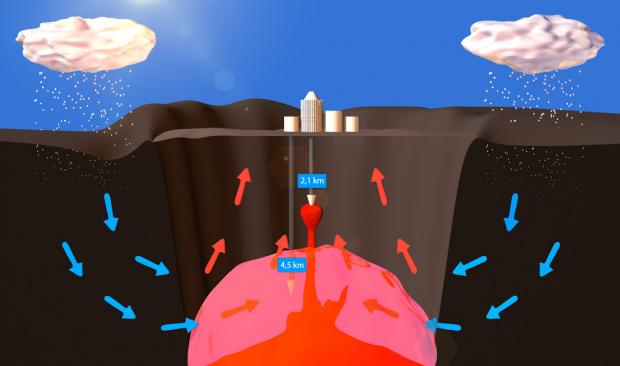
    A simplified diagram of the Krafla Caldera, a collapsed depression in the terrain. IDDP-1 was originally designed to drill to a depth of 4.5 kilometres, down to the pink area where water becomes supercritical, neither water nor steam. Instead the drilling was halted at around two kilometres down because drillers hit a pocket of magma, liquid rock. (Figure: Per Byhring, forskning.no). Click to enlarge.

    The main geothermal power station in Iceland is starting to draw heat from hell. In the North of Iceland, the Crater Hell, or Víti to the natives, portrays running water near glowing magma.

    The geothermal area in the north was always a feasible option for the Icelanders to utilize the vast energy resources, lying deep in the midst of the melting hot lava. But for a long time many doubted whether Krafla would ever actually enter operation, when large-scale volcanic eruptions started only two kilometres away from the station, posing a serious threat to its existence. Work continued, however, and the station went on stream early in 1977.

    The crater erupted in 1724 and the eruption lasted for 5 years. The last eruption was a small one which lasted for nine years, between 1975 and 1984.

    The area will erupt again, but Icelandic scientists have drilled a two-kilometer deep well into the crater to judge opportunities for utilizing this deep geo-energy.

    “This is the hottest production well in the world, with a temperature of 450° C and a pressure of 140 bars, in other words about 140 times that of normal air pressure at sea level,” says Guðmundur Ómar Friðleifsson, who heads the project, to Science Nordic.

    The Icelanders are trying a novel and bold technology before the next eruption occurs. They are drilling as close to the magma chamber as they can. Here they will extract from five to ten times the energy they currently get from the drill holes that serve the power plant.

    In the vicinity of the magma, ground water is so hot and compressed that it is no longer a mixture of water and steam, but rather a superheated dry steam. This superheated steam can liberate more energy than normal steam driving the turbines that convert it into electricity.

    Following a failed attempt at drilling deep further from the volcano, IDDP decided to drill right at Krafla, but not without making thorough preparations. Drilling of the well dubbed IDDP-1 started in March 2009. Iceland was then in the midst of its worst ever economic crisis but work continued nevertheless.

    Initially everything went according to plan. Then the troubles started. The drill string got stuck and was twisted off. New holes had to be drilled next to the old one. Delays ran into weeks.

    Nor could the engineers drill the first and widest well down to 2,400 metres as planned. They decided to call it quits at a depth of 1,958 metres. This proved fortunate because soon all their problems were clear – as glass.

    The last rock they’d reached was solidified natural glass, obsidian. The engineers had drilled right into a pocket of melted rock – into magma. Geologists calculated the thickness of this pocket at 50 metres or more in order to have remained in a molten state inside the cooler rock ever since the magma chamber formed in the 1970s and ’80s.

    The obsidian created a 20-metre glass stopper in the bottom of drill hole IDDP-1. The engineers pumped cold water into the hole and the rock heated it up for months. This allowed them to appraise the heat flow.

    “We are still measuring the heat conduction from the well,” says Friðleifsson, who has managed IDDP since the beginning of 2000.

    Even though IDDP-1 is the hottest production well on the planet and the water is superheated, it has less pressure and heat than the scientists and engineers behind the IDDP originally hoped to reach beneath Krafla.

    “The well IDDP-1 will produce from 25 to 35 megawatts. This is about half of what the entire rest of the Krafla power plant currently generates. Landsvirkjun is now planning to use steam from this well in power production by year’s end,” says Friðleifsson.

    Sources

    Science Nordic

    Landsvirkjun

  • New drill for permafrost in Svalbard

    New drill for permafrost in Svalbard

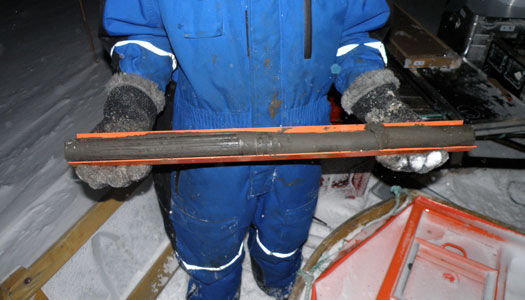
    Permafrost core

    The PAGE21 project, a new EU 7th framework collaborative research project which Arctic Portal proudly is a part of, will expand knowledge of permafrost in the Arctic. Drilling starts next week in Adventdalen, Svalbard.

    A total of 18 institutions from 11 countries are involved and UNIS is in charge of the field campaign in Adventdalen outside Longyearbyen that starts next week.

    The five main research field sites are Zackenberg in North Eastern Greenland, Abisko in Northern Sweden, Adventdalen and Ny-Ålesund in Svalbard, and Samoylov Island and Kytalyk in Russia. The individual key field research sites are collecting field data on the permafrost, such as determining its temperature, its amount of ice, the origin of the ice, and the distribution of permafrost landforms in the study areas.

    A new specially designed hydraulic drill rig has been bought for drilling. UNtil now the drilling has been hand made, down to only 2 meters. The new drill is able to collect cores from the permafrost in both sediments and bedrock down to potentially 50 m depth.

    The drill in testing in Svalbard

    The drilling that starts next week will collect up to 110m of permafrost cores from ice-wedge polygons, pingos and solifluction sheets in Adventdalen.

    The PAGE21 project combines field measurements of permafrost processes, pools, and fluxes, with remote sensing data and global climate models at local, regional and, for the first time, pan-Arctic scales.

    The output from this research will help to advance our understanding of permafrost processes at multiple scales, resulting in improvements in global numerical permafrost modelling and the ensuing future climate projections.

    Source: UNIS

  • Sea levels rise to cost trillions?

    Melting of sea ice

    The rise of sea levels due to melting sea ice, as a result of climate change, could cost around $2 trillion US dollars. This is the result of a study by the Stockholm Environment Institute in Sweden.

    By the end of the century the cost could skyrocket. The scenario made by the SEI is that the Earth´s temperature will rise by 4° by 2100. The report is part of a book, Valuing the Ocean, which is being compiled by the SEI for the UN’s Rio+20 Conference on Sustainable Development in Rio de Janeiro, Brazil, in June.

    The rise of the Earth´s temperature will have several economic impacts, for example on fisheries, tourism, as well as those associated with the oceans’ ability to absorb atmospheric carbon. If the temperature rise holds at 2 °C it could save as much as $1.4 trillion.

    Report co-editor Kevin Noone of Stockholm University emphasizes that the $2 trillion figure is not a worst-case scenario. It doesn’t count the cost of factors that aren’t easily quantifiable, such as the value of species which will go extinct when their habitats are lost.

    The value of the oceans should not be underestimated. “Every second breath [of oxygen] we take comes from marine organisms,” Noone says.

    Sources

    New Scientist