Category: News & Press Releases

Arctic Portal News Portlet

  • Stronger global governance needed

    Climate measuring tools

    Stronger global governance is needed to mitigate human impact on the earth’s climate and to ensure sustainable development. This is the statement of 32 scientists who published a paper in the journal Science.

    The article criticizes institutions around the world, including the United Nations, as inadequate for facing the issue.

    Lead author Frank Biermann, an environmental policy specialist from VU University in Amsterdam, cites climate change as the most prominent example of the failure of global governance to meet the needs of global society.

    “It just takes a long time normally to get new agreements in place,” Biermann says. “One example is climate change where the first Framework Convention has been negotiated in 1992. And since then, there is no change in the emissions trends of major countries.”

    “I mean the current state of global climate governance is surely not effective in dealing with the challenge of global warming that we see today.”

    The scientists recommend changes both within and outside of the United Nations, including:

    • A shift in the UN from consensus decision making, which requires all nations to agree to a new treaty, to qualified majority voting: “Not necessarily majority voting on the one country-one vote principle, but a system of voting where also larger countries can protect their own interest in a more meaningful way.”
    • Creation of a new council within the UN, the Council on Sustainable Development, that would consolidate the many agencies and more than 900 environmental treaties currently in effect. The call for environmental policy to be administered on the model of global economic governance—the World Bank, the International Monetary Fund. “We also argue for the upgrading of the existing U.N. environment program toward full-fledged specialized U.N. agencies, which would give this agency better possibilities, better mandate to influence norm setting processes, a better source of funding, and a higher influence in the international governance.”
    • A stronger role for civil society—for non-governmental organizations—in international decision making. This is necessary, Biermann says, in part to ensure accountability: ”The key question that we also have to ask ourselves is, ‘How can we hold these global systems of governance accountable to citizens? I mean, how can we invent in a way democracy, accountability, legitimacy at the global level?’ Civil society organizations should gain more rights in getting information and assessing information and also a stronger right to be heard in international norm setting procedures.”

    The authors are primarily public policy experts affiliated with universities including Yale, Oxford, the University of California, the University of Oregon, the University of Massachusetts, the University of Arizona, Arizona State University, Colorado State University, among others.

    Sources

    Forbes

  • Green economy in forefront at Rio+20

    Solar Energy Farm

    Green economy is the focal point of the summer. Rio+20, United Nations Conference on Sustainable Development, will be held in Rio de Janeiro, Brazil, on June 20-22, 2012.

    It will be the 20th anniversary of the 1992 United Nations Conference on Environment and Development (UNCED), in Rio de Janeiro, and the 10th anniversary of the 2002 World Summit on Sustainable Development (WSSD) in Johannesburg.

    It is envisaged as a Conference at the highest possible level, including Heads of State and Government or other representatives. The Conference will result in a focused political document.

    The objective of the Conference is to “secure renewed political commitment for sustainable development, assess the progress to date and the remaining gaps in the implementation of the outcomes of the major summits on sustainable development, and address new and emerging challenges.”

    In the latest edition of Our Planet, magazine of the xxx, the green economy is in forefront. MR. Adnan Amin, director general of the International Renewable Energy Agency states in the magazine that “by developing renewable energies we can place the world on a path to sustainable clean energy, cut emissions of greenhouse gases and benefit the environment.”

    “In the developing world, renewable energies not only help lift isolated rural communities out of poverty, creating opportunities and jobs, but can have a fundamental role in addressing energy security and climate change.”

    “Many economists say a move to renewable energies could be the turning point that is needed to drag western economies from the brink of a long-term recession. Renewable energies are a source of diversified economic growth and job creation: more than 3.5 million people are already employed in renewable energy industries.”

    The Rio+20 will be an exciting event and is specially highlighted by many because of the 20th anniversary. What comes out of the meeting is another issue, but many are optimistic that it could lead to an important document regarding renewable energy.

    Source: Our Planet

  • Greenlandic ice sheet to melt completely?

    Satellite image of Greenland

    The Greenlandic ice sheet may completely melt in 2000 years as it is more vulnerable to global warming than previously thought. This is the results of a study released this week.

    The conductors were scientist from the Potsdam Institute for Climate Impact Research (PIK) and the Universidad Complutense de Madrid.

    The temperature threshold for melting the ice sheet completely is in the range of 0.8 to 3.2 degrees Celsius of global warming, with a best estimate of 1.6 degrees above pre-industrial levels. Today, already 0.8 degrees global warming has been observed. The time it takes before most of the ice in Greenland is lost strongly depends on the level of warming.

    “The more we exceed the threshold, the faster it melts,” says Alexander Robinson, lead-author of the study now published in Nature Climate Change.

    In a business-as-usual scenario of greenhouse-gas emissions, in the long run humanity might be aiming at 8 degrees Celsius of global warming. This would result in one fifth of the ice sheet melting within 500 years and a complete loss in 2000 years, according to the study.

    “This is not what one would call a rapid collapse,” says Robinson. “However, compared to what has happened in our planet’s history, it is fast. And we might already be approaching the critical threshold.”

    In contrast, if global warming would be limited to 2 degrees Celsius, complete melting would happen on a timescale of 50.000 years. Still, even within this temperature range often considered a global guardrail, the Greenland ice sheet is not secure.

    Previous research suggested a threshold in global temperature increase for melting the Greenland ice sheet of a best estimate of 3.1 degrees, with a range of 1.9 to 5.1 degrees. The new study’s best estimate indicates about half as much.

    “Our study shows that under certain conditions the melting of the Greenland ice sheet becomes irreversible. This supports the notion that the ice sheet is a tipping element in the Earth system,” says team-leader Andrey Ganopolski of PIK.

    “If the global temperature significantly overshoots the threshold for a long time, the ice will continue melting and not regrow – even if the climate would, after many thousand years, return to its preindustrial state.”

    Sources

    PIK Potsdam

  • Excitement about EU Arctic Information Centre

    Excitement about EU Arctic Information Centre

    Director of the Arctic Centre Paula Kankaanpää, Lady Catherine Ashton, Minister for Foreign Affairs Erkki Tuomioja and Ambassador Hannu Halinen.

    The EU Arctic Information Centre will bring the Arctic closer to the European Union, and vice versa. Catherine Ashton, High Representative of the Union for Foreign Affairs and Security Policy and Vice President of the Commission, visited Rovaniemi and the Arctic Centre of the University of Lapland in Finland last week.

    She travelled together with Erkki Tuomioja, Finnish Minister for Foreign Affairs. They attended an invitation seminar at the Arctic Centre discussing the plan to establish the EU Arctic Information Centre as a network of institutions, with a hub in Rovaniemi.

    The EU Arctic Information Centre has been proposed by a group of leading Arctic research institutions. It will be a network model with nodes by expert institutions in Europe and a hub in the Arctic region of EU.

    The idea in this proposal is to organize European cooperation to inform and communicate about the Arctic, its environment, communities, cultures and peoples through the Information Centre. The new Centre will also offer requested information material to the experts, decision makers and the general public on arctic issues.

    The proposal follows the Arctic statements of the European Union (Commission 2008 and the Council 2009) that have high importance for sustainable development of the Arctic regions.

    Ms. Ashton and Mr. Tuomioja were very positive in the meeting. Ashton noted that “this is a very important place because it’s also the birth place of both the Northern dimension and the Arctic Council. And I will be completely upfront in saying I can think of nowhere better for the Arctic Information Centre to be but here.”

    The proposed Centre would have numerous positive effects and Ashton was positive it could be established in the near future. And minister Tuomioja noted that it just needed a final decision.

    “EU is preparing to establish an Arctic Information Centre in Rovaniemi. To reach that a decision prepared according to the Commission rules is still required. In Rovaniemi there was a confident mood that the decision will be ready soon and the comments given by Ashton did not weaken this confidence, to say the least”, wrote minister Tuomioja in his blog after the visit.

    Ashton also talked with the leaders of Sami parliaments of Finland, Norway and Sweden. She continued her Arctic trip to Kiruna (Sweden), Tromsö (Norway) and Svalbard.

    Sources

    Tha Arctic Centre

  • France and Iceland agree Arctic cooperation

    France and Iceland agree Arctic cooperation

    Össur Skarphéðinsson

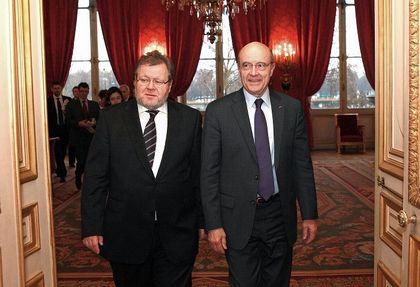
    France has agreed to cooperation with Iceland regarding the Arctic. The foreign ministers of the two countries met this week to finalize the agreement.

    Mr. Össur Skarphéðinsson of Iceland and Mr. Alain Juppé of France met and discussed several matters.

    “We agreed to a cooperation regarding the Arctic. This is in line with our policy of engaging cooperation related to relative projects with as many nations as possible,” Össur said to Fréttablaðið.

    France will invite Icelandic researchers to their stations, both in Ny Alesund in Svalbard and to Antarctica. Iceland will invite French specialist to Akureyri for research there.

    Close cooperation between the University of Akureyri and the established University Pierre and Marie Curie will be engaged.

    Iceland will also participate in a big project related to economic and social impacts of climate change in the Arctic.

    Sources

    Fréttablaðið

  • Joint Canadian-Russian council?

    Joint Canadian-Russian council?

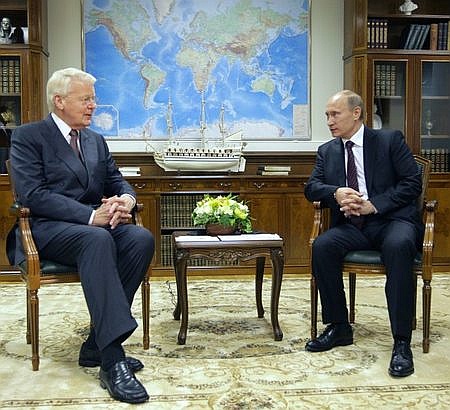
    Vladimir Putin and Ólafur Ragnar Grímsson

    The relationship between Canada and Russia is set to strengthen with an establishment of a joint research council. The countries relationship is thought to be stiff.

    “We have normal relations,” said newly elected president Vladimir Putin said, adding that he would like to meet with Stephen Harper, prime minister of Canada, at coming G8 and G20 summits. “The volume of trade is very low. Perhaps that is part of the problem.”

    Putin spoke to a group of six newspaper editors invited to his residence outside Moscow. In response to questions about Canadian relations, he said he would push for a joint scientific team, and pointed to a successful Russia-Norway approach to Arctic sovereignty.

    “The border of the continental shelf needs to be determined by scientists,” he said. He also tried to calm concerns over Russian exploration. “You needn’t suspect us of some kind of unilateral action. Yes, we have been exploring the shelf. What’s wrong with that?”

    The words from Putin are encouraging as Canada and Russia share boarders in the middle of the Arctic Ocean where land claims are being disputed. A joint research council could help the relationship between the two Arctic giants across the Arctic Ocean in the search for resources in the north.

    Source: The Globe and Mail

  • Life found in the Little Ice Age

    Life found in the Little Ice Age

    Arctic trees are older than many thought

    Many established scientist thought that trees were wiped off in the north in the Little Ice Age, which started some 115.000 years ago. That is not the case according to Danish scientist.

    Their newly published study claims that that conifer grew in northern Scandinavia in the glacial period despite several kilometer thick ice sheets.

    A huge ice sheet covered the Northern region of the world, melting some 9000 years ago. But the research show that the conifers protruded from the enormous ice sheet, on islands and in coastal areas.

    “This means that we need to rethink how life reacts to global climate changes and that life on Earth is a lot more robust than we think,” says Professor Eske Willerslev, of the Centre for Geogenetics at the University of Copenhagen, who headed the research.

    The scientist used DNA technology to determine that the trees did not have to completely emerge from the south around 9000 years ago, some actually survived.

    The Swedish professor of physical geography at Umeå University, Leif Kullman, caused a heated debate among scientist when he claimed that he found remains of trees throughout Scandinavia that dated back before the time the ice melted away. That suggested that ice free areas did exist, causing a stir in the scientific community. Now the new proof supports Kullmans theory.

    After researching over 100 European spruces the researchers found two gneric types, one of which is only found in Scandinavia. The other specie migrated from the south.

    Sediments at the bottom of a lake in Trøndelag in central Norway revealed samples of 10,300 year-old DNA, which indicate that the indigenous Scandinavian spruce type was located in central Norway, while the country was supposed to have been covered by a thick layer of ice.

    From samples dating back some 20,000 years, they also managed to identify DNA from both pine and spruce on the island of Andøya in northwestern Norway. “This means that Kullman, who everyone though was mad, was probably right,” says Willerslev.

    Sources

    Science Nordic

    BBC

  • Bright future for new solar panels

    Solar energy panels

    Norwegian scientists have found a new, cheap and environmental friendly way to use solar power. The new substance is metal hybrides that Research Fellow Trygve Mongstad has found to be very effective.

    “These metallic hydrides are chemical compounds consisting of a metal bound with hydrogen,” Mongstad explains. He works at the Institute for Energy Technology (IFE) at Kjeller, Norway.

    The new solar panels can be described as little discs of glass that have a thin coating of vaporized magnesium-nickel hydride.

    These metal hybrides are the same ones that were once used in hydrogen fuel-cell cars.

    “Here at IFE’s solar energy department we are experimenting with exciting new uses for the characteristics of metal hydrides,” he says and adds that he has hopes that metal hydrides can be put to the same use in solar cells as is crystalline silicon, the dominant bulk material for solar cells.

    One of the best things is that the new cells are even cheaper than the existing ones. “Solar cells are cheaper than ever but still not affordable enough for solar energy to compete on a large-scale with, for instance, coal-fired power plants,” he says.

    He adds that although the solar industry is going through a hard time it is still the way of the future.

    Solar cells are all about the efficiency, todays panels have the efficiency of 10-20 percent, depending on the technology. The efficiency goes up to 43% on the new panels according to Mongstad.

    The raw materials are readily available and consist of cheap metals and hydrogen. These materials are environmentally friendly and in this context non-toxic. As the thickness is just one-hundredth of that of silicon cells, they require less energy to manufacture.

    Sources

    Science Nordic

  • One month for Rovaniemi abstracts

    One month for Rovaniemi abstracts

    Rovaniemi, Finland

    The 5th Polar Law Symposium will start in Rovaniemi, Finland, on 6th of September. The two day event will bring together internationally renowned scholars from all over the world where the Arctic will be the main focus.

    There are several themes for the symposium, as seen below. Previous symposia have proven to be extremely successful in promoting both scholarship and understanding of polar issues.

    Their outcomes were beneficial to scholars, students and academicians, government agencies, policy makers, jurists and various stakeholders alike.

    The symposium invites researchers, faculty members, young scholars, jurists, post-graduate research students, policy makers, stakeholders and others interested to submit abstracts within the scope of the below mentioned theme.

    The abstract should contain no more than 200 words and should be sent to Kamrul Hossain by 31. March 2012.

    The theme for the symposium is quite open. It covers a wide variety of topics relating to the Arctic and the Antarctic.


    • Human rights issues, such as autonomy and self-government vs self-determination, the rights of indigenous peoples to land and natural resources and cultural rights and cultural heritage, indigenous traditional knowledge.
    • Local and national governance issues.
    • Environmental law, climate change,security and environment implications of climate change, protected areas and species.
    • Regulatory, governance and management agreements and arrangements for marine environments, marine mammals, fisheries conservation and other biological/mineral/oil resources.
    • Law of the sea, the retreating sea ice, continental shelf claims.
    • Territorial claims and border disputes on both land and at sea.
    • Peace and security, dispute settlement.
    • Jurisdictional and other issues re the exploration, exploitation and shipping of oil, gas and minerals, bioprospecting.
    • Trade law, potential shipping lines through the northwest and northeast passages, maritime law and transportation law.
    • The roles and actual involvement of international organizations in the Polar regions, such as the Arctic Council, the European Union, the International Whaling Commission, the Nordic Council, the North Atlantic Treaty Organization, and the United Nations, as well as NGOs.

    These include:

    • Human rights issues, such as autonomy and self-government vs self-determination, the rights of indigenous peoples to land and natural resources and cultural rights and cultural heritage, indigenous traditional knowledge.
    • Local and national governance issues.
    • Environmental law, climate change,security and environment implications of climate change, protected areas and species.
    • Regulatory, governance and management agreements and arrangements for marine environments, marine mammals, fisheries conservation and other biological/mineral/oil resources.
    • Law of the sea, the retreating sea ice, continental shelf claims.
    • Territorial claims and border disputes on both land and at sea.
    • Peace and security, dispute settlement.
    • Jurisdictional and other issues re the exploration, exploitation and shipping of oil, gas and minerals, bioprospecting.
    • Trade law, potential shipping lines through the northwest and northeast passages, maritime law and transportation law.
    • The roles and actual involvement of international organizations in the Polar regions, such as the Arctic Council, the European Union, the International Whaling Commission, the Nordic Council, the North Atlantic Treaty Organization, and the United Nations, as well as NGOs.
  • Oil service station in Iceland?

    Oil service station in Iceland?

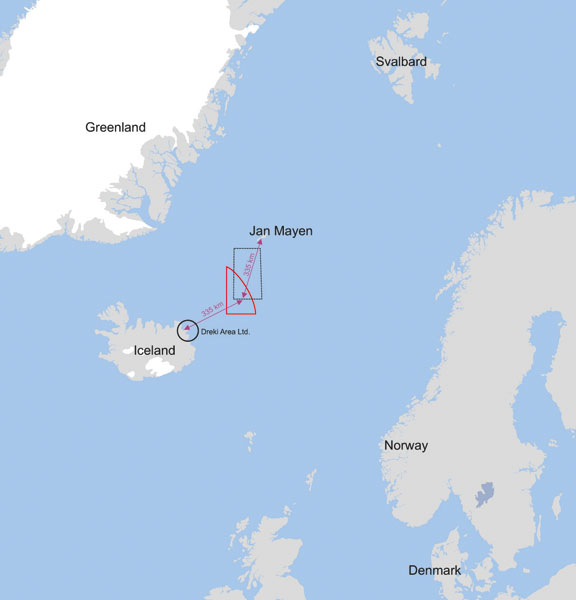
    Map of the Dreki area

    Norwegian company Sagex Petrolium has requested information about servicing for oil entities in the eastern part of Iceland. Looking to the Dreki area, oil processing could be feasible in the area in the near future.

    The request was sent to Norwegian authorities. The area is just south of Jan Mayen, but the most promising oil area is around 260km from the islands.

    The distance to the nearest harbour in Iceland is 400km. The advantage is that Iceland has infrastructure in place and a good airport and deep fjords, convenient for sailing.

    Jan Mayen is not feasible since the infrastructure is small and the airport primative. It would mean a lot of money and nature röskun for the area.

    Although oil is thought to be in the area, it is not clear if it is in workable state.

    The municipality of Þórshöfn, Langanesbyggð, is already working on possible oil servicing areas in the eastern part of Iceland, in conjunction with the town of Vopnafjörður.

    Sources

    Stöð 2 TV Channel