Category: News & Press Releases

Arctic Portal News Portlet

  • New study confirms oil formations in Dreki

    New study confirms oil formations in Dreki

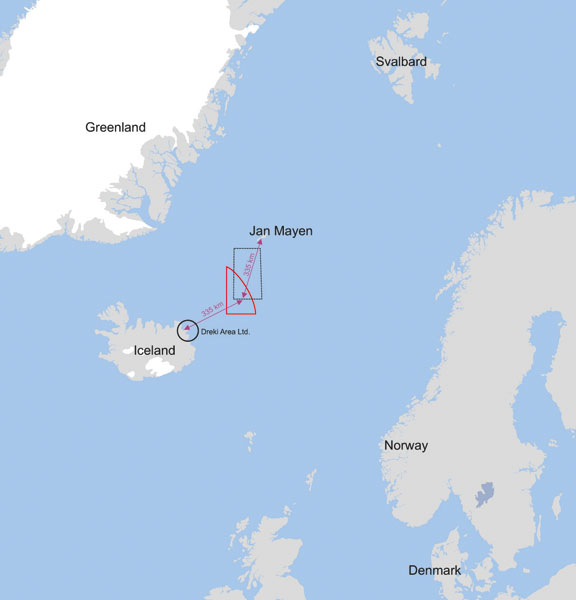
    Dreki area map

    Results from a new study show that oil can most certainly be found in the Dreki area. Two companies, TGS and Volcanic Basin Petroleum Research (VBPR) collected samples that confirmed this.

    High hopes have remained for a long time that oil could be found in the Dreki area. The map shows where it is; both Iceland and Norway have the rights for resources in the area.

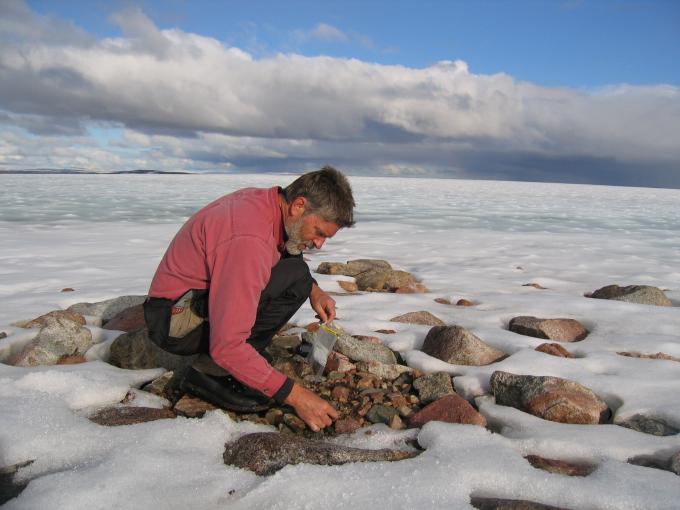
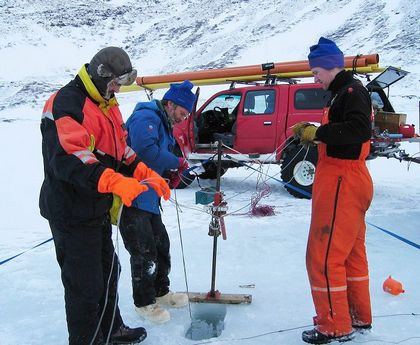
    The two companies collected over 200kg of samples from a 1000m high rig underwater. The samples were taken from 12 areas.

    According to Icelander Kristinn Einarsson from the National Energy Authority in Iceland, says that this confirms that oil formation is a fact and this is the best result yet that oil can indeed be found in the area.

    “The samples are taken from rocks from the Jurassic period, 200-150 million year old rock formations,” Kristinn told RÚV.

    Prior to last summer no rocks older than 50 million years had been drilled or sampled in this area. Advanced geochemical analyses of the recovered sediments suggest active seepage of Jurassic oil and a working hydrocarbon system.

    A comprehensive project report is available for immediate delivery. The report is highly relevant for the current Icelandic Licensing Round but also for deep water exploration along the European and Greenlandic continental margins. For the report, see the energy authority website.

    Bidding for the search will open in April.

    Sources

    RÚV (Icelandic National Television)

    National Energy Authority in Iceland

  • King Penguins recovered fully

    King Penguins in Antarctica

    The King Penguin has recovered from near extinction some 80 years ago. They are over 500.000 in Antarctica, again. It was in 1919 one of the first wildlife campaign started.

    It was triggered when only around 4000 animals were left after gruesome slaughtering. The ban of hunting them and reduced fishing in the area allowed them to recover.

    New Zealand blubber merchant Joseph Hatch made his fortune by boiling 3 million penguins to extract oil for lamps. This was around 100 years ago.

    The penguins were caught at Macquarie Island, a remote island between Antarctica and New Zealand.

    DNA analysts report that the genetic diversity of the population is close to pre slaughter levels.

    “It is remarkable that a nearly extinct population has recovered levels of past genetic diversity in only 80 years,” says Tim Heupink of Griffith University in Nathan, Australia.

    Heaupink studied 17 king penguins which he caught alive. He took flesh from their feet and released. He then compared their DNA to bones found in a former colony of Penguins around 1000 year old.

    It brings hope that properly protected, other beleaguered populations of birds and mammals can swiftly regain not just their numbers but also their genetic diversity – which is vital to long-term survival.

    Sources

    New Scientist

  • Same quota for Minke whales in Norway

    Same quota for Minke whales in Norway

    Arctic Portal news

    The Norwegian Ministry of Fisheries and Coastal Affairs has renewed the quota of Minke whales in Norwegian waters. The quota of 1286 animals is the same as last year.

    The quota is set based on models developed by the Scientific Committee of the International Whaling Commission (IWC).

    “With this we have decided on a quota that fulfills the necessity of sustainable development of the harvesting of the whale stocks,” Lisbeth Berg-Hansen, the Minister of Fisheries and Coastal Affairs said.

    Berg-Hansen also stressed that Norway must facilitate for continued stability and favorable conditions for the whaling industry.

    Sources

    BarentsObserver

    Ministry of Fisheries in Norway

  • Nordic Council meets in Reykjavík

    Nordic Council meets in Reykjavík

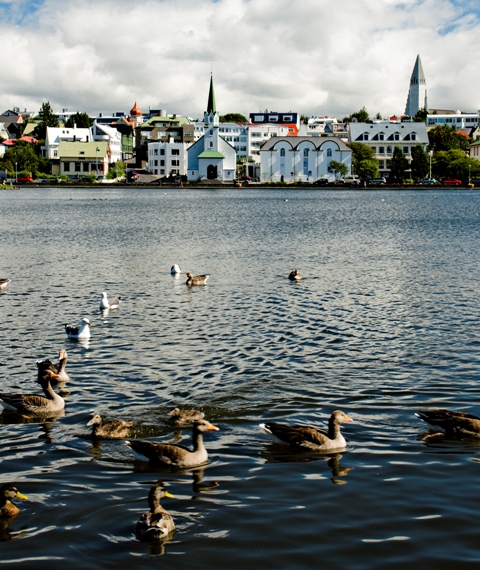
    Lake in Reykjavík

    The first Nordic Council theme session of the year will be held in Reykjavík Iceland in March. The Arctic will be in the forefront of the session.

    On March 23rd a plenary debate is scheduled which will highlight Arctic issues from an environmental-, equality- and welfare perspective.

    It will be broadcasted live online.

    The many and complex political challenges faced in the Arctic is also one of three main themes for the Finnish Presidency of the Nordic Council in 2012.

    Promoting a form of development that guarantees the living standards of the Arctic people is one of the key issues of the presidency, according to the Norden website.

    “A balance has to be struck between the rights and needs of the people and protection of the fragile natural environment, particularly because global interest in exploiting Arctic natural resources is growing, as is interest in opening up Arctic transport routes. A variety of national, regional and global bodies are involved in Arctic issues,” it states.

    The Nordic Council will have its meeting in Reykjavík two days prior to the theme session.

    Source: Norden

  • Great melt – But not in the Himalayas

    A melting glacier in the Himalayas.

    A new study led by a research team from the University of Colorado Boulder shows that glaciers and ice caps in the world, outside Greenland and Antarctica, are shedding roughly 150 billion tons of ice annually.

    This is the first comprehensive satellite study of the contribution of the world’s melting glaciers and ice caps to global sea level rise. The result indicates they are adding roughly 0.4 millimeters annually according to physics Professor John Wahr who led the study. Melting sea ice contributes to global rise in sea levels, which could lead to significant threats in the future.

    The team used satellite images to conduct the study and the annual shed between the years 2003-2010 was enormous. The total does not count the mass from individual glacier and ice caps on the fringes of the Greenland and Antarctic ice sheets — roughly an additional 80 billion tons.

    Launched in 2002, two GRACE satellites whip around Earth in tandem 16 times a day at an altitude of about 300 miles, sensing subtle variations in Earth’s mass and gravitational pull. Separated by roughly 135 miles, the satellites measure changes in Earth’s gravity field caused by regional changes in the planet’s mass, including ice sheets, oceans and water stored in the soil and in underground aquifers.

    One unexpected study result from GRACE was that the estimated ice loss from high Asia Mountains — including ranges like the Himalaya, the Pamir and the Tien Shan — was only about 4 billion tons of ice annually. Some previous ground-based estimates of ice loss in the high Asia Mountains have ranged up to 50 billion tons annually, Wahr said.

    A leading glacier expert in Iceland, confirms that the melt in the Himalayas is not as great as many have thought. He says that it is a misunderstanding that millions of people will be without water if the glaciers melt. Even if they melt, it would continue to snow in the Himalayas and it would be sufficient for the water supply.

    He also concluded that the total loss in the Himalayas was not sufficient, as the cap near the top in the Himalayas was getting thicker, while the outsides were shrinking.

    Tómas also point out that the great gap in between studies of the Himalayas shows that the measurements are not as accurate as many think. A study from a few years back showed great melt in the Himalayas, much greater then this study.

    Source: Colorado Boulder

  • From Pole to Pole with the Arctic Tern

    Bird marked with tracker

    Carsten Egevang, a researcher at the Greenland Institute of Natural Resources, has compiled a video which shows the travelling of the Arctic Tern.

    The video talks about the migratory odyssey of the Arctic tern. These terns fly from the Arctic to the Antarctic and back every year.

    During its lifetime, the tiny bird flies the equivalent of three round trips between the Earth and the Moon.

    The birds were marked and then visited a year later to compile the information. It took some time to spot the birds again!

    This amazing story has been put together in this video:

    http://www.youtube.com/watch?v=bte7MCSBZvo

  • Huge unused energy resource in Iceland

    Huge unused energy resource in Iceland

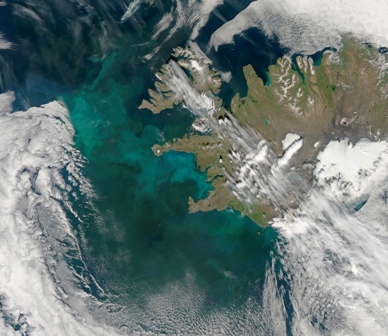
    Satellite image of Iceland

    Iceland is falling behind when it comes to usage of tidal power. The small nation in the Northern Atlantic is surrounded by ocean, yet it has failed to use its forces for energy.

    Research on tidal power has been miniature in Iceland. Geothermal energy has been the focal point.

    A total of 21 members out of 63 in the Parliament in Iceland have put forward a suggestion of more research and more money looks likely to be put in the research.

    A database of information will be set up in Iceland on the usage, which is long overdue. An expert thinks that this is one of the biggest unused energy resources in Iceland.

    Icelandic company Valorka has been granted the IIA 2011 awards for its invention, the Valorka turbine.  IFIA (International Federation of Inventors) grants this awards and the company has high hopes for the turbine.

    Valdimar Össurason is the inventor and owner of Valorka. “The Irish have researched their potential energy efficiency from tidal power to around 240tw hours per year. If we localize that to Iceland, it would be 330tw hours per year. That is 20 times the energy usage in Iceland, per year,” he said.

    A prototype for testing underwater will be made is his research is successful.

    Sources

    Fréttablaðið

  • Relation between weather and sea ice

    Relation between weather and sea ice

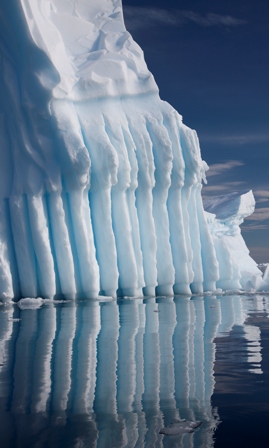
    Iceberg in the arctic

    The probability of snowy cold winters in Central Europe rises when the Arctic is covered by less sea ice in summer. Scientists of the Research Unit Potsdam of the Alfred Wegener Institute for Polar and Marine Research in the Helmholtz Association have made this discovery.

    The scientist have decrypted a mechanism in which a shrinking summertime sea ice cover changes the air pressure zones in the Arctic atmosphere and impacts our European winter weather. If there is a larce scale melt in the summer, like in recent years, two important effects are intensified.

    Firstly, the retreat of the light ice surface reveals the darker ocean, causing it to warm up more in summer from the solar radiation.

    Secondly, the diminished ice cover can no longer prevent the heat stored in the ocean being released into the atmosphere (lid effect). As a result of the decreased sea ice cover the air is warmed more greatly than it used to be particularly in autumn and winter because during this period the ocean is warmer than the atmosphere.

    “These higher temperatures can be proven by current measurements from the Arctic regions,” reports Ralf Jaiser, lead author of the publication from the Research Unit Potsdam of the Alfred Wegener Institute. The warming of the air near to the ground leads to rising movements and the atmosphere becomes less stable.

    “We have analysed the complex non-linear processes behind this destabilisation and have shown how these altered conditions in the Arctic influence the typical circulation and air pressure patterns,” explains Jaiser.

    Sources

    Alfred Wegener Institute

  • ACI’s 3rd Polar Shipping Summit

    ACI’s 3rd Polar Shipping Summit

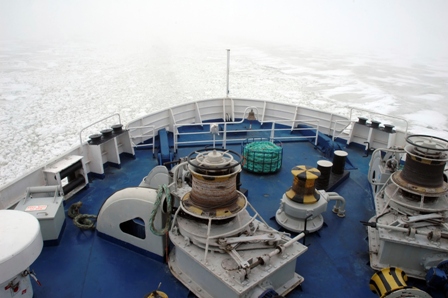
    Ship

    ACI’s 3rd Polar Shipping event will discuss in depth the business developments in the Arctic and the opportunities created for the shipping industry. The summit will be held in London, England, on the 30th of May, running until the 31

    .Providing a platform for networking and exchanging ideas on operational efficiency, safety, insurance and risk-management in  the Arctic, the summit’s aim is to offer delegates a tool for business development and improvement of their bottom line.

    Exploring new opportunities and rising to their challenge through the industry’s best practices whilst achieving financial targets is the ultimate goal of this event

    Tero Vauraste from Arctica Shipping will host the keynote address, representitives from Maersk and other big shipping companies will also post their addresses.

    Interactive roundtable discussion will also be held.

    Click here for the full agenda and contacts.

  • Little Ice Age caused by volcanic eruptions

    Little Ice Age caused by volcanic eruptions

    University of Colorado Boulder Professor Gifford Miller

    The Little Ice Age is a cold period that scientist have debated when begun, and how it started. New research sheds new light on this important time in question.

    A new study published in the Geophysical Research Letters, states that the Little Ice Age was caused by the cooling effect of several volcanic eruptions and sustained by changes in the Arctic ice cover.

    The research team conducted its work in Iceland and Canada, both in and near glaciers, and in ancient plants.

    The eruptions happened earlier then many have predicted the ice age began, just before 1300. Nasa for example says that it happened around 1550.

    This resulted in the Earth getting colder for centuries. The global dip was around 1°C, but parts of Europe cooled even more. The Thames River in London even froze.

    Disputes have arisen over what caused the cooling, but the new study concludes it was the volcanic eruptions. The four eruptions between 1250 and 1300 blasted huge clouds of sulphate particles into the upper atmosphere which cooled the Earth, because the sun´s beamc was reflected back into space.

    Researchers in Hvítárvatn Iceland

    “This is the first time we can put an almost specific dates to the Little Ice Age,” Icelandic researcher Áslaug Geirsdóttir said. She was one of the partners in the project.

    “Key elements were the cores taken from the bottom of Hvítárvatn lake,” she said. The lake is near Langjökull in Iceland.

    The scientists studied several sites in north-eastern Canada and in Iceland where small icecaps have expanded and contracted over the centuries. When the ice spreads, plants underneath are killed and “entombed” in the ice. Carbon-dating can determine how long ago this happened, according to the BBC.

    These plants provide a record of the icecaps’ sizes at various times – and therefore, indirectly, of the local temperature.

    An additional site at Hvítarvatn in Iceland yielded records of how much sediment was carried by a glacier in different decades, indicating changes in its thickness.

    When the researchers plugged in the sequence of eruptions into a computer model of climate, they found that the short but intense burst of cooling was enough to initiate growth of summer ice sheets around the Arctic Ocean, as well as glaciers.

    The extra ice in turn reflected more solar radiation back into space, and weakened the Atlantic Ocean circulation commonly known as the Gulf Stream.

    The eruptions are known to cool the earth for a short period of time, not 8000 years, but the scientists have discovered how this happened.

    Sources

    Geophysical Research Letters

    BBC

    NASA

    Fréttablaðið


    The tags below provide an opportunity to view previously posted related news within the selected category