Category: News & Press Releases

Arctic Portal News Portlet

  • Arctic Strategies and Policies – Inventory and Comparative Study

    Arctic Strategies and Policies – Inventory and Comparative Study

    Arctic Portal news

    The eight Arctic states – Canada, Denmark/Greenland, Finland, Iceland, Norway, Russia, Sweden and the USA – are responding to recent environmental, (geo)political and (geo)economic changes, and challenges of globalization.

    This includes (re)defining their northern policies and interests nationally, their position and role in the Arctic region as well as northern cooperation. Sweden´s launch of its strategy for an Arctic policy in May 2011 denotes the adoption of specific national arctic strategies or state policies by all Arctic states.

    Based on these strategies and state policies, their priorities and priority areas Dr. Lassi Heininen from University of Lapland, Finland, and the chairman of the NRF Steering Committee, has created an inventory on, and comparative study of, these national arctic / northern strategies and policies.

    The final version of the study will be completed in August 2011. The draft version, “Arctic Strategies & Policies: Inventory & Comparative Study” was presented to the Standing Committee for Parliamentarians of the Arctic Region in February 2011 in Tromsö, Norway.

    The study will be launched at the 6th Open Assembly of the Northern Research Forum in Hveragerdi, Iceland on the 4. -5. of September 2011. Simultaneously it will be made available online at the NRF web site: www.nrf.is

    The study will be published by the Northern Research Forum and the University of Lapland.

    Further information

    Contact Lassi Heininen

  • NRF 6th Open Assembly Open for registration

    Northern Research Forum

    Registration for the 6th NRF Open Assembly is now open. The 6th NRF Open Assembly will be held at Hotel Örk in Hveragerdi,south Iceland.

    The overall objective of the Open Assembly in Hveragerði, Iceland, is to address the impact of dwindling ice – terrestrial as well as ocean bound – on the complex interface of nature and society in all climatic zones of the world, with an emphasis on the Arctic, the Antarctic and the Himalayans. In light of the man-made part of climate change, particularly meaning global warming, and the natural phenomena of ice is gradually becoming a concept of global politics – a common heritage of humankind- affecting societal life in quite dramatic ways on a global scale. This turn in the interrelationship and working of the society/nature interface is the focus of the Assembly.

    Further information about the 6th NRF Open Assembly

    Registration for the 6th NRF Open Assembly

  • Arctic Frontiers 2012 – call for papers

    Arctic Frontiers 2012 – call for papers

    Arctic Frontiers

    The Arctic Frontiers (AFT) conference is a central arena for discussions of Arctic issues. The conference brings together representatives from science, politics, and civil society to share perspectives on how upcoming challenges in the Arctic may be addressed to ensure sustainable development.

    Arctic Frontiers (AFT) holds its 6th annual conference in Tromsø from 22-27 January 2012, Norway, with the title “Energies of the High North”. Arctic Frontiers 2012 will discuss the global energy outlook, and assess the potential of traditional and renewable energy resources in the North.

    Arctic Frontiers is composed of a policy section and a scientific section. This call for papers addresses only the scientific section from January 25th to January 27th 2012. The parallel sessions address 4 connected, interwoven and interdisciplinary themes:

    1. Arctic Geology, Hydrocarbon Reservoirs & Gas Hydrates
    2. Technological development & Environmental challenges
    3. Social, political and economic aspects of energy projects in the High North
    4. Renewable and Alternative Energy

    Interested scientists are invited to submit abstracts to one of these four sessions for both oral and poster presentations. Deadline for submission of abstracts: October 24th 2011

    For more information, download the complete Call for Papers and the abstract submission form on the AFT homepage

  • A New EU-Arctic Newsletter is out

    A New EU-Arctic Newsletter is out

    EU Arctic Forum

    The EU-ARCTIC FORUM, established in 2010, provides the European Parliament a platform on all issues with regard to the Arctic, facilitating exchange and input of information as well as interlinking the fragmented debates on the Arctic within the EU.

    The newsletter informs about activities in particular of the EU-ARCTIC-Forum and gives an overview on the development of the Arctic issues within the European Union.

    The June 2011 Newsletter can be read HERE

  • The seventh The International Congress of Arctic Social Sciences a success

    The seventh The International Congress of Arctic Social Sciences a success

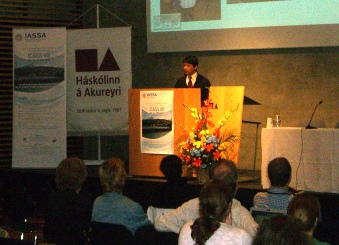
    ICASS speaker Sven

    The seventh The International Congress of Arctic Social Sciences (ICASS) that was held in the town of Akureyri, Iceland the days of 22nd – 26th of june is thought to be a great success.

    The theme of the conference, Circumpolar Perspectives in Global Dialogue, referred to the inter-linkage of worldwide environmental changes to the development of Arctic societies. The theme also referred to the fact that the Arctic is not just an empty wilderness with endless access to resources but an area inhabited with people that have to endure and adjust to environmental changes in their society.
    The conference hosted 10 sessions with 380 lectures about emerging social and cultural issues regarding the Arctic.

    During the Conference, an election was made about the location of the eight ICASS and the secretariat. It was decided that the ICASS VIII will be held in 2014 in Prince George, Canada. The IASSA secretariat will be located at University of Northern British Columbia (UNBC) in Prince George. Professor Gail Fondahl, University of Northern British Columbia, Prince George, Canada, has been elected new IASSA president for the term 2011-2014 and will take over as IASSA president September 1, 2011.

    Gail Fondahl

    Gail Fondahl submitted a bid for the IASSA secretariat – to be hosted by University of Northern British Columbia (UNBC), Prince George, Canada – and won the bid at the election for IASSA secretariat held at the IASSA General Assembly at ICASS VII in Akureyri. Three candidates were bidding for the IASSA secretariat; UNBC, Yukon College, and University of Nordland at Bodø.

    After the announcement of the location of the new secretariat, an election for IASSA council was held. Eight councilors were elected, and Gail Fondahl was announced new president by the newly elected IASSA council.

    There are nine councilors on the newly elected IASSA council: eight councilors were elected by the General Assembly; and IASSA President Joan Nymand Larsen (2008-2011) continues on the IASSA council as past president (ex-officio).

    IASSA Council 2011-2014:

    Gail Fondahl, president elect
    University of Northern British Columbia, Canada

    Joan Nymand Larsen, outgoing president (ex-officio)
    Stefansson Arctic Institute, Akureyri, Iceland

    Alona Yefimenko
    Indigenous Peoples Secretariat, IPS, Copenhagen, Denmark

    Andrey Petrov
    University of Northern Iowa, USA

    Birger Poppel (re-elected)
    University of Greenland, Nuuk, Greenland

    Chris Southcott
    Lakehead University & Yukon College, Canada

    Florian Stammler (re-elected)
    Arctic Centre, University of Lapland, Rovaniemi, Finland

    Peter Schweitzer (re-elected)
    University of Alaska Fairbanks, USA

    Tatiana Vlasova
    Russian Academy of Sciences, Moscow, Russian Federation

  • N.W.T. Oil Pipeline Leaks – Up to 1500 Barrels Spilled

    N.W.T. Oil Pipeline Leaks – Up to 1500 Barrels Spilled

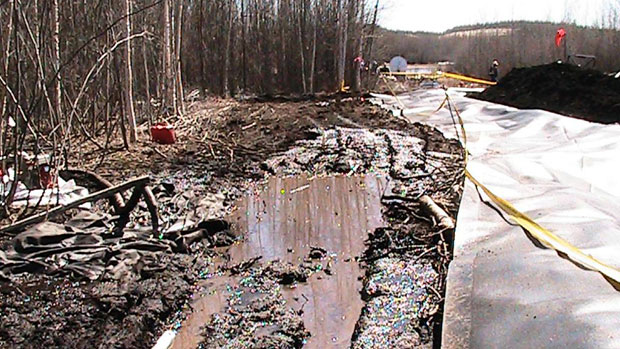
    NWT oil spill

    The Energy Company Enbridge Inc. says up to 1,500 barrels of oil may have leaked from its pipeline in the Northwest Territories last month, much higher than the company’s initial estimate of four barrels.

    On May 9, Enbridge Inc. reported that it had confirmed a crude oil leak from a pipeline on its Norman Wells System (Line 21) approximately 50 km south of the community of Wrigley, NWT. On May 20th Enbridge returned the Norman Wells line to service after completing the necessary repairs.
    According to Enbridge Inc., the oil remains contained and there are no impacts to moving water. Their original four barrel estimate was based on oil collected at the surface and did not take into account the subsurface impacts, which were believed to be not significantly, which they were.

    The increase in subsurface oil was discovered during the ongoing environmental site assessment, which includes subsurface analysis and is standard practice for all releases. Based on current estimates provided by the third party experts on site, Enbridge anticipates the release volume could range from a minimum of 700 barrels to a maximum of 1,500 barrels. Based on its current analysis, Enbridge anticipates the probability that the maximum volume would be exceeded to be low. The company has confirmed that they have removed approximately 100 barrels of oil.
    Chief wants inquiry

    The massive increase did not surprise the Wrigley Chief, Tim Lennie, who was among the first people to discover the leak. Lennie said while people in Wrigley, a community of over 100, had suspected it was a larger spill all along, the latest news is still hard to digest.
    “It’s anger, it’s frustration. I’m quite certain with this news, there will be more questions,” he said. “There needs to be an inquiry on this, I feel now.” states Lennie.

    River not affected, says company

    Third party experts are onsite and the company is working to define the subsurface impacts. Once this work is complete, a revised estimate of the size of the release can be determined. The company continues to recover oil and is shipping it off site. Contaminated water is being treated onsite. Contaminated soil will be removed once site conditions allow.

    Enbridge says it is important to note that the oil is contained in an area along and directly adjacent to the right of way and that no watercourses are threatened. There continues to be no impact to the Willowlake River. The area will be continued to be monitored closely. Crews of approximately 15 people, comprised of Enbridge and contract support personnel, are onsite and continue to recover crude oil, and conduct environmental assessment activities.

    Tim Lenniw Lennie however states that he has heard from people living in the area that the spill has impacted the area.
    The National Energy Board says it has no reason to doubt the information it has received from Enbridge, where the information from Enbridge is considered safe.

    The Norman Wells pipeline was back up and running on May 20, after repairs were made. Enbridge says the cause of the pipeline leak remains under investigation.

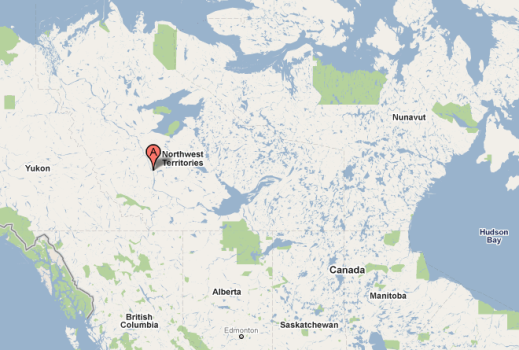
    Northwest Territories on a map

    Source:

    CBC News

    Enbridge Inc.

  • Greenpeace activists on Arctic oil rig arrested

    Greenpeace activists on Arctic oil rig arrested

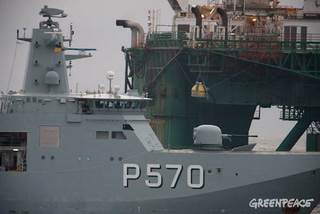
    Danish navy ship

    The Danish navy has reportedly confronted and arrested a crew of two environmental activists “occupying” a 53,000-ton offshore oil rig in a “survival pod” hanging from the Cairn Energy oil rig, about 100 miles off the coast of Greenland, the non-governmental organization Greenpeace announced late Wednesday via prepared statement.

    The anti-Arctic development group vowed to “continue their campaign after climbers believed to be from the Danish navy arrested an occupation team. “The world’s had its eyes on the activists for about a month, since the team occupied a British offshore oil rig, the Leiv Erikkson, as it made its way north. After that failed, Greenpeace decided to continue to follow the rig, reporting that since last Sunday two activists had been successfully dangled from the “survival pod” underneath it.

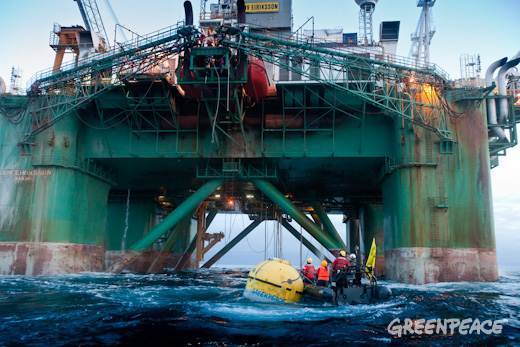
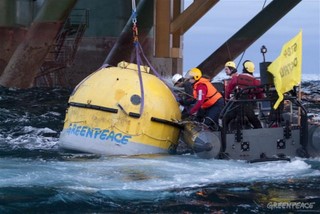
    According to the press release from Greenpeace, “a climb team operating from the rig broke into the pod–hanging 25 metres over the freezing Arctic Ocean–and arrested” the pair, one from England and the other from the U.S.

    cairn energy resccue pod

    “Our [Greenpeace] climbers are in jail now, but this won’t stop us opposing the madness of drilling for oil that we can’t afford to burn and in a region where a spill would be almost impossible to clean up. This isn’t over. We must keep on pushing till the oil companies get out of the Arctic,” the press release said.

    Greenpeace said in a web posting that it had delayed drilling, which must occur within a narrow window due to harsh weather conditions in the Arctic region, but Cairn Energy denied this.

    A Cairn Energy spokesman said there had been “no impact on schedule.”

    Cairn Energy is leading a charge into offshore Greenland, which explorers believe could hold billions of barrels of oil. Exxon Mobil, Husky Energy and others also plan to drill there. However, following BP’s Gulf of Mexico oil spill concerns about the difficulty in tackling offshore spills has increased and environmental campaigners have made Arctic drilling a key battleground.

    The Danish government is preparing to claim the North Pole for the Kingdom of Denmark, along with other areas of the Arctic, much of which is believed to be rich in oil and gas resources. New shipping routes, including the fabled Northwest Passage, are becoming accessible and thus exploitable as the Arctic ice recedes. This could become extremely beneficial for the Greenlandic society.

    Source: Alaska Dispatch
    Greenpeace

  • Greenpeace activists cling to Arctic drill rig

    Greenpeace activists cling to Arctic drill rig

    Greenpeace activists in Greenland

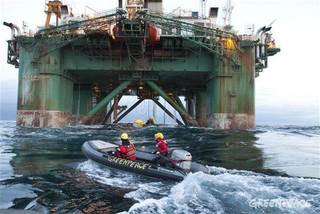
    On Sunday Greenpeace activists climbed up an oil rig off Greenland’s coast in an attempt to stop the Scottish oil company, Cairn Energy, from starting deepwater drilling in the arctic waters. The activists arrived at the rig in inflatable speedboats launched from the Greenpeace ship Esperanza, which had avoided a Danish warship shadowing them for days.

    The environmental group said the activists scaled the Cairn Energy rig early Sunday and are now hanging under it in a “survival pod”, which is occupied by two Greenpeace members. It said the group has enough food and water to stay there for 10 days. Cairn Energy had earlier this month won permission to drill up to seven oil exploration wells off the Arctic island’s west coast.

    Greenpeace has criticized Cairn, which is the only company drilling in the area, for not taking the extra precautions needed to avoid accidents such as the 2010 Gulf of Mexico oil spill.

    Greenpeace activists stuck to a pod in Greenland

    The company has said that they “seeks to operate in a safe and prudent manner” and pointed out that authorities in Greenland have established stringent operating regulations, similar to those applied in the Norwegian North Sea.
    Greenpeace said it hopes the action can stall Cairn’s plans to complete the exploration before winter, forcing the company to abandon the search for oil for another year. for they claim that if drilling is delayed for just a short time, Cairn could struggle to meet a tight deadline to complete the exploration before winter ice closes in, forcing it to abandon the search.

    Cairn Energy is currently the only company drilling in the area, but Greenpeace has warned that an arctic oil rush could be set off if the company strikes oil this summer.

    “We are preventing it from drilling because an oil spill up here would be nearly impossible to deal with due to the freezing conditions and remote location,” States Greenpeace campaigner Ben Ayliffe. “A BP-style blow-out off the Greenland coast would make the Deepwater Horizon clean-up look simple.”

    Greenpeace activists also climbed aboard the Leiv Eiriksson rig when it left a port in Istanbul in April, but were forced to abandon that protest due to bad weather. Last year, activists also tried to stop drilling in the area by climbing onto Cairn’s Stena Don rig.

    Source: physorg
    Greenpeace