Category: News & Press Releases

Arctic Portal News Portlet

  • Tenure Track for teaching and research personnel – University of Helsinki

    Tenure Track for teaching and research personnel – University of Helsinki

    University of Helsinki

    The University of Helsinki has introduced a TENURE TRACK for teaching and research personnel, intended to increase the predictability, competitiveness and attractiveness of academic careers while promoting internationalisation at the University.

    The University employs talented, motivated academics who have completed their doctoral degree three to seven years ago and have since accrued academic and other relevant qualifications. Successful applicants will be employed as assistant professors. The duration of the employment contract will be two to five years, depending on the appointee’s background and experience. If the appointee produces successful work which fulfils pre-determined criteria, employment may be continued with a second fixed-term contract, after which the appointee may receive a permanent position as professor.

    The academic qualifications and teaching experience of applicants will be considered when making the selection. Additional merit will be granted for working outside Finland and other international experience as well as experience in acquiring research funding.

    The Faculty of Science is announcing one open tenure-track position, located in the Division of Geography at the Department of Geosciences and Geography.

    The Department of Geosciences and Geography is among the leading Finnish research and education units in its field. In addition to research in geology and geography, the Department conducts seismologic research and attends to official duties related to seismology. The Department has an overall budget of more than EUR 7 million, and a staff of over 100, of whom 14 are professors.

    Major subjects available at the Department include geology, geography and regional studies. Geography comprises three specialisation options: physical geography, human geography and geoinformatics. In addition, geography offers the option to specialise as a subject teacher. Of the disciplines at the Division of Geology, quaternary and environmental geology as well as geochemistry and hydrogeology are particularly important partners for physical geography.

    The field of the assistant professorship is SPATIAL ENVIRONMENTAL RESEARCH

    The appointee to the position of assistant professor is expected to conduct research of an internationally high level. In addition, the appointee must take advantage of national and international research funding opportunities, participate in teaching and doctoral education at the Department as well as be active in the interaction between science and society at large.

    The Department places particular weight on documented research in the physical-chemical processes of aquatic and terrestrial environments or ecosystem research. The Department houses well-equipped, functional laboratories, which the assistant professor is expected to support in his or her research.

    Applications must be accompanied by an English-language curriculum vitae, a list of publications, a report on experience and qualifications which are relevant in the evaluation of teaching skills, as well as other relevant documents, or an English-language academic portfolio including the previously mentioned documents and the necessary information (instructions are available here: http://www.helsinki.fi/facultyofscience/vacancies/portfolio.pdf). In addition, the application must include a two-page English-language report on how the applicant intends to develop research in his or her own field while in this position.

    Upon request from the Faculty, applicants should prepare to submit ten publications of their own choice to be sent to assessors after the application period. The publications must be submitted via email as PDF attachments.

    The application must be addressed to the Faculty of Science. The Faculty requests that the application and its enclosures be sent to the University of Helsinki Registry via email to hy-kirjaamo(at)Helsinki.fi. Applications may also be submitted by post to the following address: University of Helsinki Registry, P.O. Box 33 (Yliopistonkatu 4), 00014 University of Helsinki, Finland. The closing date for applications is 27 April 2011 at 15.45 local Helsinki time.

    Further information may be obtained from Professor Miska Luoto, miska.luoto@helsinki.fi, tel. +358 9 191 50768.

    Helsinki, 28 March 2011
    University of Helsinki Central Administration

    University of Helsinki

  • Royal Arctic Charity Expedition

    Royal Arctic Charity Expedition

    Prince Harry

    Britain’s Prince Harry will join a team of wounded military servicemen at the start of their expedition to trek unaided to the Geographic North Pole.

    The Prince – Patron of the charity Walking with the Wounded – will join the group at their base camp in Longyearbyen, north Norway on 29th March, where he will undertake three days of training with the team. The Prince will then trek with the team for five days as they commence their expedition high above the Arctic Circle. Prince Harry will depart the ice on 5th April, to return to the United Kingdom for continued military training.

    The Walking with the Wounded team includes four wounded soldiers, who have suffered life-changing injuries during active service, including two amputees. They will be accompanied by two expedition leaders and a Norwegian polar guide. Their four week expedition will see the team covering up to 200 miles of the frozen Arctic Ocean by foot, pulling their own equipment in sleds weighing in excess of 100kg and in temperatures that can drop to minus 45° celsius (-49°F)

    The Walking with the Wounded Expedition supports other charities that help injured soldiers rebuild their lives. The money raised from this expedition will be used for educational courses and training programmes to aid rehabilitation back into ordinary life.

    Source: The Prince of Wales

  • Call for Proposals to be supported via the INTERACT Trans-National Access program for the summer season 2011

    Call for Proposals to be supported via the INTERACT Trans-National Access program for the summer season 2011

    Arctic Portal news

    International Network for Terrestrial Research and Monitoring in the Arctic INTERACT has a main objective of building capacity for identifying, understanding, predicting and responding to diverse environmental changes throughout the wide environmental and land-use envelopes of the Arctic.

    INTERACT was proposed by the existing SCANNET network of field stations situated in all eight Arctic countries. The cooperation has a long history between the European members, resulting from EU-funding in 2001-2004 within the 5th Framework Programme. This bottom-up network has expanded during the last 6 years with new members from Russia and North America to become a true circumarctic network of terrestrial field stations.

    The INTERACT contract under FP7 has a Trans-National Access program that offers access to 18 research stations in Northernmost Europe and Russia. The call is now open for the summer season 2011.

    For further information, please visit the INTERACT homepage

  • International Network for Circumpolar Health Research (INCHR) Annual Meeting and Scientific Sessions

    International Network for Circumpolar Health Research (INCHR) Annual Meeting and Scientific Sessions

    logo_thule

    INCHR Annual General Meeting (AGM) will take place at Oulu, Finland, on June 14-15, 2011. The program consists of a Sámi Health workshop and INCHR Scientific Sessions with oral and poster presentations, and of an INCHR General Assembly. New members welcome -membership application will be available at the meeting!

    The registration fee 75 Euro includes lunch, coffee and congress material. Detailed information about the program, registration, accommodation and abstract submission can be found from the INCHR website and from the congress secretary, Dr Hannele Savela.

    The deadline for abstract submission is on April 1st , 2011. The deadline for registration is on May 15th, 2011.

    Summer Institute in Circumpolar Health Research (SICHR)

    The Summer Institute in Circumpolar Health Research will be held in Oulu, Finland, 13-17 June 2011. It consists of two 1.5 day courses, aimed to PhD level and other graduate students. The registration to the courses is open on-line until May 15th 2011.

    Registration fee is 150 Euro for one course and 250 Euro for both courses. The course fees include participation in the INCHR Annual Meeting meeting on 14-15 June. The travel and hotel bookings are an individual responsibility of the participants. The deadline for registration for the courses is on May 15th, 2011.

    Course 1: Contaminants and Human Health, June 13-14, 2011

    The course gives the students knowledge about current contaminants, their sources and health effects on human and surrounding environment in the Arctic regions and populations. Further on, the students will have the awareness of different assessment methods related to health effects of contaminants, and how the health effects are evaluated and validated on a population level.

    Course 2: Risk Communication, June 16-17, 2011

    University of Oulu

    The course gives the students an overview on different aspects related to risk communication: concepts, definitions and ethics of risk communication, risk communication models, process of risk communication, case study examples, risk assessment and management in relation to risk communication, risk management and community decision making , conflict resolution by risk communication, conflicting risks and messages and difficulty of communicating scientific information.

    Travel grants: Nordic PhD level students are entitled to apply for a course travel grant, including registration, travel and accommodation costs. The grant also covers free participation to INCHR Annual Meeting. If you are interested in applying a travel grant, please contact Dr Kirsi Latola, Thule-institute, University of Oulu, by May 15th, 2011.

    The events are organized by the INCHR and the Centre for Arctic Medicine at Thule Institute, University of Oulu. The courses are arranged in collaboration by the fore mentioned institutions and the Finnish Graduate School of Toxicology . The student travel grants and the financial support for the courses are provided by NordForsk Top-level Research Initiative “Effect studies and adaptation to climate change”, organized by the Nordic Network “People and Ecosystems in a changing world “.

  • Arctic Report Card

    Arctic Report Card

    Dissolving Sea Ice, South of Svalbard

    Issued annually, the Arctic Report Card is a timely source for clear, reliable and concise environmental information on the state of the Arctic, relative to historical time series records.

    Material presented in the Report Card is prepared by an international team of scientists. The Arctic Report Card is collaboratively supported by the international Arctic Council.

    The Conservation of Arctic Flora and Fauna (CAFF) Circumpolar Biodiversity Monitoring Program (CBMP) provides collaborative support through the delivery and editing of the biological elements of the Report Card.

    The 2011 Arctic Report Card has been published. Amongst the results are significant changes in the atmosphere and the sea ice and the ocean.

    The NOAA (National Oceanic and Atmospheric Administration) issues the Arctic Report Card annually The Arctic Report Card is a timely source for clear, reliable and concise environmental information on the state of the Arctic, relative to historical time series records.

    Among the 2011 highlights are:

    Atmosphere: In 2011, the average annual near-surface air temperatures over much of the Arctic Ocean were approximately 2.5° F (1.5° C) greater than the 1981-2010 baseline period.

    Sea ice: Minimum Arctic sea ice area in September 2011 was the second lowest recorded by satellite since 1979.

    Ocean: Arctic Ocean temperature and salinity may be stabilizing after a period of warming and freshening. Acidification of sea water (“ocean acidification”) as a result of carbon dioxide absorption has also been documented in the Beaufort and Chukchi seas.

    Land: Arctic tundra vegetation continues to increase and is associated with higher air temperatures over most of the Arctic land mass.


    Here is a video from NOAA about the report.


    2010 Report card:

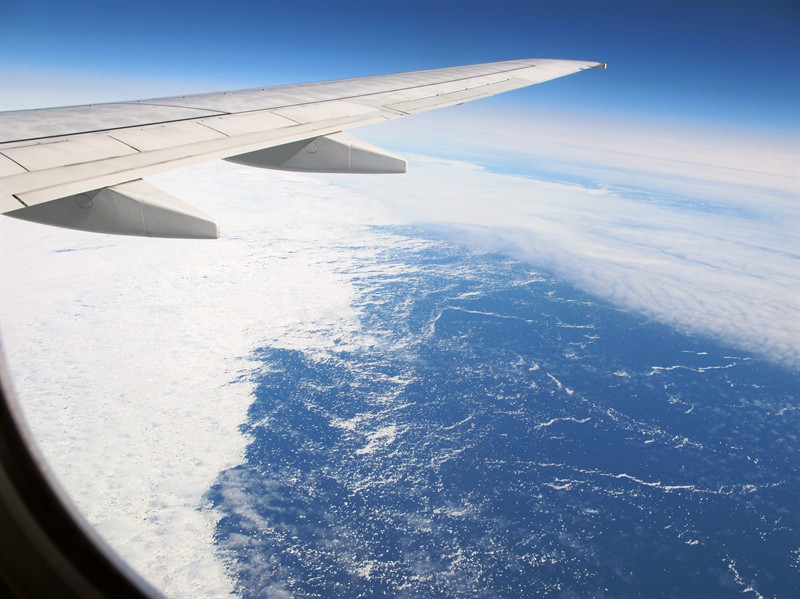
    ice glacier from above

    Highlights of the 2010 report card is:

    • Four years of record minimum sea ice extents
    • Record temperatures and ice loss in Greenland
    • Strong links between the Arctic and mid-latitude weather in winter 2009-2010

    Below is a video about the 2010 report card.

    [http://www.youtube.com/watch?v=NjmHMSv2Amk]

  • Environmental Protection

    Environmental Protection

    Arctic Portal news

    Offshore Oil and Gas Development in Northwest Russia: Consequences and Implications – Bellona Foundation

    • Introduction
    • Ch.1: Oil and Gas Resources on the Arctic Continental Shelf in Russia
    • Ch.2: Transporting oil and gas in Northwest Russia
    • Ch.3: Environmental Risks when extracting and exporting oil and gas
    • Ch.4: Oil and gas accidents – prevention and liquidation
    • Ch.5: Environmental Impact of oil and gas activity in the Arctic
    • Conclusion


  • Political overview

    Political overview

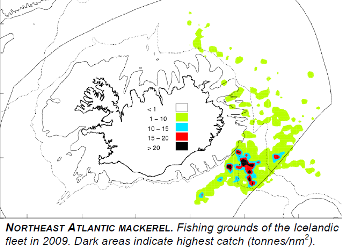
    Northeast Atlantic Mackerel fishing grounds

    “Counting fish is somewhat just like counting trees, except you can’t see the fish and it moves” This joke explains the nature of fish and its ability to move. Living resources like fish and other marine animals change their distribution patterns in relation to their habitual conditions, regardless of Exclusive Economic Zones and other jurisdictional waters.

    This fact can and has caused some political disputes, even though the Legal issues in connection with maritime boundaries and rights to fisheries both in countries’ economic zones as well as international waters have mostly been settled under the United Nation Convention for the Law of the Sea (UNCLOS).

    The distribution patterns of some species are changing faster than international agreements and conventions, causing disagreement of utilization of those species. The most recent case is the Mackerel dispute of Iceland and the European Union and other contracting parties (coastal states) of the North East Atlantic Fisheries Commission (NEAFC).

    During the recent years, Atlantic Mackerel has entered Icelandic waters due to warming waters and is in search for nutrition. The Mackerel extracts biomass from Icelandic waters and migrates again into coastal states waters, causing a huge biomass transfer. The composition of the biomass that the Mackerel transfers is thought to be spawns and fingerlings of economically valuable species and nutrition for those economically valuable species, such as small capelin and herring. In spite of that, Iceland has not been issued any quota from the overall maximum allowable catch issued by NEAFC, based on recommendations from the International Council for the Exploration of the Sea (ICES).

    Halibut on drying racks

    In the beginning the EU and the other coastal states did not want to recognize the fact that Mackerel was in Icelandic waters, however the catch over the recent years in Icelandic waters can’t be ignored. The Mackerel started as a by catch with herring fisheries in Iceland but is now in great abundance that direct harvest of Mackerel has started. Therefore Icelandic officials issued a unilateral quota, since it was not allowed any from the overall maximum allowable catch issued by NEAFC, based on recommendations from ICES.

    Still, there is no agreement and currently Iceland has issued quota in Icelandic waters for 130.000 tons. That is addition to the total recommended catch from ICES, since the other states refuse to give share and accept Iceland as a coastal state with Mackerel. This economical and political approach by the states might therefore threaten the Mackerel stock since no agreement is available of total catch.

    Disputes like those might become more common in the future since changes are occurring and economical valuable species will move to find their ideal habitat and they do not care about man made Exclusive Economic Zones. Economical and political approach of controlling maximum allowable catch of species is not in favor of the environment. An ecosystem approach has to be established in order to be able to utilize marine resources in a sustainable way. In order to do that a collective responsibility has to be established within stakeholders of this abundant resource that has supported Arctic peoples and others over the centuries.

  • Economical opportunities

    Economical opportunities

    Arctic Portal news

    Northward shift of species might also have great economical opportunities for those countries and areas that are dependable on fisheries.

    A northward shift of species might bring in more economically valuable species into the area from the south and therefore benefit the local fisheries.

    Some shift in fisheries technologies will be needed, but that poses not a great threat, for human adaption is very flexible.

    A southern ward specie such as the Atlantic Mackerel has been shifting northwards due to warming waters.

    This has caused economical opportunities for countries such as Iceland and the Faroe Islands.

    The Atlantic Mackerel is valuable specie and could come as economical substitute specie for capelin, however the role of the Mackerel in the food web of the Arctic and the Sub Arctic is not known.

    Due to its size, it is not dependable food source for other species such as the Cod or the Pollock. Also, signs lead to that the Mackerel eats spawns, fingerlings and other small fishes, such as small herring and capelin.

    Therefore the Mackerel might be in direct competition with currents species for nutrition.

    It is however unknown if climate change will support growth of other smaller species that might come in substitution for current nutrition for higher species like Cod or Pollock

  • The Northward Shift

    fishing hole in the ice

    Climate change poses both threats and opportunities for Arctic fisheries. Those concerns include indicators of a major ecosystem northward shift, meaning that species will shift northwards in order to find ideal habitat conditions.

    Such shift has ambiguous effects, especially in economical terms, meaning that traditional species that are harvested might leave traditional waters, moving from one Exclusive Economic Zone to another and or into unfishable waters

    Some will lose their ideal habitat, since a northward shift is not infinite and species that are weaker to adjustment will lose in the competition for their ideal habitat. That poses a threat to the traditional commercial fisheries for countries and areas that are economical dependable of traditional fisheries of such species.

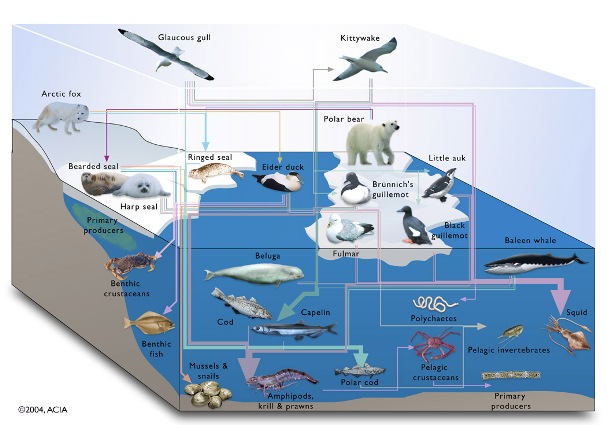
    Marine Food Web

    As an example, a northward shift of coldwater specie like capelin might have enormous affect to the biodiversity in the Arctic. Capelin feeds mainly from zoo plankton and is an important food source for many valuable benthic and pelagic species, such as Atlantic cod and Pollock.

    A northward shift of the capelin, due to warmer waters, might therefore affect other stocks significantly, even though warmer waters do not affect those species directly. The basis for growth of the Atlantic cod is capelin and without such important food source the cod needs to find substitute specie, like shrimp (which is also coldwater specie that is moving further north), herring, spawns, fingerlings or other smaller species.

    Species in the higher levels of the Arctic food web need to adapt by finding other food sources or simply move along with the current food source. One direct effect of climate change to one specie might
    therefore affect indirectly too many other species that depend on that species.

  • International Monitoring Plan for Polar Bears

    International Monitoring Plan for Polar Bears

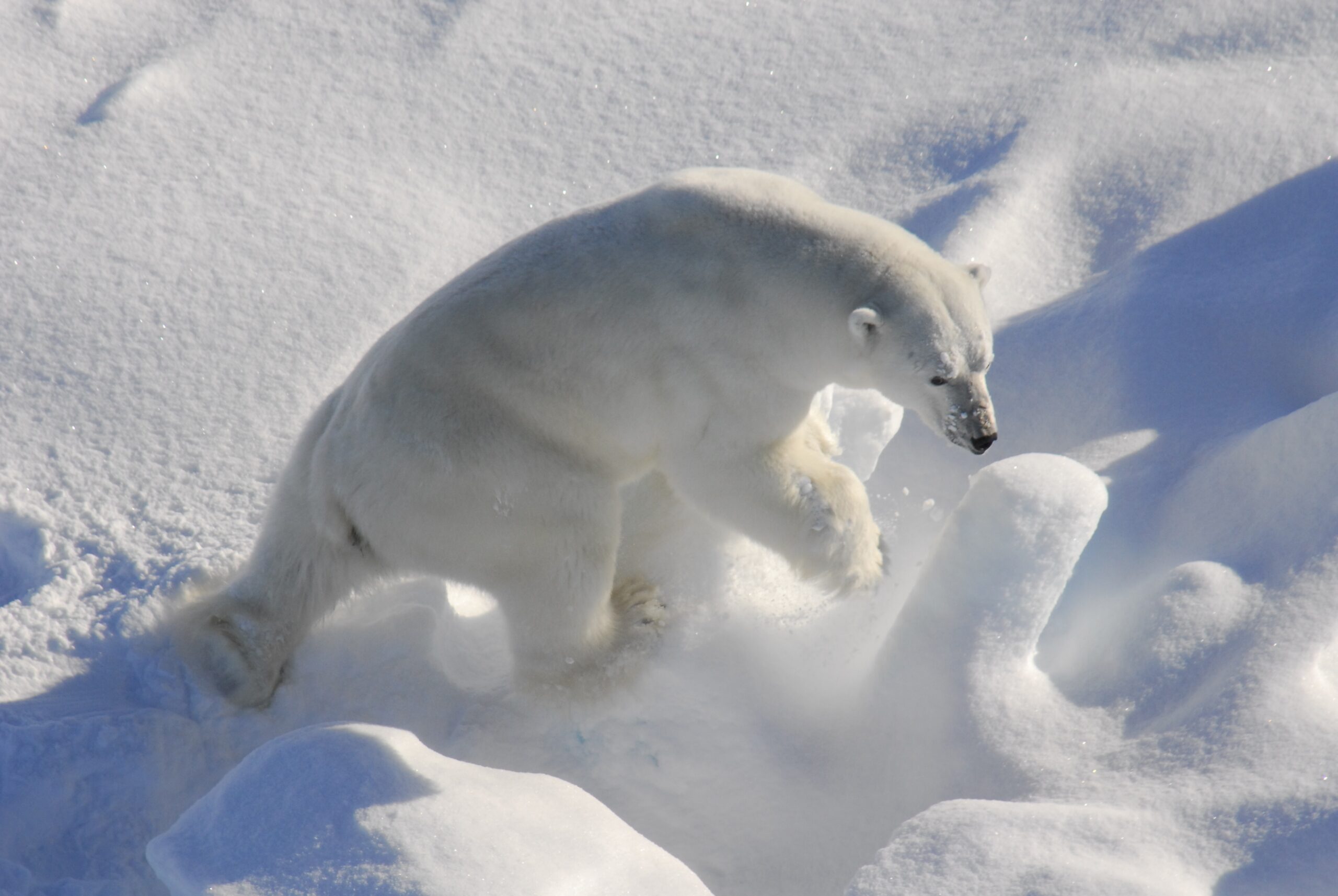
    Polar Bear

    Specialists Meet to Develop an International Monitoring Plan for Polar Bears

    Twenty-two scientists, managers and community experts from Russia, Norway, Canada, Greenland and the United States met in Edmonton, Canada

    on February 19th to 21st, 2011 to develop a Pan-Arctic Monitoring Plan for Polar Bears. The U.S. Marine Mammal Commission sponsored the workshop and the Conservation of Arctic Flora and Fauna (CAFF – www.caff.is) Working Group of the Arctic Council managed it. CAFF invited participants based on their expertise on polar bears and/or monitoring. Please download press package here

    The workshop focused on developing a coordinated and efficient pan-Arctic monitoring approach that would:

    • detect changes in polar bear populations across the Arctic,
    • implement standard assessment measures using community-based and scientific monitoring,
    • identify which subpopulations to monitor and the necessary frequency of monitoring,
    • use a suite of indicators to assess subpopulation status and trends,
    • identify the factors driving population changes, and
    • report the results to decision-makers from local communities to national government and regional bodies.

    Arctic ecosystems are changing rapidly and will continue to do so. Monitoring polar bears is a considerable challenge that will require substantial resources. To be successful, we must focus and prioritize circumpolar monitoring efforts and work together across national boundaries. Doing so is essential to better coordinate our assessment efforts, further our understanding, and convey the information needed to conserve and manage this remarkable species” said workshop organizer Dag Vongraven from the Norwegian Polar Institute.

    The results of the workshop will be used to develop a Pan-Arctic Polar Bear Monitoring Plan over the coming months (expected release September 2011). The draft plan will undergo comprehensive review prior to adoption.