Blog

  • Two working groups, one aim

    Two working groups, one aim

    Interactive Data Map

    Today, the 4th of December, Arctic Transportation Infrastructure Response and Capacity and Sustainable Development in the Arctic workshop brings together aviation and maritime specialists from eight Arctic states in order to discuss gaps in infrastructure around the remote Arctic.

    Two separated groups, during two hours sessions try to create terms that are going to be used internationally in future AMATII database. What is more, maritime and aviation working groups try to find the answer on what legal, regulatory and fiscal mechanisms facilitate inter-modal infrastructure investment.

    Mrs Sarah Barton, facilitator for maritime working group and Mr James Hemsath for the aviation will review and summarize team’s efforts in order to communicate the outcome to international and regional policy makers.

    Later today, participants will have a chance to view and evaluate the Arctic Port and Airport Database and web-based interactive map, which is the primary deliverable of this project. Subject matter expert input will help refine and strengthen this tool.

    The workshop will end with an interactive plenary session, discussing next steps and outlining areas of consideration for a Guidance Document, a deliverable for this Arctic Council project.

    The Conference will continue daily until Thursday.

  • From everywhere but Antarctica!

    From everywhere but Antarctica!

    Field trip to Dynjandi

    A master’s program in Coastal and Marine management on the Western tip of Iceland sees students from all over the world engaging in Arctic studying. The University Center of the Westfjords hosts the program which is described as a cross-disciplinary program that prepares students for diverse positions in both the public and private sectors.

    Among courses thought are Iceland’s Environment and Natural Resources, Understanding the Coast and the Ocean, Underwater Heritage, Aquaculture and Marine Renewable Energy.

    The University of Akureyri cooperates with the studies, UNAK has specialized in fisheries science and related matters for many years.

    The program at the University Centre of the Westfjords has been running since 2008. Before the program started it sought recognition and quality control from the University of Akureyri which in the end is responsible for the diploma. The fifth years started this fall but in total 40 students have graduated, the first ones in 2010.

    The website also states: “Among the fields which the master’s program in Coastal and Marine Management prepares students to work in are resource and land use planning, environmental impact assessment, consulting work, teaching and research. The program is internationally oriented and taught in English, and both students and instructors come from a diverse range of countries.

    The master’s program in Coastal and Marine Management brings together people of different backgrounds who share their experience, knowledge, and ideas in a small-scale, creative and fertile intellectual environment, with the goal of finding ways of using natural resources in a sustainable way. We welcome new faces to join our exciting group of natural resource management specialists.”

    A total of 92 have started the studies, 40 graduated and 46 are currently studying. Only a few have have abandoned the studies. “The students love their graduation day; they have a whole fjord for themselves!” Dagný Arnarsdóttir, the Program director, told BB, a local newspaper. The graduation is held in Hrafnseyri in Arnarfjordur, famous for the waterfall Dynjandi.

    Field trip in the westfjordsAccording to program manager Ingi Björn Guðnason the program has used social media for advertisement to reach the right people. “We have used Google and Facebook ads to lead people to our website which has detailed information about the program. We have also used specialized websites for advertisement which show different programs for students who want to travel to study. Later we have been lucky that the word has simply spread out about the program which we can thank both the students who have a good experience from here and the teachers as well. They have helped advertising the studies in numerous ways. That is probably the most effective advertisement, positive feedback from the students who talk to their friends about it. This positive feedback has allowed us to cut back on advertisement costs which were running high in the beginning.”

    Ingi says that visits to the University Centers website have increased greatly after this program was founded. They have grown greatly and can reach 700 per day, but in total it has 95.000 visits for the last year.

    Structure

    The program has three semesters, fall, spring and summer, which runs from April to July. Next is a thesis but students need to post a detailed description of their intended study for acceptance of a concession committee. “This year we will have a specialized workshop for the thesis and the result is a thesis question. Most students are graduated within two years but if they want they can leave after the courses, which take 18 months,” Dagný says.
     

    Each course is thought in a session, ranging from 2 to 8 weeks. They include lectures and individual and group projects. “We also try to use new technology as much as we can. Tests in a class room can be necessary in some countries, but how knowledge is measured and assessed, can differ greatly. We try to offer real project in the field when we can. We also use role-play for example to discuss different aspects to subjects from different groups. I see different kinds of valuations for the Universities in the future. A new generation is coming up of both teachers and students are coming up and the schools will have to adjust.”

    Westfjords the focal point

    The location of the program is unique, in the West of Iceland, which has some of the most prosperous fisheries in the country, and breathtaking landscape. “We encourage students to do their projects about the area here and the result is that two out of three have written or done material about the Westfjords or its fisheries. Students have a reputation of wanting to give something back to the society here and by filling in gaps of knowledge about anything related to the studies, they do so, for example writing about sustainable coastal areas or exploitation and protection of the oceans and the coast. The students often have close cooperation with organizations and companies for their thesis work.”

    Puffin in Iceland

    Many nationalities

    “We get applications from all over the world but we have to limit the students to their capabilities with first grade or higher, their language skills (for example the TOEFL test) and if we can be assured that their material is authentic. Over the years most students have come from Canada but it’s getting more international and more Europeans have come in over the last two years. We have representatives from every continent now except for Antarctica!”
     

    “The students choose their projects in a number of manners, Icelanders tend to write a little bit more about Icelandic related projects, but international students do the same, they also write about Icelandic projects.”

    Diversity in teachers

    Since the program has very little structure, no permanent staff for example, the knowledge has to be sought from diverse backgrounds. Getting teachers and instructors over the years has run smoothly and they are both Icelandic and international. “This is a real sign of quality for us. We have very high standards and have specific goals to keep, and this shows quickly in the Icelandic university environment.”

    “After the studies the students have either continued to study, either doing PhD studies and other masters programs. Most often the students go to their homes for jobs related to the studies. Many of them have excellent jobs, a few work in project management, some are specialists in ministries, some in aqua centers or national parks. One runs the biggest national park in Canada, one has built a national Park in East Congo under very hard circumstances. And our students have kept in touch with the Westfjords and will be back with their families at some point! They help us in promoting the area, and Iceland.”

    Future prospect

    “The future will see the University Center promote the knowledge even better than before, for example by translation projects to Icelandic. Another aim is to maintaining the knowledge in the studies with the institutions in Iceland,” Dagný says.

    Sources

    Bæjarins Besta

    University Center of the Westfjords website


    See also:

    Click here to enter the
    Arctic Portal News Portlet
  • Norway takes part in exploration in Iceland

    Norway takes part in exploration in Iceland

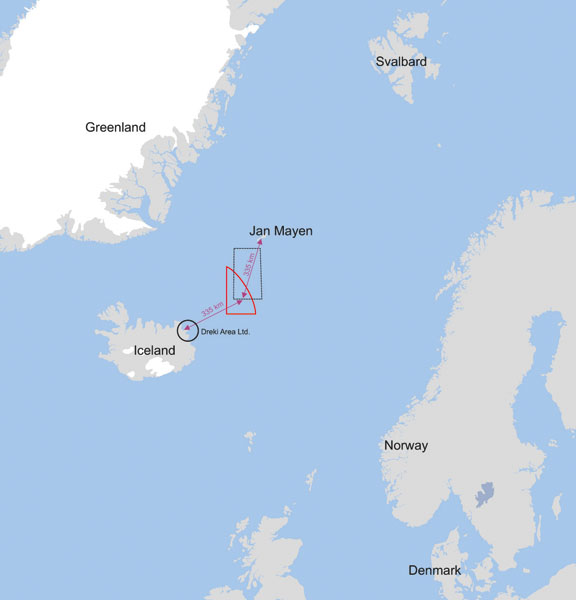
    The Dreki area on a map

    The National Energy Authority of Iceland (NEA) has today finished processing two applications for licences for exploration and production of hydrocarbons in the Dreki Area. The Ministry of Petroleum and Energy in Norway has today, 3 December 2012, notified NEA of their decision to participate in both licences to a 25 % share in accordance with the agreement between Iceland and Norway.

    NEA sought the opinions of the Ministry for the Environment and the Ministry of Fisheries and Agriculture in accordance with the hydrocarbons act and evaluated the opinions based on the applications and the work programmes involved.

    Furthermore, NEA made a careful evaluation of the technical and geological capacity of the applicants to handle the extensive activities associated with the licence. Finally, NEA studied the financial capacity of the parent companies of the applicants in order to ensure that the applicants have sufficient financial strength to conduct the activities for the long-term and can handle the corresponding environmental and safety elements.

    Following the processing of NEA of the applications

    Blue: Valiant Petroleum ehf. and Kolvetni ehf.  Red: Faroe Petroleum Norge AS, Branch in Iceland and Iceland Petroleum ehf.

    at the end of October, NEA made a decision to grant licences to Faroe Petroleum Norge AS, Branch in Iceland and Iceland Petroleum ehf., on the one hand, and Valiant Petroleum ehf. and Kolvetni ehf., on the other.

    Furthermore, the Norwegian authorities were notified of the decision, draft licences sent for their perusal and a formal answer requested on whether they intended to participate in the licences in accordance with the agreement between Iceland and Norway from 1981, which entails the right of Norway to participate in licences within the area of the agreement up to a 25 % share.

    The anticipated licensees have read the draft licences and submitted their comments, which NEA has taken into account as has been agreed by the parties involved. Norway has also participated in this process through the Ministry of Petroleum and Energy, i.e. gone through the draft licences and submitted comments to NEA.

    The Ministry of Petroleum and Energy in Norway has today, 3 December 2012, notified NEA of Norway’s decision to participate in both licences to a 25 % share in accordance with the agreement between Iceland and Norway.

    The licences cannot by issued before the Norwegian Parliament has approved the decision on the participation by the Kingdom of Norway through the State-owned oil company Petoro AS. Following this and the signing of the parties to the licences of their joint operating agreements, NEA will grant the licences, probably in the beginning of January of next year.

    A third application was received from Eykon Energy ehf. The processing of this application was delayed and the applicant given a respite until 1 May 2013 to find an additional participant in the licence that receives approval by NEA on having sufficient expertise, experience and capacity to undertake the licenced activities. NEA will take the application for final processing subsequent to receiving information on such a new participant in the application.

    Sources

    NEA

    Map of potential oil and gas areas

  • AMATII Workshop starts today

    AMATII Workshop starts today

    AMATII

    Monday, 3rd of December 2012 the workshop on Arctic Transportation Infrastructure Response and Capacity and Sustainable Development in the Arctic starts today in Hotel Natura in the capital city of Iceland – Reykjavik.

    The registration opens at 14.00 after which the small group brainstorming and crowd sourcing of definitions and terminology will take place.

    Arctic experts will meet in both plenary and work sessions to discuss infrastructure vis-à-vis response, technology and investment. Case studies and illustrative stories of northern aviation and marine infrastructure – contributed by participants – will serve to highlight the challenges of infrastructure development in the Arctic and its role in facilitating sustainable development.

    Participants will also have a chance to view and evaluate the Arctic Port and Airport Database and web-based map, which is the primary deliverable of this project. Subject matter expert input will help refine and strengthen this tool.

    The workshop will end with an interactive plenary session, discussing next steps and outlining areas of consideration for a Guidance Document, a deliverable for this Arctic Council project.

    Please, follow the links to read about the Arctic shipping and aviation challenges on the Arctic Portal Shipping Portlet.

    Source

    Institute of the North

  • Transpolar flights, a shortcut through the Arctic

    Transpolar flights, a shortcut through the Arctic

    Arctic Voyage of Richard Byrd and Umberto Nobile

    “Aviation is a proof that given, the will, we have the capacity to achieve the impossible.”

    Eddie Rickenbacker

    Long before the jet age, commercial aircraft were flying through the Arctic Circle. After the successful voyages of Richard Byrd and Umberto Nobile in 1926, the feasibility of polar aviation was demonstrated in actual practice. Nowadays, commercial traffic, connecting Europe, North America and Asia through the north polar routes is a routine.

    Cross-polar air corridors bring new opportunities for both commercial and private travel markets. Transpolar aviation reduces the burn of fuel by making the travel time shorter what lowers the cost of trans-polar air operations.

    Flying direct paths between many of North American and Asian cities also decreases the environmental threats of greenhouse gases emissions, which are now one of the major concerns of the Arctic States.

    Polar air corridors refer to aircraft routes lying across the uninhabited polar ice cap region, 78 degrees north from the northern latitude what includes areas of northern part of Alaska and most of Siberia. Term of Polar Route was originally adopted in the middle of 20th century and applied to the great circle between Europe and west coast of North America.

    The Polar Route formally opened after the Cold War for commercial flights between Europe and Asian Far East as before that period civilian flights were not able to cross the air space over the Soviet Union and China as those countries were much concerned about the possibility of trans-polar attack.

    Nowadays commercial traffic through the northern hemisphere is operated by various aircraft as Boeing 747 – 400 and Airbus A340, with ranges of around 7000 nautical miles. In 2001, Arctic States adopted policy letter, Guidance for Polar Operations, which outlined a number of specific requirements for polar flight operations, including cold weather conditions, special communication capabilities, fuel freeze strategy, evacuation and recovery plans for abandoned passengers and special monitoring requirements as the aircraft operating in the Arctic rely almost exclusively on satellite communications, where a pilot´s signal is beamed into the space and bounced back to a ground control station.

    Modern aircraft flying the polar route

    Arctic operating planes handle the distances between Europe, Asia and North America and are managed by various airlines. The International Air Transportation Association proposed the establishment of the Pacific Project which would meet the increasing air traffic demand between Asia and North America which is very likely to double by the end of 2025.

    Opening of new and improving strategies on already used air traffic routes offer possibilities to reach various locations in the northern hemisphere in easy and cost efficient way.

    Trans-Arctic shipping routes appear to emerge as the fastest way of transportation between North America and Asia. Flying direct paths across the uninhabited Arctic ice cap region, helps aircraft to reduce the fuel burns, travel time and associated environmental carbon emissions.

    Advanced transportation technology increases the importance of airships for trade and economic development. It is being defined that aircraft able to fly the Polar Routes are the most competitive in northern areas without highly developed infrastructure.

    There are 676 airports currently maintained around the Arctic and majority of them is situated in Alaska, United States. There are 79 airports in Arctic Canada, 71 in Russia, 62 in Denmark (Greenland and Faroe Islands), 56 in Norwegian Arctic including Svalbard, 55 in Finland, 35 in Sweden and close to 20 in Iceland. Not all of them exist as ports of entries for international traffic as those are partly used domestically.

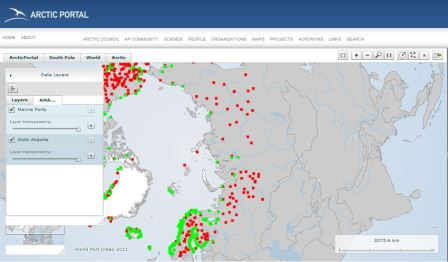
    (Map: Arctic Portal) Air shipping routes Interactive map aims to locate and provide with significant information with regards to Arctic airports. This research will show the mechanisms associated with Arctic air traffic in rather difficult, unique climate and familiarize with Arctic airports locations and information with regards to runway length and elevation to indicate approximate size of the airport and load classification.
    Trans – Arctic aviation leaves a significant scare in the fragile Arctic environment. All forms of air traffic used to cross the Arctic air space emit carbon dioxide and other greenhouse gases, like oxides of nitrogen and water vapor, into the northern atmosphere.

    Emissions of an Arctic airship can vary significantly, according to the size of the aircraft, the number of passengers on board, the distance of journey and the altitude as it was proved that aircraft flying on high altitudes produce more carbon dioxide than those operating on lower altitudes.

    Reducing air travels and Arctic air tourism opportunities seem to be another alternative way to reduce aviation impact on climate change and Arctic environment. If future travel demand could be managed with supplementary ways of transportation, increased taxation would not be needed to be implemented by the Arctic States.

    To read more about Arctic aviation, please enter the Aviation chapter in Arctic Portal Shipping Portlet.

  • EU in the Barents region addressed

    EU in the Barents region addressed

    NArFU conference discussions

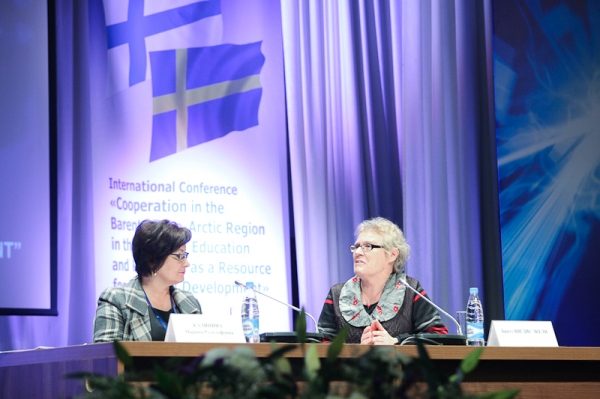
    Leading researches and experts, politicians, representatives from business and authorities are attending the conference “Cooperation in the Barents Euro-Arctic Region in the field of education and research as a resource for regional development”.

    The conference is held in the Northern (Arctic) Federal University (NArFU). 

    The conference yesterday started with the plenary session. Ingvild Broch, Coordinator External Review made a short overview of cooperation in the spheres of education and research in the BEAR and pointed out some future challenges. She touched upon some important historical facts of international cooperation between Russia and Scandinavian countries. Marina Kalinina, Vice-rector of International cooperation, NArFU spoke about “University as a Driving Force of Change” and named the priority goals of the Northern (Arctic) Federal University.

    Harry Malinen, Senior expert of the University of Lapland and Lapland University Consortium (Finland) talked about the opportunities for the universities within EU framework. He paid special attention to existing international programs in the Barents region and EU relevant for those who work within research and education area. Anatoly Smirnov, the President of the National Institute for Research of Global Security finished the plenary session with his report about information technologies in the Barents region.

    Later this day a new cooperation agreement was signed between NArFU and Finnmark College. Ingvar Hauge, the senior advisor of Finnmark University College and Elena Kudryashova, the Rector of NArFU signed the document that marks the beginning of a new stage in the history of collaboration between two universities. This agreement aims to develop partnership in educational and exchange programs as well as other important issues.

    “Murmansk and Arkhangelsk universities are the most important partners for us in Russia. I would like to bring forward cooperation in the fields like language, tourism, economics, social works, management of natural resources. And the most important sight of this cooperation is perhaps student and academic exchange, what I think we can bring forward,” Ingvar Hauge commented.

    After a short coffee break the participants of the conference went on parallel sessions that focused on different issues of Barents region cooperation and its connections to cooperation with business and industry, challenges in education, and carrier paths in BEAR for youth.

    Consul General of Sweden in St.Petersburg Mr. Jan Nyberg, visited NArFU in the framework of the conference this day as well. During a working meeting with Elena Kydryashova and Marina Kalinina he discussed the issues of cooperation between Russian and Swedish universities. Jan Nyberg also had an excursion around the campus and had a meeting with the students and lecturers from the Institute of Philology and Cross-Cultural Communication, who study Swedish language.

    During closing plenary session the participants had a possibility to sum-up the result of intensive sessions’ work and to share their findings and proposals for the new Kirkenes Declaration.

    Source

    NArFU

  • Online seminar on reindeers

    Online seminar on reindeers

    Reindeers on the run

    A seminar entitled Civilisation of Reindeer and future of the Arctic is shown live over the internet today.

    The seminar has many interesting speakers and presentation and it is easily accessible here.

    Nomadic Herders and Industrial Development of Natural Resources is held in the Nomadic Herders Days in St. Petersburg, Russia.

    The venue is Saint-Petersburg State University, Faculty of Geography and Geoecology and the chair of the today is  Dr. Konstantin Klokov.

    Source

    ICR

  • Barents cooperation stressed at NArFU

    Barents cooperation stressed at NArFU

    NArFU conference

    Leading researches and experts, politicians, representatives from business and authorities are attending the conference “Cooperation in the Barents Euro-Arctic Region in the field of education and research as a resource for regional development” which began yesterday.

    The conference is held in the Northern (Arctic) Federal University (NArFU). In a welcoming address Britt Vigdis Ekelu, vice President of Education in the University of Tromsø said that it was “very interesting for us to discuss our common past.

    Fruitful and extensive cooperation in the fields of medicine, education, biology, student exchange has been established between our universities during the years of collaboration,” she said, and stressed close cooperation in the region.

    The first plenary session was held later with the framework of the conference. Sverre Stub, Ambassador, Ministry of Foreign Affairs of Norway spoke about “Norway’s views on the Barents cooperation”. Andrej Shalev, Honorary Council of Norway in Archangelsk reviewed the last twenty years of Barents Cooperation.

    President UArctic Lars Kullerud held a lecture about “Circumpolar cooperation in higher education and research: University of the Arctic”. Katja Sukuvaara, Senior Advisor, Joint Managing Authority, Kolarctic ENPI CBC Programme spoke about the Kolarctic program.

    “Cooperation gave us an opportunity to normalize relationships between the countries in a small amount of time,” Sverre Stub said. “And the most important thing is that this cooperation has been gradually developing and involved more and more people. Contacts between people became the main basis of Barents region cooperation and turned to be the greatest achievement.”

    Later a panel discussion was held on the theme “Northern Universities for the development of the region: new realities – new perspectives”. A dialogue between the university community and politicians”. The discussion focused on the issues of Barents region cooperation, new challenges of education and research in the North, the role of universities in the development of international relationships. Special attention was paid to the problems of Barents region, such as population outflow.

    The first day of the conference be considered as having been a successful event not only because of the quality of the lectures and but also because of its international character. The participants praised a constructive and motivating atmosphere during the sessions and informal talks, according to the Narfu website.

    Source

    NArFU

  • Two windmills rise in Iceland

    Two windmills rise in Iceland

    The windmills being moved

    Iceland will have two new windmills set up this winter. They were transported to its location this week, but Iceland has a short history of windmill use.

    Iceland is rich in energy and geothermal power is the major input, of 2/3 of Iceland’s energy production. Iceland imports around 14% of its energy sources.

    Hydroelectric power accounts for almost 20% of the energy production but hopes for the windmills are high. Energy company Landsvirkjun is setting up the windmills, each is 900kw but in total their energy production will be around 5,4 Gwh per year.

    They are 55m high and each blade is 22m in length. The total height is therefore 77m.

    In wind at 15m per second they produce its peak total, but if the wind goes below 3m they automatically stop to produce. It peaks in between 15m and 28m per second wind and stops again if the wind goes beyond 34m.

    German company Energon produced the windmills and will help with insertation in December. They should be able t run full speed in January.

    Energy production in Iceland in 2011 - Pie chart

    Landsvirkjun says on their website that the windmills are a part of research- and development program for sustainable energy in Iceland, and that several areas are well equipped for windmill use.

    Windmills are generally 0,5-1 kw and Landsvirkjun says that it is very well possible for Iceland to produce 50-100 Gwh per years with windmills within a few decades.

    Sources

    Mbl.is

    Landsvirkjun

    Iceland Statistics

  • New report on melting glaciers

    New report on melting glaciers

    Melting glacier in Svalbard

    A new report of current rates of changes of land ice in the Arctic and North-Atlantic region has been released. It shows that the Greenlandic glacier shrinks by 200 square kilometers every year.

    Helgi Björnsson, a glaciologist at the University of Iceland, says that the Greenlandic glacier is melting rapidly, at twice the rate in the last 10-20 years. The glacier tongue is also stretching further out in the ocean than ever.

    The report states that the world oceans are rising of 3,3 mm every year, and almost 1/5 of that is because of the Greenlandic glacier. Only 20 years ago it was 2 mm less per year.
    The report included research on ice in Greenland, Iceland, Svalbard and Scandinavia.

    Glaciers in Iceland are also getting thinner, by 1 meter every year. Since 1990 glaciers in Iceland has shrunk by 150 square kilometers.

    The report is available here, in the Arctic Portal Library.

    This is the first Interim report of current rates of changes of land ice in the Arctic and North-Atlantic region from the Nordic Centre of Excellence ‘Stability and Variations of Arctic.

    Land Ice’ (SVALI). SVALI is one of three Nordic Centres of Excellence within the Nordic Top Research Initiative sub-programme ‘Interaction between Climate Change and the Cryosphere’. The report (Deliverable D.1.1-7 in the project) is written by the partners in Theme 1 “Observing the present – baseline and changes”.

    The report is a step towards answering one of the key questions to be addressed within SVALI: How fast is land-ice volume in the Arctic and North-Atlantic area changing?

    The report is available here, in the Arctic Portal Library.

    Sources

    Rúv

    SVALI report