Tag: Arctic Council

  • Arctic Marine Shipping Assessment Report 2009

    Arctic Marine Shipping Assessment Report 2009

    AMSA 2009 report

    The Protection of the Arctic Marine Environment working group of the Arctic Council has released a new Arctic Marine Shipping Assessment report for the year 2009.

    The AMSA working group, led by Canada, Finland and the United States has produced a extensive and well-illustrated document that represents a four-year effort to consider and review all aspects of Arctic shipping. It includes documentation of shipping activities from a baseline year (2004) and future projections in key areas such as environmental protection, marine infrastructure, human dimensions, and governance. The report also contains series of very useful maps and charts.

    Main topics of the report are:

    • Arctic Marine Geography, Climate and Sea Ice
    • History of Arctic Marine Transport
    • Governance of Arctic Shipping
    • Current Marine Use and the AMSA Shipping Database
    • Scenarios, Futures and Regional Futures to 2020
    • Human Dimensions
    • Environmental Considerations and Impacts
    • Arctic Marine Infrastructure

    The Arctic is undergoing extraordinary transformations early in the 21st century. Natural resource development, governance challenges, climate change and marine infrastructure issues are influencing current and future marine uses of the Arctic. The Arctic Council, recognizing these critical changes and issues, at the November 2004 Ministerial meeting in Reykjavik, Iceland, called for the Council’s Protection of the Arctic Marine Environment (PAME) working group to “conduct a comprehensive Arctic marine shipping assessment as outlined under the Arctic Marine Strategic Plan (AMSP) under the guidance of Canada, Finland and the United States as lead countries and in collaboration with the Emergency Prevention, Preparedness and Response (EPPR) working group and the Permanent Participants as relevant.” The Arctic Marine Shipping Assessment, or The AMSA 2009 Report, is the product of that Arctic Ministerial decision in Reykjavik and was approved at the 2009 Arctic Council´s Ministerial meeting in Tromsø.

    The AMSA 2009 Report

  • Arctic Council Ministerial Meeting in Tromsø

    Arctic Council Ministerial Meeting in Tromsø

    Arctic Council

    During this week 27th of April – 1st of May, Tromsø in Northern Norway will be the capital of the Arctic as the city is the venue for The Arctic Councils biennial Ministerial Meeting. Besides this event the Norwegian minister of Foreign Affairs, Mr. Jonas Gahr Støre, together with former US Vice-president, Mr. Al Gore, have called several of the worlds foreign ministers to a conference about the global warming. The conference entitled “Melting Ice: Regional Dramas, Global Wake-Up Call” takes place.

    The two meetings will gather around 400 of the worlds leading experts and politicians on Arctic matters. In addition round 80 journalists and photographers have announced their participation.

    At the end of the ministerial meeting the Chairmanship will be handed over to the Danish delegation. The new chair of the Arctic Council will be MFA Per Stig Møller

    Parts of the “Melting Ice” Conference are broadcasted live at the Arctic Portal Webcast, along with parts of the Arctic Council´s Ministerial Meeting. All videos presented will be archived at the Webcast Archive.

    About the Arctic Council

    Starting in the late 1980s, international cooperation in the Arctic has increased to the extent that a new regional identity is emerging, with numerous political initiatives and new fora.
    The so-called Murmansk Speech by President Mikhail Gorbachev of the Soviet Union is often regarded as the initiating event for current regional cooperation in the Arctic. It had still the Soviet rhetoric on peace but reflected more the processes of glasnost and perestroika in the Soviet Union through its six proposals. The first two were about establishing a nuclear-weapon-free zone in northern Europe and reducing military activities. The others discussed confidence-building measures in northern seas, civilian cooperation in developing natural resources, coordination of scientific research, cooperation in environmental protection, and opening the Northern Sea Route to foreign ships.

    SAO meeting in Kautokeino

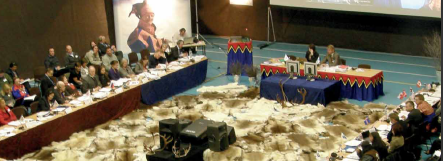
    SAO Meeting, Kautokeino, Norway, November 19. – 20. 2008

    Intergovernmental Arctic cooperation officially started in 1989 with the Rovaniemi process in the wake of Mikhail Gorbachev’s Murmansk speech. At the first ministerial meeting in Rovaniemi, Finland, of the eight Arctic states, which also included three northern indigenous peoples organizations, the Arctic Environmental Protection Strategy (AEPS) was signed in June 1991. The initial focus on environmental protection gradually expanded to related fields, notably sustainable development. In 1996, the Arctic states replaced the AEPS with the Arctic Council as a high-level intergovernmental forum for Arctic international cooperation that would include as Permanent Participants a certain number of transnational northern indigenous peoples organisations. Therefore the Arctic Council was established as a high level intergovernmental forum to provide a means for promoting cooperation, coordination and interaction among the Arctic States. The Arctic Council deals with common Arctic issues, with the involvement of the Arctic Indigenous communities and other Arctic inhabitants. These issues are, in particular, sustainable development and environmental protection in the Arctic.

    For further information, please visit the Arctic Council homepage and Melting Ice: Regional Dramas, Global Wake-Up Call Conference homepage.

    Reference

    Arctic Human Development Report
    The Arctic Council