Tag: marine

  • From everywhere but Antarctica!

    From everywhere but Antarctica!

    Field trip to Dynjandi

    A master’s program in Coastal and Marine management on the Western tip of Iceland sees students from all over the world engaging in Arctic studying. The University Center of the Westfjords hosts the program which is described as a cross-disciplinary program that prepares students for diverse positions in both the public and private sectors.

    Among courses thought are Iceland’s Environment and Natural Resources, Understanding the Coast and the Ocean, Underwater Heritage, Aquaculture and Marine Renewable Energy.

    The University of Akureyri cooperates with the studies, UNAK has specialized in fisheries science and related matters for many years.

    The program at the University Centre of the Westfjords has been running since 2008. Before the program started it sought recognition and quality control from the University of Akureyri which in the end is responsible for the diploma. The fifth years started this fall but in total 40 students have graduated, the first ones in 2010.

    The website also states: “Among the fields which the master’s program in Coastal and Marine Management prepares students to work in are resource and land use planning, environmental impact assessment, consulting work, teaching and research. The program is internationally oriented and taught in English, and both students and instructors come from a diverse range of countries.

    The master’s program in Coastal and Marine Management brings together people of different backgrounds who share their experience, knowledge, and ideas in a small-scale, creative and fertile intellectual environment, with the goal of finding ways of using natural resources in a sustainable way. We welcome new faces to join our exciting group of natural resource management specialists.”

    A total of 92 have started the studies, 40 graduated and 46 are currently studying. Only a few have have abandoned the studies. “The students love their graduation day; they have a whole fjord for themselves!” Dagný Arnarsdóttir, the Program director, told BB, a local newspaper. The graduation is held in Hrafnseyri in Arnarfjordur, famous for the waterfall Dynjandi.

    Field trip in the westfjordsAccording to program manager Ingi Björn Guðnason the program has used social media for advertisement to reach the right people. “We have used Google and Facebook ads to lead people to our website which has detailed information about the program. We have also used specialized websites for advertisement which show different programs for students who want to travel to study. Later we have been lucky that the word has simply spread out about the program which we can thank both the students who have a good experience from here and the teachers as well. They have helped advertising the studies in numerous ways. That is probably the most effective advertisement, positive feedback from the students who talk to their friends about it. This positive feedback has allowed us to cut back on advertisement costs which were running high in the beginning.”

    Ingi says that visits to the University Centers website have increased greatly after this program was founded. They have grown greatly and can reach 700 per day, but in total it has 95.000 visits for the last year.

    Structure

    The program has three semesters, fall, spring and summer, which runs from April to July. Next is a thesis but students need to post a detailed description of their intended study for acceptance of a concession committee. “This year we will have a specialized workshop for the thesis and the result is a thesis question. Most students are graduated within two years but if they want they can leave after the courses, which take 18 months,” Dagný says.
     

    Each course is thought in a session, ranging from 2 to 8 weeks. They include lectures and individual and group projects. “We also try to use new technology as much as we can. Tests in a class room can be necessary in some countries, but how knowledge is measured and assessed, can differ greatly. We try to offer real project in the field when we can. We also use role-play for example to discuss different aspects to subjects from different groups. I see different kinds of valuations for the Universities in the future. A new generation is coming up of both teachers and students are coming up and the schools will have to adjust.”

    Westfjords the focal point

    The location of the program is unique, in the West of Iceland, which has some of the most prosperous fisheries in the country, and breathtaking landscape. “We encourage students to do their projects about the area here and the result is that two out of three have written or done material about the Westfjords or its fisheries. Students have a reputation of wanting to give something back to the society here and by filling in gaps of knowledge about anything related to the studies, they do so, for example writing about sustainable coastal areas or exploitation and protection of the oceans and the coast. The students often have close cooperation with organizations and companies for their thesis work.”

    Puffin in Iceland

    Many nationalities

    “We get applications from all over the world but we have to limit the students to their capabilities with first grade or higher, their language skills (for example the TOEFL test) and if we can be assured that their material is authentic. Over the years most students have come from Canada but it’s getting more international and more Europeans have come in over the last two years. We have representatives from every continent now except for Antarctica!”
     

    “The students choose their projects in a number of manners, Icelanders tend to write a little bit more about Icelandic related projects, but international students do the same, they also write about Icelandic projects.”

    Diversity in teachers

    Since the program has very little structure, no permanent staff for example, the knowledge has to be sought from diverse backgrounds. Getting teachers and instructors over the years has run smoothly and they are both Icelandic and international. “This is a real sign of quality for us. We have very high standards and have specific goals to keep, and this shows quickly in the Icelandic university environment.”

    “After the studies the students have either continued to study, either doing PhD studies and other masters programs. Most often the students go to their homes for jobs related to the studies. Many of them have excellent jobs, a few work in project management, some are specialists in ministries, some in aqua centers or national parks. One runs the biggest national park in Canada, one has built a national Park in East Congo under very hard circumstances. And our students have kept in touch with the Westfjords and will be back with their families at some point! They help us in promoting the area, and Iceland.”

    Future prospect

    “The future will see the University Center promote the knowledge even better than before, for example by translation projects to Icelandic. Another aim is to maintaining the knowledge in the studies with the institutions in Iceland,” Dagný says.

    Sources

    Bæjarins Besta

    University Center of the Westfjords website


    See also:

    Click here to enter the
    Arctic Portal News Portlet
  • French Arctic Marine Research introduced

    French Arctic Marine Research introduced

    Dr. Marie-Noëlle Houssais

    Today at the University of Akureyri, dr Marie – Noelle Houssais gave a speech on French contribution to the Arctic marine scientific research.

    For the past two decades France has been extremely active in contributing to main axes of Arctic marine research.

    Governmental and non – governmental organizations have been involved in monitoring and evaluating of the climate system, understanding the processes, underpinning its variability as well as estimating the future state of the Arctic and the potential impacts.

    Dr. Houssais highlighted socio – economic impacts of climate change in the Arctic to include marine transportation on northern sea routes, exploitation and extrication of marine living and non – living resources.

    France has a long history in both Arctic and Antarctic research activities and expeditions. Logistical support to polar activities in the country largely benefits Arctic and Antarctic projects.

    Dr. Marie Houssais is a Doctor of Sciences at Universitee Pierre et Marie Curie Paris Sorbonne (UPMC), an oceanographer physicist specializing in the polar regions. She was elected member of Scientific Council of the UPMC over the period 2008 – 2012. It was dr Houssais´ second visit to Iceland.

  • Future for Arctic marine use

    Future for Arctic marine use

    L. W. Brigham gives the speech on outcomes from AMSA report

    On Wednesday, 25th of April 2012, during the IPY Conference prof. Brigham gave a speech on key drivers and futures for Arctic Marine use.

    He stressed globalization, climate change and geopolitics as key drivers of the profound change in the Arctic. For the Arctic Ocean and marine traffic, this change is driven primarily by Arctic natural resource development and marine tourism. This was one of the key findings of work done by the Arctic Marine Shipping Assessment (AMSA) of the Arctic Council during 2005-09. The scenarios creation effort in AMSA indicated that the two most important (and uncertain) drivers, of many, were (A) the level of natural resource development and trade, and (B) governance (the degree of stability of rules and regulations for Arctic marine navigation).

    Mr Brigham highlighted, that nowadays we see expanded Arctic marine transport systems evolving in offshore Russia, Norway, Greenland, and potentially in the U.S. maritime Arctic in summer 2012. Existing year-round marine transport to the world’s largest nickel mine (Norilsk Nickel) in Northwest Russia, and seasonally to the world’s largest zinc mine in northwest Alaska (Red Dog) are well established. Plans are being made to link a large, high grade iron ore mine on Baffin Island in Canada to European steel producers. All of these marine systems indicate much greater links of the Arctic to the global economy.

    Recent experimental voyages across the Russian maritime Arctic by tankers and bulk carriers confirm plausible, summer marine routes eastbound from northern Norway and the Russian Arctic to markets in China. Cruise ship traffic by medium and large ships continues to increase in western Greenland. Importantly, continued Arctic sea ice retreat creates greater marine access throughout the Arctic Ocean for science and commercial marine operations; longer navigation seasons during the summer are a reality today.

    One of the key factors that must be kept in mind is, despite the extraordinary changes in Arctic sea ice thickness, extent and character (moving to a future Arctic Ocean without multi-year ice), the Arctic Ocean will remain fully or partially ice-covered during the winter and much of the spring and autumn. Polar class ships will be required for future operations once a mandatory Polar Code of Navigation is promulgated by the International Maritime Organization.

    Action is also being taken by the Arctic Council and the Arctic states to address future Arctic marine use: a new binding Arctic Search and Rescue Agreement gained approval in 2011, and a new Arctic Oil Spill Task Force is developing a second instrument to address this critical issue. There is little doubt globalization of the Arctic and regional climate change are closely coupled, and they will have immense influence over future marine use and the strategies developed to protect Arctic people and the marine environment.

  • Political overview

    Political overview

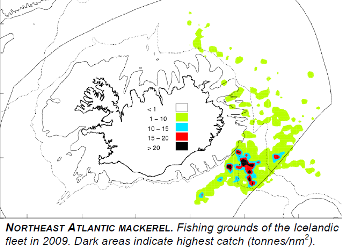
    Northeast Atlantic Mackerel fishing grounds

    “Counting fish is somewhat just like counting trees, except you can’t see the fish and it moves” This joke explains the nature of fish and its ability to move. Living resources like fish and other marine animals change their distribution patterns in relation to their habitual conditions, regardless of Exclusive Economic Zones and other jurisdictional waters.

    This fact can and has caused some political disputes, even though the Legal issues in connection with maritime boundaries and rights to fisheries both in countries’ economic zones as well as international waters have mostly been settled under the United Nation Convention for the Law of the Sea (UNCLOS).

    The distribution patterns of some species are changing faster than international agreements and conventions, causing disagreement of utilization of those species. The most recent case is the Mackerel dispute of Iceland and the European Union and other contracting parties (coastal states) of the North East Atlantic Fisheries Commission (NEAFC).

    During the recent years, Atlantic Mackerel has entered Icelandic waters due to warming waters and is in search for nutrition. The Mackerel extracts biomass from Icelandic waters and migrates again into coastal states waters, causing a huge biomass transfer. The composition of the biomass that the Mackerel transfers is thought to be spawns and fingerlings of economically valuable species and nutrition for those economically valuable species, such as small capelin and herring. In spite of that, Iceland has not been issued any quota from the overall maximum allowable catch issued by NEAFC, based on recommendations from the International Council for the Exploration of the Sea (ICES).

    Halibut on drying racks

    In the beginning the EU and the other coastal states did not want to recognize the fact that Mackerel was in Icelandic waters, however the catch over the recent years in Icelandic waters can’t be ignored. The Mackerel started as a by catch with herring fisheries in Iceland but is now in great abundance that direct harvest of Mackerel has started. Therefore Icelandic officials issued a unilateral quota, since it was not allowed any from the overall maximum allowable catch issued by NEAFC, based on recommendations from ICES.

    Still, there is no agreement and currently Iceland has issued quota in Icelandic waters for 130.000 tons. That is addition to the total recommended catch from ICES, since the other states refuse to give share and accept Iceland as a coastal state with Mackerel. This economical and political approach by the states might therefore threaten the Mackerel stock since no agreement is available of total catch.

    Disputes like those might become more common in the future since changes are occurring and economical valuable species will move to find their ideal habitat and they do not care about man made Exclusive Economic Zones. Economical and political approach of controlling maximum allowable catch of species is not in favor of the environment. An ecosystem approach has to be established in order to be able to utilize marine resources in a sustainable way. In order to do that a collective responsibility has to be established within stakeholders of this abundant resource that has supported Arctic peoples and others over the centuries.

  • Marine Governance

    Marine Boundaries

    Governance of Arctic shipping occurs through a mix of domestic and international legal instruments and “soft law” regional agreements. There is no comprehensive international legal regime for the Arctic and no multilateral political organisation with the power to regulate activities or make legally binding decisions.

    However, a cooperative mechanism, the Arctic Council, was created by the eight states in the region as a forum for discussion of all issues in the Arctic, in particular the protection of the environment, sustainable development and the affairs of native people.

    A number of international treaties apply in the Arctic, in particular the UNCLOS,[1] which provides rules concerning maritime boundaries, claims to an outer continental shelf, sovereign rights over resources and the protection of the marine environment.

    All the Arctic states are parties to the UNCLOS, except the United States. The International Maritime Organization has developed shipping rules with global application that also apply in the Arctic and a few regional “soft law” regional instruments also apply in the region.

    International Maritime Organization – IMO

    Internaitonal Maritime Organization - IMO

    The Convention establishing the International Maritime Organization (IMO) was adopted in Geneva in 1948 and IMO first met in 1959. The IMO is the most important institution in the field of international shipping law and its main task is to develop and maintain a comprehensive regulatory framework for shipping. IMO’s mandate includes establishing measures regarding safety, environmental concerns, legal matters, technical co-operation, maritime security and the efficiency of shipping.

    The work of IMO has led to massive body of international conventions, supported by hundreds of recommendations dealing with every angle of shipping. The international legal regime for the regulation of maritime shipping therefore contains a wide number of categories of standards.

    The conventions of IMO deal, in theory, with certain issues but can additionally, have legal effects on more than single set of standards. The main categories of substantive standards or requirements are; CDEM (construction, design, equipment and manning) standards, navigation standards, discharge and emission standards, contingency planning and preparedness standards and liability, compensation and insurance standards.

    The mandate of IMO is global and thus, most of its legally binding instruments have a global scope of application and apply in principle to the entire Arctic marine area. The IMO has, however, developed voluntary guidelines that apply in the Arctic waters and might become mandatory in the near future.

    The Arctic Council

    Arctic Council

    The Arctic Council has been successful in preparing assessments, developing a regional identity and setting the Arctic agenda but does not have powers to impose internationally binding rules. The Arctic Council Members have committed themselves to implementing the Arctic Environmental Protection Strategy (AEPS) in conformity with the LOS Convention.

    In 2000, the Arctic Council adopted the Action Plan to Eliminate Pollution in the Arctic (ACAP) and determined that the ACAP would be a basis for developing and implementing actions under the Council’s auspices with respect to pollution prevention and remediation.

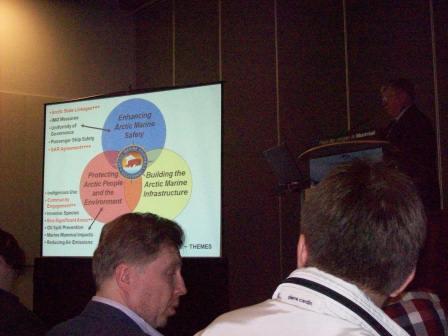
    The most recent relevant output The Arctic Council regarding Trans-Arctic shipping is the Arctic Marine Shipping Assessment (AMSA) of PAME, which was released at the Arctic Council Ministerial Meeting in Tromsø, April 2009. The AMSA contains a considerable number of Recommendations categorized under the headings Enhancing Arctic Marine Safety, Protecting Arctic People and the Environment and Building the Arctic Marine Infrastructure. AMSA was approved by the Ministerial Meeting later that month means of the Tromsø Declaration of 29 April 2009.

    The Arctic Councils’ main Working Group concerned with shipping activities is the Emergency Prevention, Preparedness and Response Working Group (EPPR) Among its’ main products are; ArcticGuide (updated annually), Field Guide for Oil Spill Response in Arctic Waters (1998), Environmental Risk Analysis of Arctic Activities (1998), Circumpolar Map of Resources at Risk from Oil Spills in the Arctic (2002) and Shoreline Clean-up Assessment Technique (SCAT) Manual (2004).

    United Nations Convention on the Law of the Sea (adopted 10 December 1982, entered into force 16 November 1994) 21 ILM 1245

  • Icelandic Fisheries Portal

    Icelandic Fisheries Portal

    Icelandic Fisheries Portal

    The Feature of the week is the newly opened Icelandic Fisheries Portal. The Portal is a project worked jointly by the Ministry of Fisheries and Agriculture in Iceland, Directorate of Fisheries, Icelandic Marine Research Institute, University of Akureyri and Matís – Icelandic Food Research.

    General Information

    fishermanThe Icelandic fisheries portal is a gateway to information on the marine ecosystem around Iceland and on Icelandic fisheries. On the Fisheries Portal, you will be able to find information on everything from the ecosystem to the economy.

    The objective of the new and improved Icelandic fisheries portal is to provide easy access to reliable information on the ecosystem and ocean environment around Iceland, on sustainable utilization of the country’s resources, and on the nutrients and healthiness of seafood in general. Statistical information is also available on fisheries and on the importance of utilizing marine resources for the Icelandic economy. All the information is in English.

    The portal is intended to serve as a comprehensive information source for experts and laymen, wanting information on Iceland’s offshore waters and their utilization, as well as on Icelandic fisheries. This could include, for instance, buyers and marketers of Icelandic seafood’s, students both in Iceland and abroad, fisheries professionals and experts as well as environmental groups and the general public.

    Contents of the Fisheries Portal

    The database will include information on the marine ecosystem, its resources and the principal marine products, markets and resource management. Historical overview is also provided along with general information about Iceland, such as geography, the society, infrastructure and politics. As such, the database, will serve as a sort of information display window for fisheries and related issues in Iceland for use by corporations, journalists, scientists, students and the public. The portal will contain general textual information, simple graphs and illustration, as well as more detailed data of use to scientists, for instance

    small harbour

    The URL of the website, operated by the Ministry of Fisheries and Agriculture in Iceland, is http://fisheries.is/