Tag: Northern sea route

  • Chinese merchant ship crosses Arctic

    Chinese merchant ship crosses Arctic

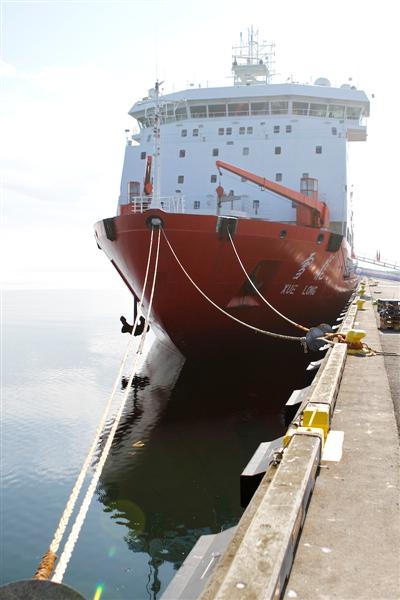
    Xue Long - The Snow Dragon

    Arctic shipping is reaching its peak this year, now in late summer. Earlier a 19.000 ton cargo vessel from China became the first Chinese merchant ship to travel from its homeland to Europe via the Northern sea route.

    The Yong Sheng, a 19,000-tonne vessel operated by state-owned Cosco Group, set sail on August 8 from Dalian, a port in northeastern China, bound for Rotterdam. According to an announcement on Cosco’s website, the journey via the Bering Strait could shave as much as 15 days off the traditional route through the Suez Canal and Mediterranean Sea.

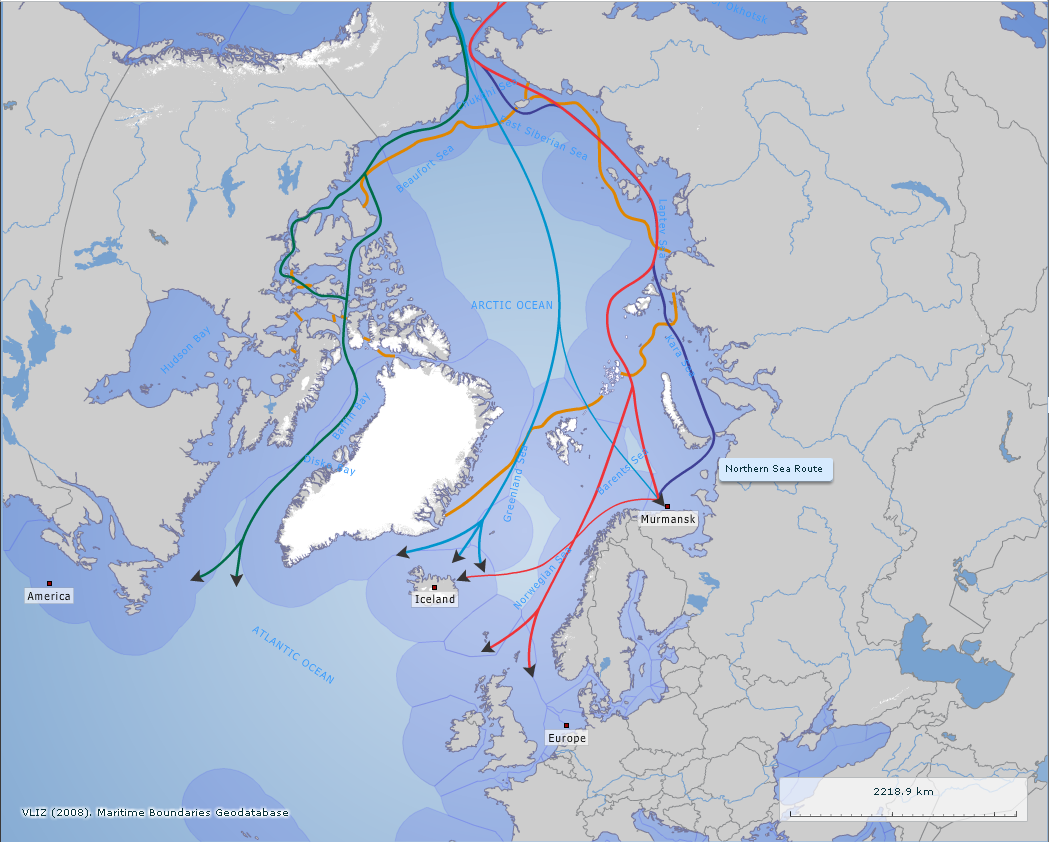
    There are three main shipping routes through the Arctic, the Norhern Sea route, the Western sea route and the Central shipping route.

    The longer Northeast Passage, the Financial Times writes, at approximately 5,400km, has the advantage of offering a relatively straight journey over the top of the Eurasian landmass. Its shorter North American rival, by contrast, twists and turns through narrow, dangerous channels in the Canadian Arctic. The Northwest Passage claimed the life of explorer Sir John Franklin and the crews of his two ships, HMS Erebus and HMS Terror, in 1847.

    But China has already demonstrated that the Central sea route might be the best route, as the ice gets thinner by the years, with the Chinare5 expedition in 2012.
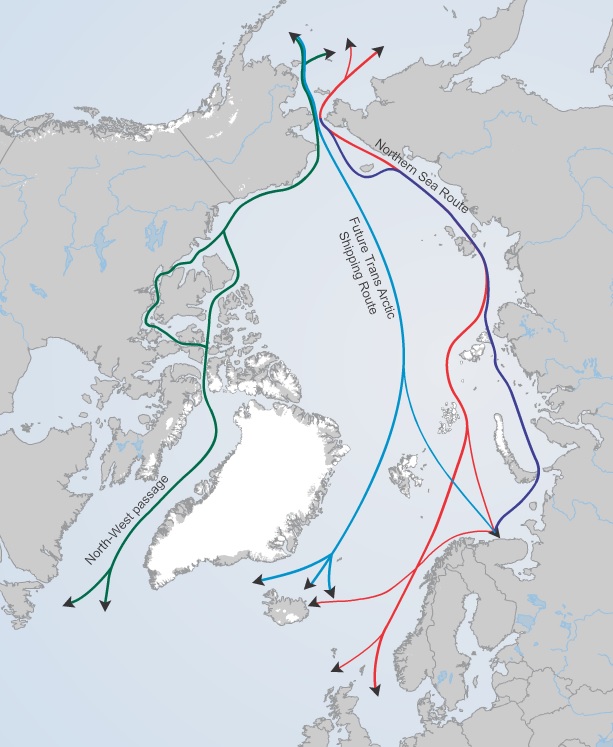
    The arctic shipping routes - map

    Arctic shipping is taking off faster than the other big economic prospect for the polar region, oil exploration, where companies such as Royal Dutch Shell and Cairn Energy have been plagued by delays.

    But analysts caution that it will be years before the route, which is only passable for a few months, is commercially viable let alone a rival to the Suez Canal, which handled more than 17,000 ships in 2012.

    “Climate change is certainly opening new Arctic shipping routes,” said Cameron Dueck, a Canadian author who sailed the Northwest Passage in 2009. “But the most common routes through the [Arctic] continue to have ice even in the warmest years, meaning shipping companies will have to be selective and opportunistic in using them.”

    Valentin Davydants, captain of Russia’s Atomflot fleet of nuclear-powered icebreakers, estimates that by 2021 15m tonnes of cargo will use the full route. In addition, 15m tonnes of liquefied natural gas and 10m tonnes of oil will use the route partially to leave Russia’s northern Arctic shore.

    That pales into insignificance compared with sea freight in the Suez Canal where in 2011 almost 18,000 vessels transported 929m tonnes of cargo.

    “You might see some oil and gas leave Russia – but I think the day that container ships will choose to use the northern sea route for economic reasons is quite a long way off,” said one of Norway’s biggest shipowners.

    But some see great potential if the Arctic route can bring its costs down, which is indeed happening as the melting sea ice means icebreakers are no longer required under Russian rules for all journeys

    Besides the Suez Canal, the traditional maritime route linking China to the EU passes through the contested South China Sea, the Strait of Malacca and pirate-infested waters in the Indian Ocean.

    The voyage between Dalian and Rotterdam along this southerly route takes 48 days. By sailing the Northeast Passage, the Yong Sheng is expected to reach its destination on September 11 – a transit time of only 35 days.

    China, which claims to be a “near-Arctic state”, has become more aggressive in asserting its interests in the northern Pacific and Arctic oceans. In May, Beijing secured “permanent observer” status at the Arctic Council, a group uniting the eight countries with territory in the polar region.

    Source

    Financial Times

  • Northern Sea Route almost passable

    Northern Sea Route almost passable

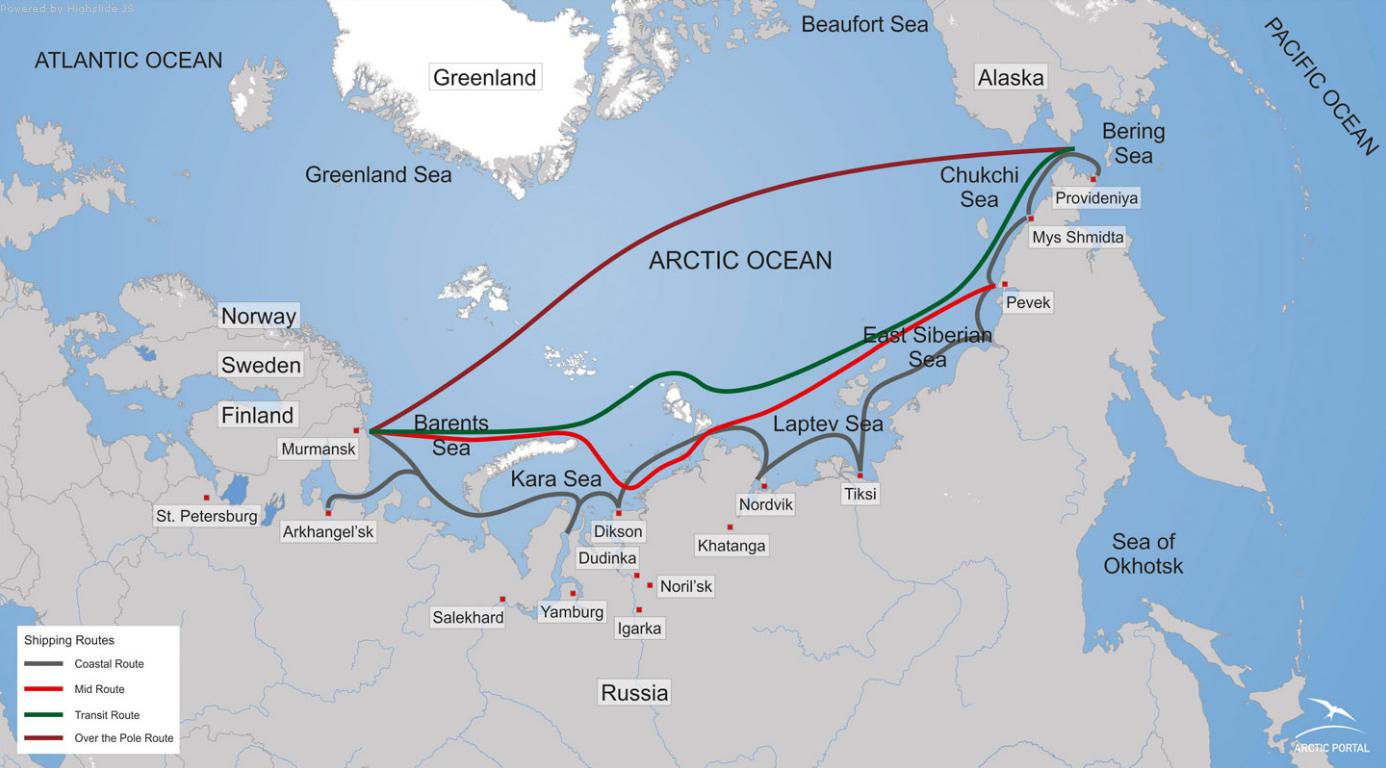
    Northern Sea Route - Map Arctic Portal

    As reported by The Northern Sea Route Administration, this year´s sailing season through the Arctic shortcut will probably be busiest in the history. The first vessels are to hit the route in the end of this month.

    The Northern Sea Route Administration has so far received 89 applications to use the Northern Sea Route (NSR). 54 vessels have so far been given permission to sail along the route, the administration’s web site reads. All the vessels will not sail the whole route between Europe and Russia, some of them will only be working on the western part of the route from Dudinka to Murmansk.

    The total cargo transported on the NSR last year was 1 261 545 tons – a 53 percent increase from 2011, when 820 789 tons was shipped on the route. According to conservative estimates the amount will grow to 1, 5 million tons in 2013.

    The Northern Sea Route is a shipping lane officially defined by Russian legislation from the Atlantic Ocean to the Pacific Ocean specifically running along the Russian Arctic coast from Murmansk on the Barents Sea, along Siberia, to the Bering Strait and Far East.

    The entire route lies in Arctic waters and parts are free of ice for only two months per year. Before the beginning of the 20th century it was called the Northeast Passage, and is still sometimes referred to by that name.

    Source: Barents Observer

  • Sabetta port becomes a reality

    Sabetta port becomes a reality

    Computer image of future Sabetta port

    Construction of Sabetta port, a key component in the huge Yamal LNG project, is now planned to start this summer.

    It is predicted that the Sabetta port will become one of the biggest in the Russian Arctic. Located in the Yamal Peninsula, it will boost shipping in the icy waters of the Ob Bay and the Northern Sea Route.

    Project Manager – Maksim Minin officially announced that the project has been delivered to the contractor and is ready to be reviewed by the state expert panel.

    The new port, a joint initiative of the Novatek company and Russian federal authorities, will be a key component in the development of the gas-rich Yamal Penisula. Linked with the South Tambey field and a major projected LNG plant, the port will be built to handle more than 30 million tons of goods per year.

    Sabetta port is planned to be operational all-year-round, despite the highly complex ice conditions of the Ob Bay.

    The total investments in the Sabetta port project amount to 75 billion RUB (€1,82 billion). The Russian government is investing 49 billion RUB (€1,19 billion) while private investments amount to 25 billion RUB (€607 million).

    The Yamal LNG project is developed by the JSC Yamal LNG, a joint venture of Novatek (80%) and Total (20%), and in close cooperation with the Federal Agency of Sea and River Transport and the Rosmorport state enterprise.

    Source

    Barents Observer

  • Moscow chosen over NSR-cities

    Moscow chosen over NSR-cities

    The Northern Sea Route.

    Russia has decided to host the administration for the Northern Sea Route in its capital, Moscow. The new headquarters will open late January this year.

    The Deputy Transport Minister of Russia, Viktor Olersky, said to RIA Novosti that a draft of the resolution has been made and it is being coordinated by federal agencies. The BarentsObserver states that both Murmansk and Arkhangelsk lost the fight for hosting the administration, after looking for having it in its respective cities for years.

    The reason given for choosing Moscow, instead of either of the two harbor cities in the route is “in order not to offend anyone”. Olersky also said that a branch could be opened later in Arkhangelsk.

    He said that although concerns may rise that Moscow is not at the sea route that it was a good location as the Emergency Situations Ministry was in Moscow, as well as other big companies and organizations who work and employ in the areas.

    The state owned enterprise will have a budget of 35 million Rubles. Only for days prior to the decision by Olersky, the Governor of Arkhangelsk Igor Orlov said that Arkhangelsk was ready to open a NSR office that would handle all practical tasks connected to traffic on the route – applications to use the route, coordination with the Agency on Hydrometeorology and Environmental Monitoring, use of Arctic aviation and so on.

    In 2012 total cargo transported through the Northern Sea Route was 1.261.545 tons, an increase of over 50 percent from 2011. The total number of ships also increased from 34 in 2011 to 46 in 2012, compared to only 4 in 2010.

    Sources

    RIA Novosti

    Barents Observer

  • Nine vessels have sailed through NSR this summer

    Nine vessels have sailed through NSR this summer

    Transport ship

    With the continuous melt of Arctic sea ice, the Region might become all free of summer ice within a next decade.

    Previous year which was marked as the longest sailing season for the Northern Sea Route, managed to handle 34 vessels. The total cargo transported, reached 820.000 tones.

    So far the year of 2012 managed to handle only 9 vessels on the Northern Sea Route. However, if the sailing season extends, this year might become new record for the new transportation path between Asia, Northern part of Europe and North America.

    Nuclear powered ice breakers have been escorting vessels in transit in convoys this summer as the ice level was extremely law. This situation was different from the one which occurred in 2011, when nuclear powered ice breakers had to follow one ship at the time in order to bring it through thick Arctic ice.

    The first two vessels to sail through Northern Sea Route this summer were Russian ´Indiga´ and ´Varzuga´ which transported diesel fuel.

    ´Nordic Odyssey´ and ´Nordic Orion´ sailed from Murmansk in northern Russian to ports in China with close to 70.000 tons of iron ore concentrate.

    The gas tankers ´Marilee´ and ´Palva´ both owned by Murmansk Shipping Company, each transported close to 60.000 tons of gas condensate to South Korea.

    Also ´Vengeri´, the tugboat and the Chinese non – nuclear ice breaker ´Xuelong´ were escorted along the Northern Sea Route this summer while sailing to the northern hemisphere.

    The scientists report that the situation on the Northern Sea Route meets the average standards. The path from Kara Gate to New Siberian Islands seems to be totally ice free, however the part of the way in East Siberian Sea, seems to be more difficult than recorded last year.

    Currently the trip via Northern Sea Route takes 9 – 11 days on average speed of 12 knots.

    Source

    Barents Observer

  • Russian megaport in the making

    Russian megaport in the making

    Arctic shipping

    A new port in the Yamal Peninsula will be on of the biggest Arctic ports when ready. Russia is building the Sabetta port and are hopeful it will boost Arctic shipping, especially in the Northern Sea Route.

    The new port, a joint initiative of the Novatek company and Russian federal authorities, will be a key component in the development of the gas-rich Yamal Penisula. Linked with the South Tambey field and a major projected LNG plant, the port will be built to handle more than 30 million tons of goods per year.
    The new port is planned to be operational all-year-round, despite the highly complex ice conditions of the Ob Bay.

    In a first phase, the port will by summer 2014 be developed to handle the deliveries of modules to the LNG plant. In the second phase, the port will be developed as a terminal handing LNG tankers, Novatek informs.

    The construction of the port was officially marked in a ceremony attended by Novatek Board Chairman Leonid Mikhelson, Russian Minister of Transport Maksim Sokolov and other prominent guests. In his speech, Minister Sokolov maintained that the construction of the Sabetta port marks the start of a new period in Russian Arctic shipping, one which “by year 2030 could lead to the boost of hydrocarbon shipments to 50 million tons per year from the Ob Bay alone”, a press release from the ministry reads.

    Source

    Barents Observer

  • Murmansk to open Arctic emergency center on NSR

    Murmansk to open Arctic emergency center on NSR

    Arctic Shipping Routes

    The Russian government announced that the emergency and rescue centers are to be open along the Northern Sea Route.

    Russian hopes for the future of NSR bring the country´s investments of more than 20 million Euros into the area. Projects for ten rescue centers, located on Chukotka, Andyr, in Murmansk, Arkhangelsk, Naryan-Mar, Vorkuta, Nadym, Dudinka and Tiksi have already been prepared and construction is planned to be finished before 2015. The first rescue center is to be located in the port of Dudinka and it will start operating from August 2012.

    The center in strategic hub for NSR – Murmansk will be ready before the end of 2013 as confirmed by the Russia’s Deputy Minister of Regional Development Aleksander Viktorov at the “Security and Cooperation in the Arctic: New Frontiers” conference recently held in Murmansk.

    The map presents all current and future shipping routes available in the Arctic for both cargo and passenger operations. Please, be referred to our Interactive Mapping System to access more information about the Arctic shipping routes and sea ports located in Russia.

    Source: Barents Observer
  • LNG tankers put to the test in ice

    LNG tankers put to the test in ice

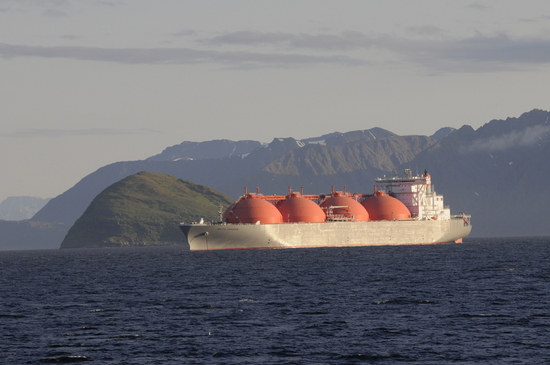
    An LNG tanker

    Many large vessels have to be strengthened to be able to sail in ice. Large companies are testing their fleets in order to be able to sail through the northern sea route.

    Gazprom is one of them which is working with Sovcomflot to carry out test for LNG tankers in ice.

    Gazprom director Aleksei Miller and Sovcomflot´s General Director Sergei Frank met last week and concluded in a press release:

    “The relevance of LNG shipping along the Northern Sea Route to the Asian-Pacific region in growing quickly. With regard to gas exports to the region, the development of LNG production is an absolute priority in comparison with pipeline deliveries. Consequently, the deliveries of Russian LNG through the Northern Sea Route allows us to significantly reduce transportation costs, thus making the LNG highly competitive.”

    Gazprom is considering to sail from the Shtokman area to Japan with gas. Statoil is thinking the same.

    Source: BarentsObserver

  • Norway to send gas through the NRS

    Norway to send gas through the NRS

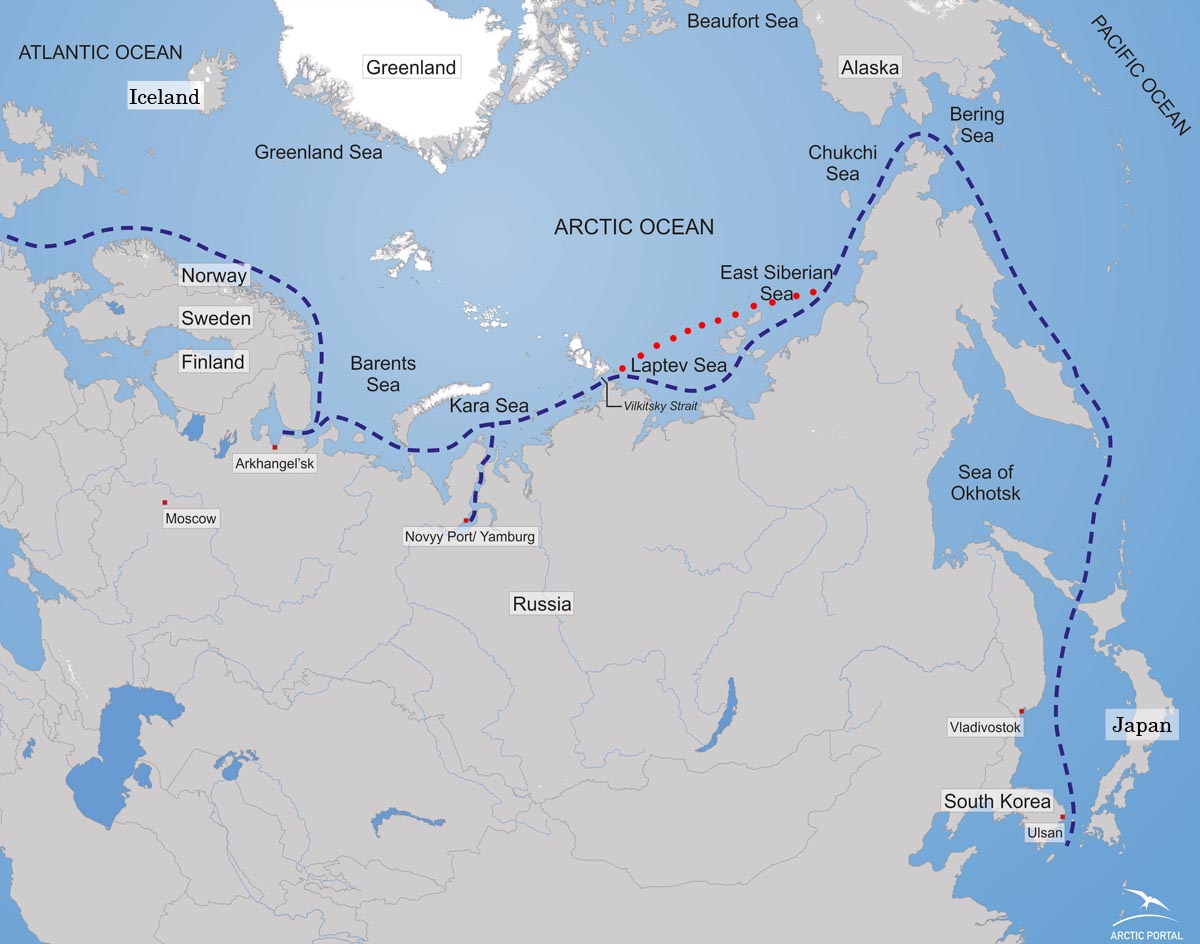
    Map of the Northern Sea Route

    Norway hopes to use the Northern Sea Route in a few months. Increased shipping saw 27 vessels using the route last year, a huge increase like indeed in the Northern Sea route.

    They want to transport gas from the Snowhite area to Asia. An LNG tanker will sail between Hammerfest in Norway to Japan as soon as the ice is thin enough.

    The vessel, Ribera del Duera Knutsen, is strentghened for sailing in sea ice. In fact it is the only LNG tanker in the world with an 1A class permission for sailing in ice.

    The sailing would take around 20 days, a big improvement from the route through the Suez Canal used today. This means the ship can go three tours next summer.

    “We have not been in contact with Statoil about the transport but technically it is possible,” Synnøve Seglem from OAS Shipping said to the NRK. “It is of course a feasible option for everybody,” he added.

    Sources

    NRK

  • A 750% increased shipping traffic in NSR

    A 750% increased shipping traffic in NSR

    Map of the Northern Sea Route

    The Northern Sea Route was busier then ever this year. In total, 34 vessels used the route, a significant increase from only 4 in 2010.

    The route was open for one month longer than last year, but this still shows that the route is becoming more feasible and more popular.

    The number is for ships that sailed from Murmansk to another country, Russians being the leading shipping operators in the NRS.

    The cargo in 2010 was 111.000 tons but in 2011 it went to 820.000.

    15 of the 34 vessels transported liquid cargo (682.000 tons), three carried bulk (110.000 tons), four refrigerator ships transported salmon (27.500), two vessels transported general cargo and ten vessels sailed in ballast, according to the Barents Observer.

    This year also saw the largest super tanker and the largest bulk carrier to go through the route.

    The map illustrates a new route, which opened up in the summer.

    Sources: Rosatomflot, RIA Novosti and BarentsObserver.