Tag: Northern sea route

  • New laws on the Northern Sea Route

    New laws on the Northern Sea Route

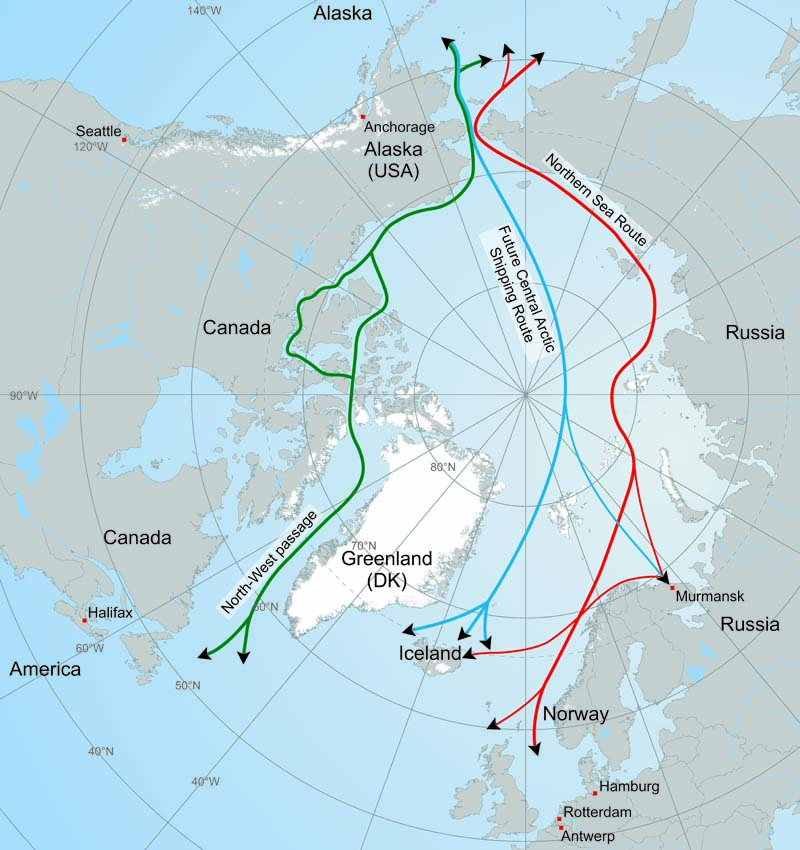
    Map of the Arctic Shipping Routes

    The Ministry Transport in Russia has introduced a new bill regarding “state regulation of merchant shipping in the waters of the Northern Sea Route. The website of the Ministry reads that Minister of Transport, Sergey Aristov, introduced the bill in Duma.

    This will be the first law on the sea route, adding to international law like UNCLOS. Read more about shipping governance here and see the UNCLOS agreement here.

    Russia plans to introduce new specialized organizations for this purpose. Transport operators will have the same access to the Northern Sea Route according to the bill which has articles on navigation, environmental protection and icebreaker assistance.

    This will ensure modern infrastructure that provides safe navigation of vessels in the Arctic seas.

    The bill has not been passed yet but the laws will take effect as soon as possible.

    The Northern Sea Route is in Russian waters, all the way from Murmansk to the Bering Strait.

    Sources: BarentsObserver and Ministry of Transport website.

  • Arctic shipping season over

    Map of The North Eastern Sea Route

    The Northern Sea Route shipping season is now over. To much ice in the Arctic ocean hinders any more shipping.

    This is the longest season ever in the route, one month longer then last year.

    The Perseverance was both the first and last vessel this year to go the route, the first one was the 29th of June and the last one today.

    The ship transported stable gas condensate from Murmansk in Russia to China, with the help of a Russian icebreaker.

    Russia’s Ministry of Transport believes cargo transport through the NSR will increase from 1,8 million tons in 2010 to 64 million tons by 2020.

    Source: Barentsobserver

    Click here to read more about the Northern Sea Route.

  • No tourism at the North Pole 2012?

    Yamal icebreaker at the North Pole

    Lack of icebreakers will most likely halt any tourism activity by cruise ships on the North Pole next year. Because of increased traffic by Russian vessels in the Northern Sea Route the icebreakers have enough to do.

    Director for Fleet Operations in Atomflot, Andrey Smirnov, has confirmed this in the Russian media.

    Russia wants to increase its traffic even more next year but lack of icebreakers and ships who are specially strengthened for sailing in ice covered waters will hinder traffic to the North Pole.

    According to Prime Minister Vladimir Putin, Russia plans to spend RUB 20 billion for the construction of a new nuclear-powered icebreaker in the near future. Funds have also been allocated for the construction of three shallow-draft diesel-powered icebreakers which, because they are part of a newer and more advanced class, will be able to replace five old vessels.

    According to Smirnov tourist cruises in the Arctic are only profitable if there are no less than two-three cruises per season: – One single cruise does not pay off.

    Cargo transport through the Northern Sea Route is expected to skyrocket in course of the next decade. Russia’s Ministry of Transport believes cargo transport through NSR will increase from last year’s 1.8 million tons to 64 million tons by 2020.

    Russian icebreakers have been transporting tourists to the North Pole for 20 years. The agency selling trips to the North Pole has already scheduled a trip with the largest of the Murmansk-based icebreakers, 50 Years of Victory,
    for the summer of 2012, the Barents Observer reports.

  • Russian cargo vessel to Shanghai and back through Northern Sea Route

    Russian cargo vessel to Shanghai and back through Northern Sea Route

    Norilsk Nickel

    Norilsk Nickel – Russian Arctic-class cargo vessel returned yesterday, Tuesday, to harbour in Dudinka after being first in history to navigate through the Arctic waters without any ice-breaker support.

    The vessel travelled through the Northern Sea Route by Russian Arctic coastline to Shanghai and back taking total of 58 days, total steaming time of 41 days, for the trip. Total length of the round trip Dudinka-Providence Bay-Busang-Shanghai-Nakhodka-Dudinka was 11,320 miles from which approximately half was in clear water and half in ices.

    According to Sergey Buzov, Deputy General Director – Head of Transport and Logistics unit of MMC Morilsk Nickel the trip was an invaluable experience, which they will use in future to plan their transport operations and can indeed be regarded as the Company’s contribution to the development of Russian Maritime Declaration in exploration and development of new Arctic regions and Arctic wealth.

    At the moment Company owns five ARC-7 ice-class vessels for Arctic transportation and the sixth will be introduced in 2011. The vessels are built in accordance with latest environmental and technological standards enabling them to navigate independently through Arctic ice without ice-breaker support.

  • Historic voyage as the first non-russian bulk carrier to take the northern sea-route

    Historic voyage as the first non-russian bulk carrier to take the northern sea-route

    arctic sea ice during the night

    During this summer there have been quite some news in connection to the northern sea-route, and it seems that even the most optimistic of projections will reveal themselves to be to modest- Recently the Arctic Portal published news on the first high capacity oil tanker going through the Northeast passage and now the first non-Russian bulk carrier to go through the Arctic.

    The bulk carrier MV Nordic Barents, what is especially noteworthy of this trip is that it is the first time that a non-Russian cargo vessel sails this route- which is partially through Russian waters. The Northern Sea Route Administration under the Ministry of Transportation and Rosatomflot, which operate the Russian national ice-breaking fleet, have given the project approval.

    The planning of the trip has demanded close cooperation between Russian, Norwegian and Danish parties and will hopefully be the first of many such ventures.

    The vessel will start it’s journey from Kirkenes Norway, carrying approximately 41.000 tons of Iron ore concentrate headed for China and is estimated to shorten the distance by 1/3, compared to taking the more traditional southern route- The MV Nordic Barents is well equipped for such a journey and is categorized as an ice-class 1a ship- which is the highest conventional ice-class- additionally Russian Icebreakers will escort the shop as it makes it’s way through the North East Passage

    Source: The Barentsobserver

  • First high capacity oil tanker throug the Northeast passage

    First high capacity oil tanker throug the Northeast passage

    Oil tanker

    On the 14 of August the ice-class tanker SCF Baltica began it’s voyage through the Northern sea-route. The tanker will be accompanied by three nuclear powered ice breakers during the two week sail. For the duration of the trip the crew till gather information on ice conditions in the area and the data used to estimate the commercial benefit of choosing the Northern sea-route vs. traditional routes in the south.

    What makes this trip special is the fact that it is the first time that a Aframax tanker of more than 100,00 dwt is navigating along the Northern sea route. The journey will cover 7,000 nautical miles where 3,000 are along the Northern sea route. The traditional southern shipping route connecting these two areas is around 12,000 nautical mile.  The ship started it’s voyage from the port of Murmansk, while the port of discharge in China is yet to be determined. The tanker is transporting gas condensate for Novatek, Russia’s largest independent gas producer. The voyage has been prepared by the ship’s technical manager, SCF Unicom and specialists from SCF’s head office in Moscow to make the voyage as safe as possible.

    The three nuclear icebreakers assisting the ship are the “Rossiya”, “Taymyr” and “50 years of Victory” the last one mentioned will be equipped with divers, equipment and specialists in dealing with oil spills and leakages.

    The northern sea route is open for less than two months in the late summer when the sea ice is at its minimum. The period can however be expected to lengthen gradually as sea ice continues to decline.

    Source: Barrentsobserver & MIC