Tag: Russia

  • Breakthrough of the Russians

    Breakthrough of the Russians

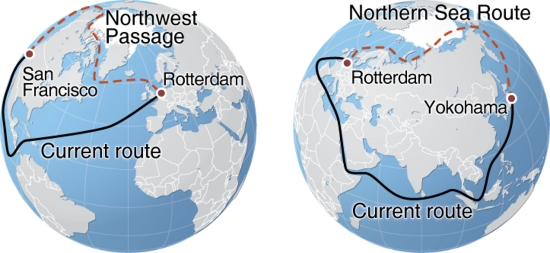
    Map of Northwest Passage and Northern Searoute

    Although the ice in the Arctic is slowly diminishing, regular sea transport has not begun in the area. Russians have perhaps the most interest in Arctic shipping due to the enormous resources near the Arctic Ocean, in their own backyard.

    But Russia has two mainfold problems. They need more icebreakers and more infrastructures to use the Northern Sea Route more regularly.

    Nikolay Patrushev, Russia’s Security Council’s secretary says instruments for navigation and communication and bases for search and rescue services are not sufficient. Russia plans to build a series of new search and rescue vessels and make the port of Amderma into a main base for a new emergency unit. Six icebreakers are being built, three of them nuclear powered.

    Tankers with a draught of over 12 meters can now use the Northern Sea Route and Russia’s second largest producer of natural gas, Novatek, is sending the largest tanker ever through the Northeast Passage in August.

    Russia’s Ministry of Transport believes cargo transport through NSR will increase from last year’s 1.8 million tons to 64 million tons by 2020, according to the BarentsObserver.

  • Northeast Passage

    Northeast Passage shipping route

    The Northeast Passage is in reality a useful sea route. It runs from the northernmost parts of the North Sea across the icy waters of the Arctic Ocean north of Russia, east to the Chukchi Sea and Bering Straits where access to the North Pacific is reached.

    Several straits in the Passage can be classified as international.

    The Northern Sea Route (NSR) is an established commercial seaway that was used for domestic transportation and played an important economic role for the Soviet Union around World War II.

    The course of NSR was defined in a Russian regulation in 1990 and is in fact (rather than theoretically), the middle part of the Northeast Passage.

    To that extent, the Northern Sea Route can be equated with the Northeast Passage if this simple fact is known.

    As with the Northwest Passage, the Northeast Passage is limited for use because of extreme natural conditions based on the geographical location of the passage. However, if climate change continues to effectively bring warmer air to the area, condition of winds, ice and currents might result in more favourable sea route. But that does not resolve the legal issues and questions that rise if foreign ships use it as no specific universal agreement has been settled on that matter.

    In the summer of 2011 sea ice was at an all time low since measuring began. That resulted in extended shipping in the route. In August it took only eight days for the STI Heritage tanker to go from Murmansk in Russia to the Bering Sea. Russia is strengthening its fleet of icebreakers and will continue to use the route when it is possible, which is still only for a few months around the summertime.

  • Increased border cooperation between Europe and Russia

    Increased border cooperation between Europe and Russia

    Norway_Russia_border_agreement

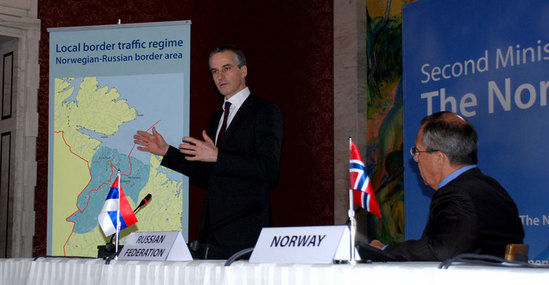
    Barents Observer – Norway and Russia signed yesterday a milestone agreement on visa-free travel between Russia and a Schengen-member state in Oslo.

    The agreement between Norway and Russia on Facilitation of Mutual Travel for Border Residents establishes an Arctic cross-border zone, including the Norwegian town of Kirkenes and the two Russian towns of Nikel and Zapolyarny on the Kola Peninsula, from where the population can cross the border without valid visa by showing only a specific ID-card. The ID-card is intended for locals who have been living in the zone for more than 3 years and have either Russian or Schengen member state citizenship. The new visa-free zone will facilitate the 20 percent increase in traffic crossing the Russian-Norwegian border in the first six months of 2010 compared with the same period last year and is in line with wider European policy of increased cross-border cooperation along the eastern rim of the European Union.

    European Border Dialogues conference, attended by 16 states, reseantly issued a Declaration on Cross-Border Cooperation in a Wider Europe identifying key challenges in current cross-border cooperation in Europe, among which are visa regulations and border crossing procedures. The new Norwegian-Russian agreement is thus a step towards abolishing the visa-regime which discourages cooperation between Europe and Russia and enhancing regional cooperation in the Barents region.

  • Historical border deal between Russia and Norway

    Historical border deal between Russia and Norway

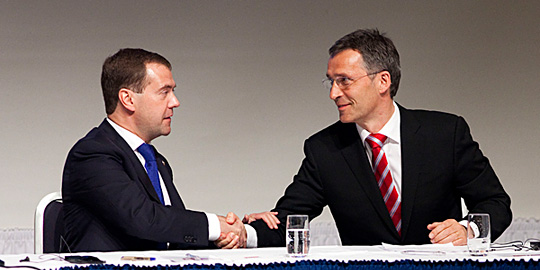
    Stoltenberg and Medvedjev shake hands

    A historical deal between Russia and Norway was signed yesterday by president of  Medvedev of Russia and Norwegian Prime minister Stoltenberg.

    The treaty resolves what has been for several decades the most important outstanding issue betweem Norway and Russia. The disagreement was about the maritime boundary between Norway and Russia in the Barents Sea and the Arctic Ocean and has largely kept the two nations from utilizing natural resources in the area, and both nations can be expected to start looking into oil and gas exploration within the area now once the deal has been signed.

    The agreement signifies the strengthening cooperation between the two nations which have gradually increasing over the last 20 years. Prime minister Stoltenberg said in an interview with the Barrentsobserver that ” Norway and Russia have developed a broad cooperation in the north consisting of organization, cultural workers, businesses, educational- and research institutions etc.” and he higlighted the importance of every-day contact over the borders.

    After the signing of the agreement the two heads of state continued discussing the possible within the energy sphere. Were both parties have aspirations for future co-operation

  • Polar Law Symposium: Russia’s Arctic Policy

    Polar Law Symposium: Russia’s Arctic Policy

    The 2nd Polar Law Symposium was held at the University of Akureyri the past weekend, September 10-12. This years Symposium was environment oriented having an indication of environment in all four themes. The themes this year were New Shipping Routes and Environmental Implications for the Polar Regions, Effective Environmental Governance, The Exploration and Exploitation of Resources and Human Rights and Polar Regions.

    Many distinguished speakers discussed the issues from different perspectives, but perhaps the most interesting or rather most anticipated information being shared at the Symposium was about the new Arctic policy of the Russian Federation by H.E. Victor Tatarintsev, Ambassador of the Russian Federation in Iceland.
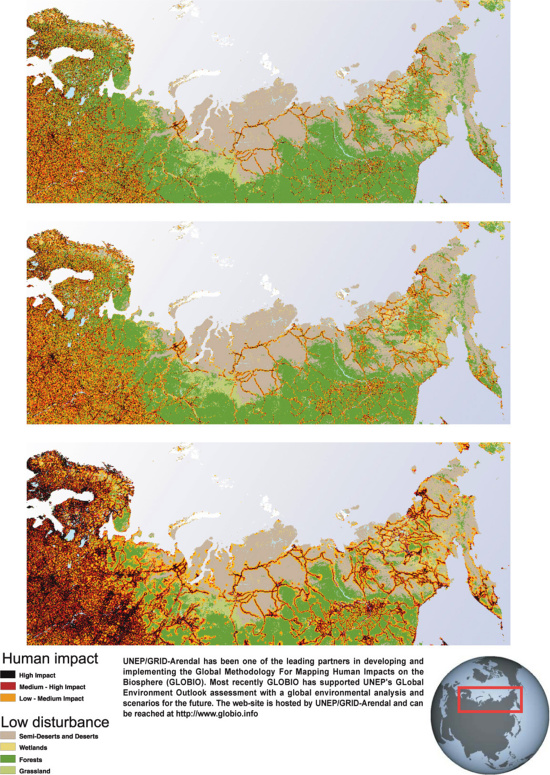
    human impact on the arcticDue to the new environmental developments in the Arctic and the international attention the area has gained in the past few years in international politics the Russian Federation has adapted a new Arctic Strategy to 2020 and beyond.

    The importance of the Arctic for the Russian Federation can not be undermined knowing the fact that it contains 1% of the Russian population and 18% of the territory, but produces 20% of the GDP and 20 % of Russia’s total export.

    According to H.E. Victor Tatarintsev the peace and international cooperation are the key issues in the Arctic in coming years. Russia will emphasize the cooperation through already existing framework, namely the Arctic Council and the Barents Euro-Arctic Council and does not aim at increasing its military presence in the area.

    The Arctic sea route will be of high importance for Russia as a strategic national transport route and reconstruction of the existing infrastructure on the Arctic coast-line will be one of the main tasks on national level. The sea route will not be important only because of the immense oil and gas production in the Russian north but also because of the development gap between the north and south, which must be cut down for the benefit of the people living in the area. New ports must be built to the remote areas to enable import of new technology and development and new kind of tourism in these areas must be made possible.

    Arctic Indigenous peoples play also a role in the new Russian Arctic Policy Russia committing itself to the existing international standards for the protection of indigenous livelihoods and will follow.
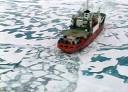
    Russian arctic shipDespite the fact that Russia is very committed to the existing cooperation regime and intends to obey the international law in all matters, H.E. Victor Tatarintsev reminded people not to simplify the situation too much. Certain unresolved legal and political issues remain in the Arctic and cooperation should be enhanced to abolish uncertainties around these issues. As an example he pointed out the Russian flag in the bottom of the Arctic sea incident, which according to him was purely scientific expedition and did not imply the political contention as it taken by the international community.

    As a conclusion, it can be said that the Russian Arctic policy aims to intensify the national development with the utmost goal of protecting legitimate aspirations of the Russian Federation while working within the international community.
  • International Arctic Security Conference

    International Arctic Security Conference

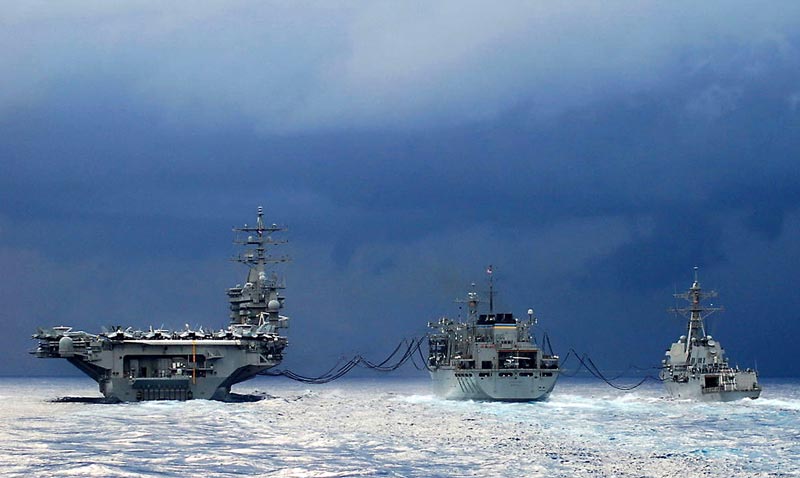
    Military ships

    According to the AFP News, an International Arctic Security Conference is been held in Anadyr, Chukotka, Russia. The main focus of the conference is on emergency situation management and prevention, nuclear accidents and rescue operations in the Arctic region.

    Six out of the eight Arctic countries take part in the conference, including the US and Canada.

    In the past year, military activities in the Arctic have been increasing again for the first time after the cold war and for example has Canada alone conducted its largest ever military exercises in the region this year.

    The unsolved sovereignty over the Arctic continental shelf can be considered one of the main reasons for the military presence in the area. It is estimated that within the Arctic continental shelf can be found an extensive amount of oil ang gas and as long as the UN Continental Shelf Committee has not given its final decision on the national limits of the continental shelf, the military presence can be expected to continue.

    According to the Illulissat declaration from May 2008, the Arctic countries – apart from Finland, Iceland and Sweden – decided to solve any upcoming conflict in the Arctic in peaceful manner. The Anadyr Arctic Security Conference can thus be considered as a part of a joint governance effort over the Arctic region.

  • New networking mechanism established in Russian northern research

    New networking mechanism established in Russian northern research

    Arctic Portal news

    New networking mechanism, promoting cooperation between science, youth associations, non-profit organizations, business and authorities, has been established for the benefit of development of northern regions in Russia.

    The cooperation called “Center for Problems of the North, Arctic and Cross-border Cooperation”, “North-Centre”, was established by Karelian Research Center of the Russian Academy of Science and International Public Youth Movement “Association AWARD”. The project is intended to unite the efforts of science in the area.

    Igor Shevchuk will be heading the project. Mr. Shevchuk is the foreign relations officer of the Karelian Research Center of RAS. Other members include, Alexander Titov, President of the Karelian Research Center of RAS, Corresponding Member of RAS, Chairman, Elena Antoshko, Head of the International Public Youth Movement “Association AWARD and Alexander Yuriev, Executive Director of the Association “Council of Municipalities, Republic of Karelia”

    The Karelian Research center is establishing a web page for the project and it will be located at http://northcentre.krc.karelia.ru/