Category: News & Press Releases

Arctic Portal News Portlet

  • Cost of Arctic Warming

    Cost of Arctic Warming

    co2ocean

    It can be agreed by most people that the Arctic as one of the last wildernesses in the world is invaluable. For the earth’s bio- and cultural diversity the Arctic as it appears today, covered with ice and snow, is irreplaceable and most environmental organizations agree that reducing climate change is the only way to preserve this fragile nature.

    The Pew Environmental Group has, however, estimated the financial value of the Arctic sea ice to the world by estimating the value of the area in terms of the climate services it provides. According to the organizations preliminary calculations the loss of Arctic snow, ice and permafrost is estimated to cost the world in 2010 US$ 61 billion to $371 billion in lost climate cooling services. By 2050, the cumulative global cost is projected to range from US$2.4 trillion to $24.1 trillion; and by 2100, the cumulative cost could total between US$4.8 trillion and $91.3 trillion.

    To learn more about the Pew Environmental Group and their melting Arctic sea ice project, please visit the Pew Charitable Trusts homepage

  • 6th Annual Arctic Shipping Summit

    6th annual arctic shipping summit

    The 6th Annual Arctic shipping Summit will take place during between 27. and 29th April 2010 in Helsinki Finland, with a pre-conference seminar on the 26.

    Leading experts from a diverse background will come together and analyze critical development and practical challenges connected to Arctic Shipping, these include

    • Strategic concerns, security and sovereignty
    • Developments in transport and exploration in Russian Arctic, North
      America and Greenland
    • The impact of climate change on potential navigation conditions
    • Challenges of ice management operations for offshore vessels
    • Technical challenges for design of ice-going ships and icebreakers
    • Stakeholder discussion on current status of training for ice-going crew

    Chairmen and speakers will include. Keynote wpeaker Sergey Donskoy, Deputy minister, Ministry of Natural Resources of the Russian Federation as well as

    • Anders Backman, Rederi AB Trasatlantic
    • Josep A. Casanovas, DG TREN, European Comission
    • Reidun Haahjem, GARD AS
    • Jan Fredrik Hammer, Beluga Projects (Norway) AS
    • DR Mikhail Grigoriev, GECON
    • Professor Frédéric Lasserre, Laval University
    • Fre?de?ric Lasserre, Laval University > Malcolm Lowings, Golder Associates
    • Wilhelm Magelssen, DNV
    • Mikko Niini, Aker Arctic Technology Inc
    • Capt David Snider, Martech Polar Consulting
    • Dr Kirsi Tikka, ABS
    • Professor Peter Wadhams, DAMTP, University of Cambridge

    The last year has seen continuing developments in the prospects for Arctic shipping, including the first commercial voyage by a western shipping company through the Northern Sea Route from Asia to Europe. During the conferance participants will be given the oppertunity to hear from Beluga Shipping on the background and results from this transit. It is clear that the Arctic shipping summit will be an exiting event, attended by some of the most prominent actors interested in arctic shipping which no-one interested in Arctic shipping should overlook. Further information can be found at the informa maritime events homepage.

  • Climate Change and Arctic Sustainable Development Report

    Climate Change and Arctic Sustainable Development Report

    Arctic Portal news

    UNESCO Publishing has just released Climate Change and Arctic Sustainable Development: Scientific, Social, Cultural and Educational Challenges.

    This book brings together the knowledge, concerns and visions of leading Arctic experts in the natural and social sciences, and of prominent indigenous leaders from across the circumpolar North.

    For more information: http://publishing.unesco.org/details.aspx?&Code_Livre=4722&change=E

  • The Arctic Tern Migration Project

    The Arctic Tern Migration Project

    Arctic Tern

    Recently, a new international study on The Arctic tern (Sterna paradisaea) was released revealing an impressive migratory pattern of the small seabird.

    An international research group with researchers from Greenland, Denmark, the US, UK and Iceland successfully mapped the impressive migratory pattern of 71,000 km from Greenland to the Weddell sea on the shores of Antarctica and back. What is interesting is that the Arctic tern flyes two different patters depending whether it is going north or south and spends almost a month on an island in the North-Atlantic before heading south. In addition, the birds separate on the coast of northwest Africa on their way south, half of the birds continuing down the coast of Africa the other half crossing through the Atlantic Ocean flying down south along the east coast of South America.

    The migration of the Arctic tern is the longest animal migration known today, which is very impressive considering that the bird is just over 100 grams.

    For more information, please visit the Arctic tern Migration Project homepage

    (image: Carsten Egevang)

  • COP15 president Connie Hedegaard resignes

    COP15 president Connie Hedegaard resignes

    connie

    COP15 president Connie Hedegaard resigned this morning. Danish Prime Minister Lars Lokke Rasmussen will replace her as head of the Conference.

    Hedegaard has maintained herself that nothing dramatic is behind her resignation and that she will continue her work as a negotiator in the COP15 as a special representative of Mr. Lokke Rasmussen. Over 100 heads of States will arrive to Copenhagen for the last three days of negotiations and it is only natural that the Danish Prime Minister takes over the presidency of the Conference at this point, she said.

    As the stakes are getting higher only three days being left of the Conference, the political pressure is increasing. Developing countries are not satisfied with the draft layed down by the inductrialized countries and it seems increasingly difficult to get industrialized countries to agree upon Kyoto-like procedure, where developed countries bear the main responsibility of the emission reduction.

  • 4th edition of The Circle

    4th edition of The Circle

    WWF - World Wildlife Fund

    WWF International Arctic Programme’s quarterly publication The Circle has been issued and is now available online on the WWF homepage.

    The issue is dedicated to changing living conditions of Arctic species and includes articles on sea ice, Caribou, marine mammals and Arctic birds.

  • Climate Talk in Turbulence

    Climate Talk in Turbulence

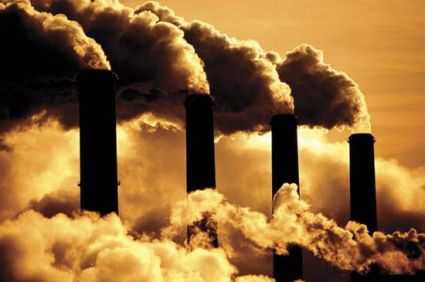
    pollution from industry

    China, India and other developing nations boycotted Climate talks today, as a protest and to demand that rich countries discuss a far more extensive cut in their emissions. This is believed to include 135 nations, which will refuse to participate in any formal working groups until the issue was resolved.

    This has to bee seen as a setback for the talks, and illustrates the long-term dispute between rich and poor nations over emissions cuts and financing cuts to deal with climate change. This has however not been interpreted as the talks are falling apart al together but rather as a ploy intended to move the agenda to the responsibilities of the industrial countries before the arrival of over 100 world leaders are scheduled to arrive in Copenhagen.

  • Over 200 protesters arrested in Copenhagen

    Over 200 protesters arrested in Copenhagen

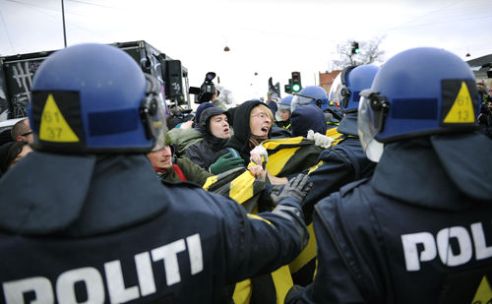
    Police securing area from protesters

    More than 200 Protesters were arrested in Copenhagen on Sunday. Approximately 1000 protesters from across Europe were present, the crowd started targeting the Danish shipping giant Moller-Maersk which is when the Police decided to intervene.

    When some of the activists refused to cooperate an intire group of 200 people were arrested including a times reporter. The protesters were moved to a warehouse in Valby which has been set up with contemporary holding cells. A police spokeswoman confirmed around 200 arrest and pointed out that it was an illegal demonstrations and that some of the activists brought gas masks and things to throw.

    Yesterday 968 protesters where arrested during a mass march on the summit venue yesterday afternoon, out of these 968 all but 13 have been released.

  • Civil Society in COP15

    Civil Society in COP15

    Arctic Portal news

    So far the major issues around the Copenhagen COP15 have concentrated on the participation of world leaders to one of the biggest gathering in the field of environmental law and politics.

    The aim is to reach an agreement on post-Kyoto CO2 emission reduction. Many leading scientists maintain that the world’s CO2 rate has reached dangerous levels and that if nothing is done to reduce the emissions the world will face unprecedented consequences. Legally binding agreement for the world’s leading polluters is inevitably necessary, but it is debatable whether the political will of states is enough to create any change.

    In addition to the politicians, Copenhagen has attracted a vast amount of representatives from different fields of civil society. In recent years, many global movements have been created around the action against climate change and many of them have now gathered to Copenhagen.  On wednesday a small group of activists from 350 movement demonstrated outside the conference hall demanding fair and legally binding climate deal. Further, members from other global movements, such as Tck and many others are gathering to People’s Climate Summit, an NGO Summit, to draft what they call “A People’s Declaration”.

    Despite the huge pressure to seal the deal in Copenhagen, some doubts have been expressed on whether the solutions that are on the table are the best ones and whether they actually solve any of the problems. Just last week one of the leading climate change scientists James Hansen from Nasa’s Goddard Insitute, expressed his doubts on the existing emission trade system comparing it to selling indulgences. He claimed that under the Kyoto mechanisms rich countries buy cheap emission credits from developing countries contributing that way to the existing economic unbalance in the world and some of the worst poverty scenarios. Further, it has been maintained that the Kyoto mechanisms do not actually address the real problem, the CO2 emission, but are one more scam for large corporations to gain money.

    Here below you can watch Annie Leonard’s provocative and eye-opening short film on cap and trade, the main mechanism in use  to combat CO2 pollution.

    [http://www.youtube.com/watch?v=pA6FSy6EKrM]

  • “Danish draft” leaked to media

    “Danish draft” leaked to media

    larslokke

    Guardian / cop15.dk – There seems to be a great change coming in the climate change negotiations, after the “Danish” draft of an agreement was leaked to media yesterday.

    The developing countires accuse the draft of being a legalisation of the developing / industrialised division in the world and contributing to the already existing problems in the developing countries. The UNFCCC head Yvo de Boer on the other hand said that only an informal paper is in question and that formal proposals will be only provided by the Chairs of the Conference.

    It will be though interesting to see if the text of the “draft” gives any hint of what can be expexted on behalf of the industrialised countires and whether the so much talked about political will is actually only a wishful thinking.  What is sure is that the negotiations are of crucial importance for the global community and a just and equal agreement should be reached for the benefit of us all.