Category: News & Press Releases

Arctic Portal News Portlet

  • LNG tankers put to the test in ice

    LNG tankers put to the test in ice

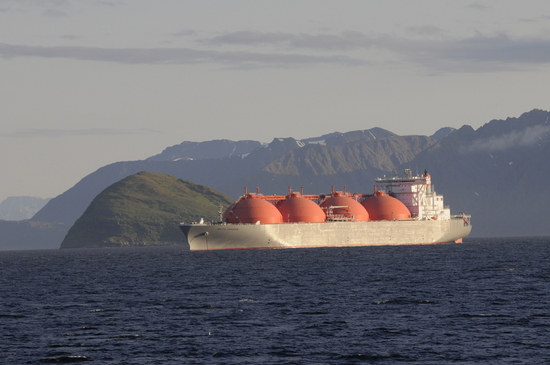
    An LNG tanker

    Many large vessels have to be strengthened to be able to sail in ice. Large companies are testing their fleets in order to be able to sail through the northern sea route.

    Gazprom is one of them which is working with Sovcomflot to carry out test for LNG tankers in ice.

    Gazprom director Aleksei Miller and Sovcomflot´s General Director Sergei Frank met last week and concluded in a press release:

    “The relevance of LNG shipping along the Northern Sea Route to the Asian-Pacific region in growing quickly. With regard to gas exports to the region, the development of LNG production is an absolute priority in comparison with pipeline deliveries. Consequently, the deliveries of Russian LNG through the Northern Sea Route allows us to significantly reduce transportation costs, thus making the LNG highly competitive.”

    Gazprom is considering to sail from the Shtokman area to Japan with gas. Statoil is thinking the same.

    Source: BarentsObserver

  • Warm in Svalbard

    Warm in Svalbard

    Longyearbyen, Svalbard

    Svalbard is heating up, fast. Last week the heat was 1 °C, highly unusual for this time of year.

    Some call it a “strange winter” but the Average temperature over the last 30 days was minus 5,8 °C, in tial 9,3 °C above the normal.

    This is according to the weather data statistics for Longyearbyen made by the Norwegian Metrological Institute.

    Sea ice around Svalbard has also been unusually low.

    This corresponds to news saying that 2011 was a record in Arctic temperature.

    Sources

    BarentsObserver

    Norwegian Metrological Institute

  • Gore invites president to Antarctica

    Gore invites president to Antarctica

    Ólafur Ragnar Grímsson, the president of Iceland

    Ólafur Ragnar Grímsson, the President of Iceland, is in Antarctica with Al Gore and a host of scientists. The exploration also includes director James Cameron, and billionaires Richard Branson and Ted Turner.

    The goal of the exploration is to explore the melting ice cap in Antarctica and discuss how the nations of the world can unite in realistic action against Climate change.

    The Climate Reality Project, Gore´s company, is planning the trip with National Geographic.

    Amongst other in the exploration is James Hansen from NASA, Yao Tandong from China, Christiana Figueres form UNFCCC and scientist from Harvard and leading universities in Europe.

    The exploration is actually sailing in the National Geographic vessel.

    The exploration started yesterday and will end on February 6th.

    Sources

    Vísir.is

  • Russia boost coal production

    Russia boost coal production

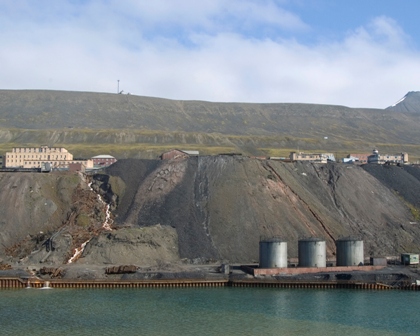
    Coal site in Barentsburg, Svalbard

    Russia will increase its coal production significantly over the next years. Russia produces around 330 million tons of coal each year but it will be increased to 440 million tons.

    A new development program was introduced by Prime minister Vladimir Putin yesterday. He said that 3,7 trillion rubles will be spent on the program, over the next 18 years.

    Most of the money will be spent on investment in private companies. Putin also said that infrastructure of transportation of coal needed to be looked at closely.

    Russia is the 6th largest coal producer in the world, producing around 5% of the worlds production. More than one third of it is exported.

    Coal production sites in Kusbass will be strenthened, as well as in Vorkuta.

    Source: BarentsObserver

  • Record Arctic temperature in 2011

    Record Arctic temperature in 2011

    The Arctic temperature has been rising for many years

    The year 2011 was another heat record in the Arctic. Climate change is therefore in no way retreating.

    The image on the right clearly shows the annual temperature rising. Click to enlarge the image.

    NASA has released data on the temperatures yeasterday. According to NASA’s Goddard Institute for Space Studies (GISS), the annual mean surface temperature (land and air) for the region north of 64°N (the Arctic Circle is at 66° 33’N) in 2011 was 2.28 degrees Celcius above that which characterized the 1951-1980 period.

    Temperatures in the region have been rising rapidly since the late 1970s and have not dropped below the long term mean since 1992, for nearly 20 years.

    This year’s annual mean temperature broke the record that was just set in 2010, when the temperature was 2.11oC above 1951-1980 levels.

    The global average surface temperature in 2011 was the ninth warmest since 1880, according to NASA scientists. The finding continues a trend in which nine of the 10 warmest years in the modern meteorological record have occurred since the year 2000.

    Sources

    NASA´s Goddard Institute

  • Statoil strengthens around Greenland

    Statoil strengthens around Greenland

    Oil barrels

    Statoil in Norway, owned at 70% by the state, has bought searching permissions in Greenland. This strengthens the status of Statoil around Greenland.

    The seller is oil explorer Cairn Energy who sold 30% of their oil research permissions.

    The reason is that Cairn wants to go into cooperation with a big company with experience of searching for oil in the Arctic.

    Statoil is the frontrunner in that race.

    Cairn spent more than anticipated in research in 2011, over 400 million pounds. Simon Thomson, says that Statoil´s experience will increase the odds of finding oil around Greenland.

    “In Greenland, Statoil’s extensive Arctic operating and development experience makes them the partner of choice for the Pitu block where we see significant potential,” he said to the BBC.

    Sources

    BBC

  • Water bulge might cause changing weather

    Water bulge might cause changing weather

    The rise of the bulge

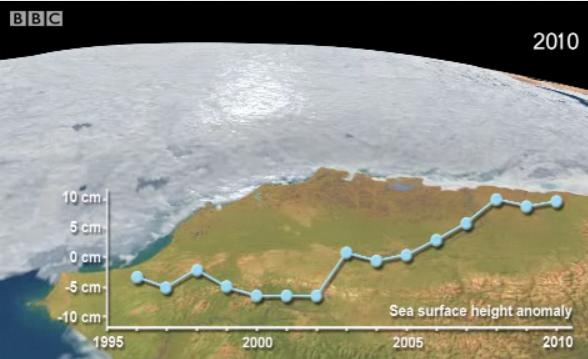
    Scientists have found an enormous dome in the western Arctic Ocean, full of fresh water. The bulge is thought to be around 8000 cubic meters in size and has risen about 15cm in 10 years.

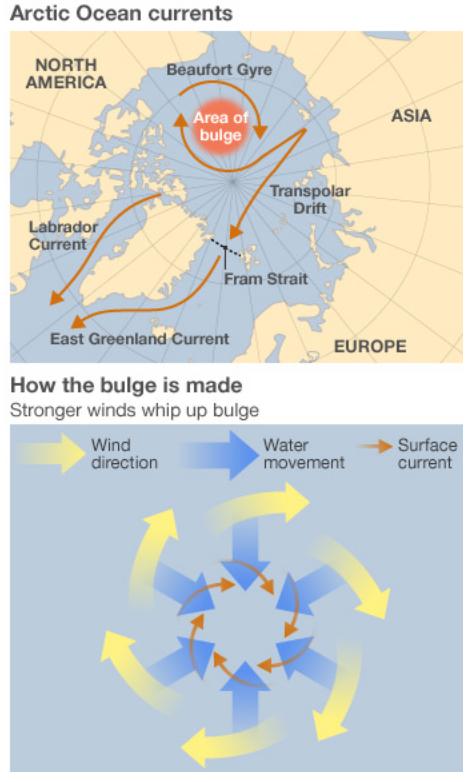
    The image on the right shows the rise of the bulge, rising fast in 10 years. The second picture then shows how a bulge is made.

    “In the western Arctic, the Beaufort Gyre is driven by a permanent anti-cyclonic wind circulation. It drives the water, forcing it to pile up in the centre of gyre, and this domes the sea surface,” explained lead author Dr Katharine Giles from the Centre for Polar Observation and Modelling (CPOM) at University College London to the BBC.

    The making of the bulgeAn ESA satellite was used to discover the bulge. Most of the fresh water is coming from the Russian side of the Arctic.

    Winds and currents have transported this fresh water around the ocean until it has been pulled into the gyre. The volume currently held in the circulation probably represents about 10% of all the fresh water in the Arctic, according to BBC.

    If the fresh water were to enter the North Atlantic in large volumes, the concern would be that it might disturb the currents that have such a great influence on European weather patterns.

    These currents draw warm waters up from the tropics, maintaining milder temperatures in winter than would ordinarily be expected at northern European latitudes.

    “The ice is now much freer to move around,” said Dr Giles to the BBC.

    “So, as the wind acts on the ice, it’s able to pull the water around with it. Depending on how ridged the surface of ice is or how smooth the bottom of the ice is – this will all affect the drag on the water.”

    “If you have more leads, this also might provide more vertical ice surfaces for the wind to blow against.”

    Sources

    BBC

  • New production record for Russia

    New production record for Russia

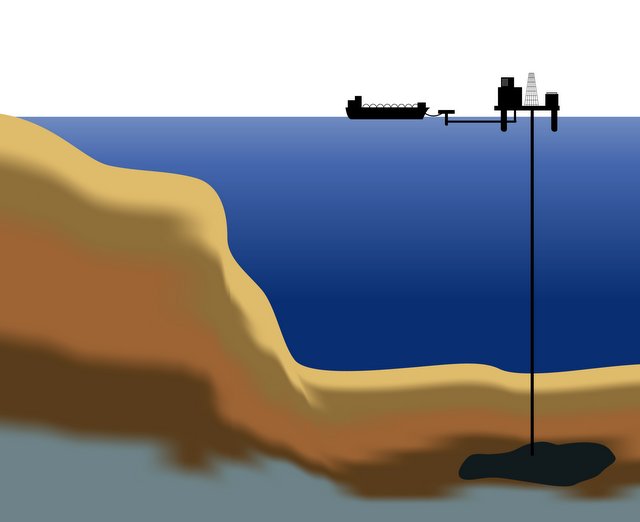
    Offshore oil production schema

    Oil production in Russia last year set a new record for post-soviet times. A total of 511 million tons were produced in 2011.

    The production only went up one percent from 2010. The trend is unlikely to continue for the next three years.

    Sergei Kudriashov, Russias vice minister of energy, confirmed this to Russian public television station Russia 24.

    “We understand that in the three coming years, we are going to have a lull in the operation of new deposits. That’s why the principle task now is to use the resources we have and maximise the efficiency of work in old deposits,” he said.

    HIs estimate is that Russia will produce around 510 million tons the next three years, but no more records will be set for a few years.

    “In 2008, when oil prices were at a high, we saw a drop in production. In the last three years, we’ve succeeded in reversing the trend,” he said.

    Sources

    Sunday Times

    Russia 24

  • No oil rigs available – Many being built

    No oil rigs available – Many being built

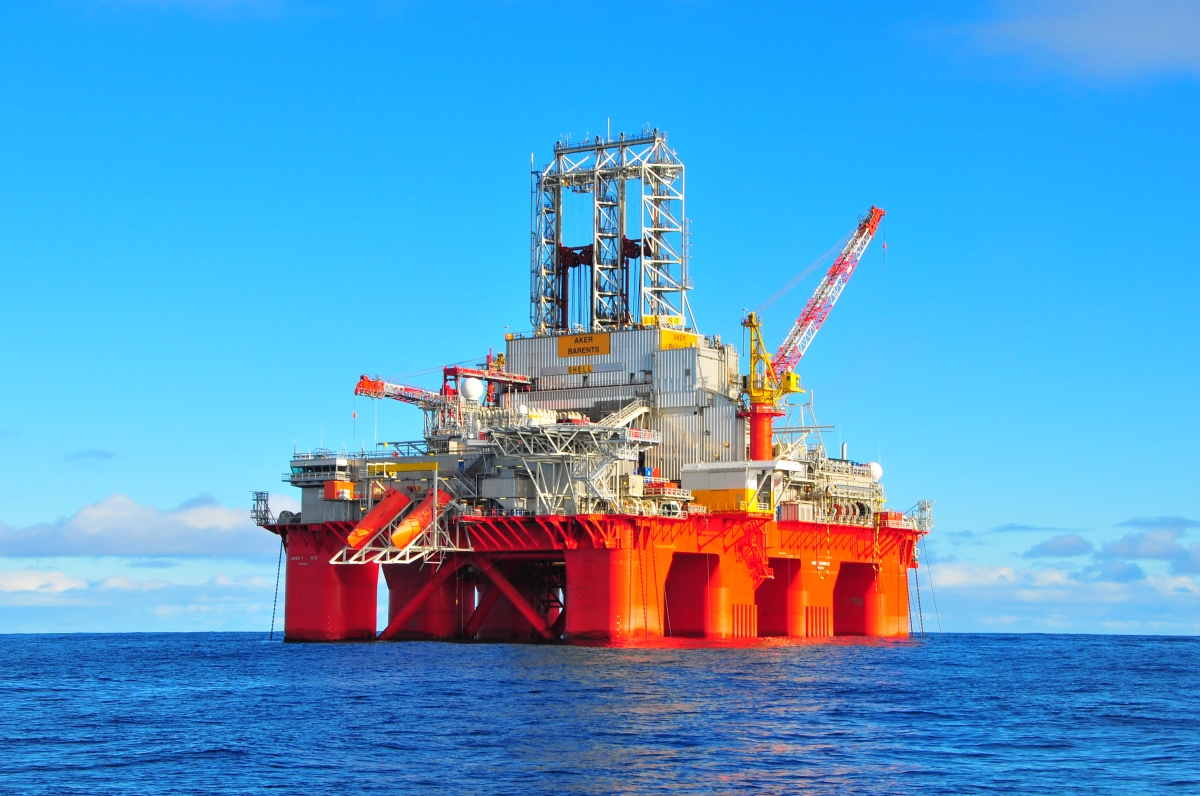
    The Aker Barents oil rig

    Over 70 oil rigs are being built around the world to meet growing demand. Many of them are custom made for the Arctic, specially made to cope with harsh conditions and deep waters.

    Lack of oil rigs could be hindering search for oil. But many oil rigs are made for the Arctic, like the Aker Barents.

    He discovered oil 200 miles out of Norway, in freezing temperatures, blistering winds and at great depth. He can drill 10.000 meters in 3000 meters deep waters.

    Aker Barents can also stand waves up to 12 meters and wind velocity up to 45 knots for some time.

    But most oil rigs in the world are booked for many years. New areas could get in trouble, although the new rigs could come to the rescue.

    Norwegian company Oddfjell Drilling is one of many making custom-made-for-the-Arctic rigs, made to drill in hard conditions and deep sea.

    Sources

    Offshore.no

  • Arctic Frontiers online webcast

    Arctic Frontiers online webcast

    Arctic Frontiers

    The 2012 Arctic Frontiers conference starts in Tromsø on the 22. of January and runs until the 27th. The conference will be broadcasted live online.

    The theme of the conference is Energies of the High North, including nonrenewable and renewable resources of energy. The conference will have both a science section and a policy section which will commence with a “State of the Arctic” segment.

    Numerous interesting lectures will feature in the conference, which is even still open for registration.

    Here is the schedule of the policy section on Monday and Tuesday, due to be shown live. Click here to access the section to watch the conference.

    Monday 25 January, 09:00 to 17:00

    Session I: State of the Arctic 2012 in the context of the global energy outlook

    • 09:30 Thomas B. Johansson, Co-Chair, Global Energy Assessment: Setting the scene – global energy outlook and the Arctic.
    • 10:00 Matt Entenza, Senior Advisor on Energy and the Economy to Minnesota Governor Mark Dayton, USA.
    • 10:30 Esa Härmälä, Director General of the Energy Department, Finland. (Midnight) Sun Belt – Areal of Growth
    • 11:00 Coffee break
    • 11:30 Clément Gignac, Minister of Natural Resources and Wildlife, Quebec, Canada: Development in Québec: the Plan for empowering the North
    • 12:00 Lisa Murkowski, Senator for Alaska, USA: Video speech about priorities for energy politics in the USA and in Alaska.
    • 12:05 Ola Borten Moe, Norwegian Minister of Petroleum and Energy: Norwegian Energy Policy.
    • 12:35 Questions and debate with Minister Borten Moe
    • 13:00 Lunch

    Session II: Energy resources and industrial development in the Arctic

    • 14:00 Marcia McNutt, Executing director of U.S. Geological Survey: Challenges ahead for oil and gas resources in the Arctic.
    • 14:30 Sergey Kungurtsev, representative of the Administration of the Nenets Autonomous District, Russian Federation: Priorities for the development of industry in Nenets Autonomous District.
    • 15:00 Joep Coppes, Vice president of the International Association of Oil and Gas Producers: For a sustainable development in the High North, how can the oil and gas industry contribute?
    • 15:30 Ann Christin Gjerdseth, Chair of OG21, Norway: Sustainable development of Petroleum in the Arctic through superior technology and knowledge.
    • 16:00 Tim Dodson, Executive vice president Statoil, Norway. Unlocking the resources of the north

    Tuesday 24 January, 09:00 to 16:30

    Session II (continued): Energy resources and industrial development in the Arctic

    • 09:00 Salve Dahle, Chairman of Steering committee: Opening day 2
    • 09:00 Aleksey Titovskiy, Head of Foreign Economy Division, on behalf of the Administration of the Yamal-Nenets Autonomous District, Russian Federation: Priorities for the development of industry in the Yamal-Nenets Autonomous District.
    • 09:30 Valborg Lundegaard, Executive Vice President Engineering, Aker Solutions, Norway: Technological achievements in the Arctic for more than 100 years – What are the Arctic challenges facing us now.
    • 10:00 Elisabeth Harstad, Managing Director, DNV Research and Innovation, Norway: Barents 2020 – international industry cooperation for safety standards in the Barents Sea. Are there Pan-Arctic lessons?!
    • 10:30 Coffee break

    Session III: Developing secure and sustainable energy projects in the High North

    • 10:50 Nina Jensen, Conservation Director Policy, WWF-Norway: Climate and energy challenges of the High North.
    • 11:20 Ånund Killingtveit, Professor Department of Hydraulic and Environmental Engineering, NTNU, Norway: Renewable energy – How can it contribute to securing safe and sustainable energy in the High North?
    • 11:50 Martin Fortier, Executive Director ArcticNet Inc., Canada: The Art of Successful Industry-Academia Collaboration: Lessons from the Canadian Arctic.
    • 12:20 Lunch
    • 13:10 Arctic Frontiers Emerging Leaders: Energies of the High North. Introduction by Barry B. White, US Ambassador to Norway
    • 13:40 Anna Naikanchina, Vice president of RAIPON, Russian Federation: Indigenous peoples and energy projects in the Arctic: integration, risks and perspectives
    • 14:10 Emma Wilson, International Institute for Environment and Development, UK: Risk and reward: the role of civil society, business and the state in shaping the impacts of large-scale energy projects in the North.
    • 14:40 Coffee break
    • 15:00 Arctic Lavvo Dialogue – «Energy and Industrial Development and Peoples in the Arctic. » Moderated debate.
    • 16:15 Closing by Salve Dahle, Chairman of Steering committee of Arctic Frontiers

    Sources

    Arctic Frontiers